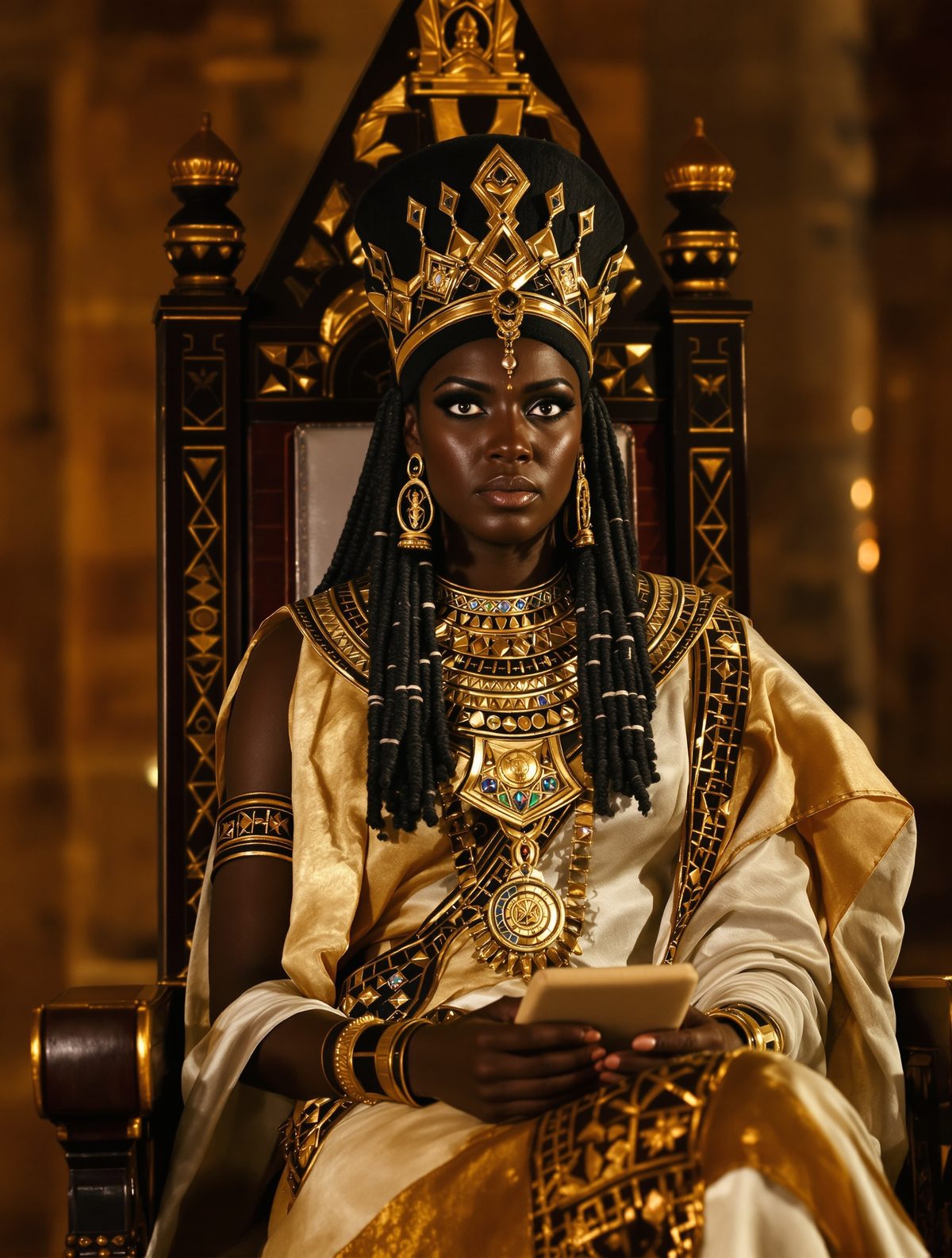
The golden goblet trembled in Queen Shanakdakheto's weathered hands as she read the papyrus scroll for the third time. The hieroglyphic symbols, illuminated by flickering oil lamps in her private chamber, spelled out a conspiracy so devastating it would have broken a lesser ruler. Her own son—the prince she had groomed for greatness, the heir to the mighty Kingdom of Kush—was plotting to murder her.
It was 690 BC, and in the shadow of the great pyramids of Nuri, the most powerful woman in Africa was about to make a decision that would echo through history. What happened next would prove that in the ancient world, the crown came before blood—even a mother's love.
The Iron Queen of a Golden Kingdom
Queen Shanakdakheto ruled over one of the ancient world's most formidable empires from her palace at Meroë, in what is now Sudan. While most people today barely remember the Kingdom of Kush, it was once so powerful that it conquered and ruled Egypt for nearly a century, with Kushite pharaohs sitting on the throne of the two lands.
Shanakdakheto wasn't just any queen—she was a Kandake, a title that would later be corrupted into "Candace" and appear in the Bible. The Kandakes were warrior queens who ruled absolutely, commanding armies, commissioning massive temple complexes, and conducting diplomacy with Rome itself. Unlike their Egyptian counterparts, who often ruled as regents or co-rulers, the Kandakes wielded power in their own right.
Archaeological evidence reveals that Shanakdakheto commissioned numerous building projects, including temples adorned with reliefs showing her as a formidable figure with broad shoulders and regal bearing. Her name appears on monuments from the First Cataract of the Nile all the way south to the Blue and White Nile convergence—a territory larger than modern-day Egypt.
But perhaps most remarkably, she ruled during Kush's golden age of iron production. While much of the ancient world still struggled with bronze-working, Kush had mastered iron smelting on an industrial scale. The capital at Meroë was dotted with so many slag heaps from iron furnaces that early archaeologists called it "the Birmingham of ancient Africa." This technological advantage gave Shanakdakheto's armies weapons that could slice through bronze armor like papyrus.
A Prince in the Shadows
Prince Arakakamani had grown up in the lap of luxury, surrounded by the wealth of tribute from conquered lands and the reverence due to a future king. The palace at Meroë was a marvel of ancient engineering—multi-story buildings with sophisticated drainage systems, elaborate gardens, and walls decorated with scenes of royal triumph.
Yet something had soured in the prince's heart. Palace records, painstakingly translated from Meroitic script, suggest that Arakakamani chafed under his mother's long reign. At 25, he had expected to assume greater responsibilities, perhaps even co-rule as was sometimes the custom. Instead, Shanakdakheto showed no signs of relinquishing power.
The prince began to gather supporters among the nobility—ambitious men who whispered that a male ruler might be more aggressive in expanding Kushite territory, perhaps even reconquering Egypt from the Assyrians who had driven out the Kushite pharaohs decades earlier. They met in secret chambers beneath the palace, their conversations lit by smuggled oil lamps, plotting a palace coup that would make Arakakamani king and his mother a memory.
What the conspirators didn't know was that Shanakdakheto had spent decades building one of the ancient world's most sophisticated spy networks. Her agents weren't just palace servants—they were merchants who traveled trade routes, priestesses who heard confessions in temples, and even concubines who shared the beds of foreign diplomats. In the Kingdom of Kush, the queen's eyes and ears were everywhere.
The Web of Betrayal Unravels
The plot began to unravel on a sweltering night in 690 BC during the festival of Apedemak, the lion-headed war god. While the capital celebrated with wine, music, and sacrificial offerings, a serving girl named Atasamale crept through the palace corridors with information that would change the course of history.
Atasamale had been carefully cultivated as an asset by the queen's spymaster—a shadowy figure known only as "the Silent One" in palace records. For months, she had served wine and delicacies to the prince's conspirators, her presence so routine they spoke freely in front of her. She had memorized names, dates, and most crucially, the planned timing of their coup.
The conspiracy was audacious in its scope. During the upcoming ceremony of royal renewal—a sacred ritual where the queen would enter the temple of Amun alone to commune with the gods—the conspirators planned to seal the temple doors and set it ablaze. They would emerge as heroes who had "tried" to save her but were "tragically" too late, with Prince Arakakamani reluctantly accepting the crown to prevent chaos.
When Shanakdakheto received this intelligence, palace observers noted that she showed no emotion whatsoever. She dismissed the messenger with a casual wave, finished reviewing administrative documents about grain supplies, and retired to her private chambers as if nothing had happened. But inside, the woman who had never lost a battle was fighting the greatest war of her life—between her love as a mother and her duty as a queen.
The Ultimate Test of Royal Authority
For three days, Shanakdakheto wrestled with her decision. Ancient Kushite law was clear: treason against the crown was punishable by death, regardless of the perpetrator's identity. But this wasn't just any traitor—this was her son, the child she had nursed, taught to read hieroglyphs, and prepared to inherit one of Africa's mightiest empires.
Palace records suggest she consulted with the high priestess of Isis, seeking divine guidance. The goddess of motherhood and magic offered no easy answers. Shanakdakheto also met with her council of war chiefs, though she revealed nothing of her son's involvement, speaking only in hypotheticals about treason and punishment.
On the fourth day, she made her choice. Using a reed pen and royal ink mixed with gold dust, Queen Shanakdakheto personally wrote the death warrant for Prince Arakakamani and his co-conspirators. Her hieroglyphic characters were steady and clear—there was no tremor of doubt, no smudge of hesitation. The document, sealed with her personal scarab ring, was delivered to her most trusted executioner before dawn.
The prince was arrested in his chambers at sunrise, still wearing the golden armlets and ivory amulets of his royal status. Ancient sources suggest he was given the opportunity to take his own life—a final mercy from a mother who had loved him—but he refused, perhaps hoping his royal blood would save him.
It didn't. Arakakamani was executed that same morning along with twelve co-conspirators, their bodies burned and their ashes scattered to prevent them from achieving immortality in the afterlife—the cruelest punishment imaginable in ancient African belief systems.
The Queen Who Never Looked Back
In the immediate aftermath of her son's execution, many expected Queen Shanakdakheto to withdraw from public life, perhaps abdicating in favor of another heir. Instead, she did the opposite. She launched the most ambitious building campaign of her reign, commissioning new temples and palaces that seemed to shout her continued authority to the world.
Most remarkably, she ordered the construction of a new royal pyramid at Nuri—not for herself, but as a monument to her other children who had remained loyal. The pyramid complex included elaborate burial chambers and offering chapels, ensuring that her faithful heirs would be remembered for eternity while her treacherous son was condemned to be forgotten.
Shanakdakheto ruled for another fifteen years after her son's execution, maintaining Kush's independence even as the Mediterranean world convulsed with wars and conquests. When Roman legions finally dared to probe Kushite borders, they found an empire still unified under a queen who had proven that nothing—not even maternal love—could shake her resolve.
The story of Queen Shanakdakheto and Prince Arakakamani offers a chilling reminder that power, once grasped, rarely loosens its grip willingly. In our modern age of political dynasties and family businesses, we might ask ourselves: when power and love collide, which force proves stronger? The iron queen of ancient Kush answered that question with a mother's broken heart and a ruler's steady hand—and her choice echoes through history as both an inspiration and a warning about the true cost of absolute power.