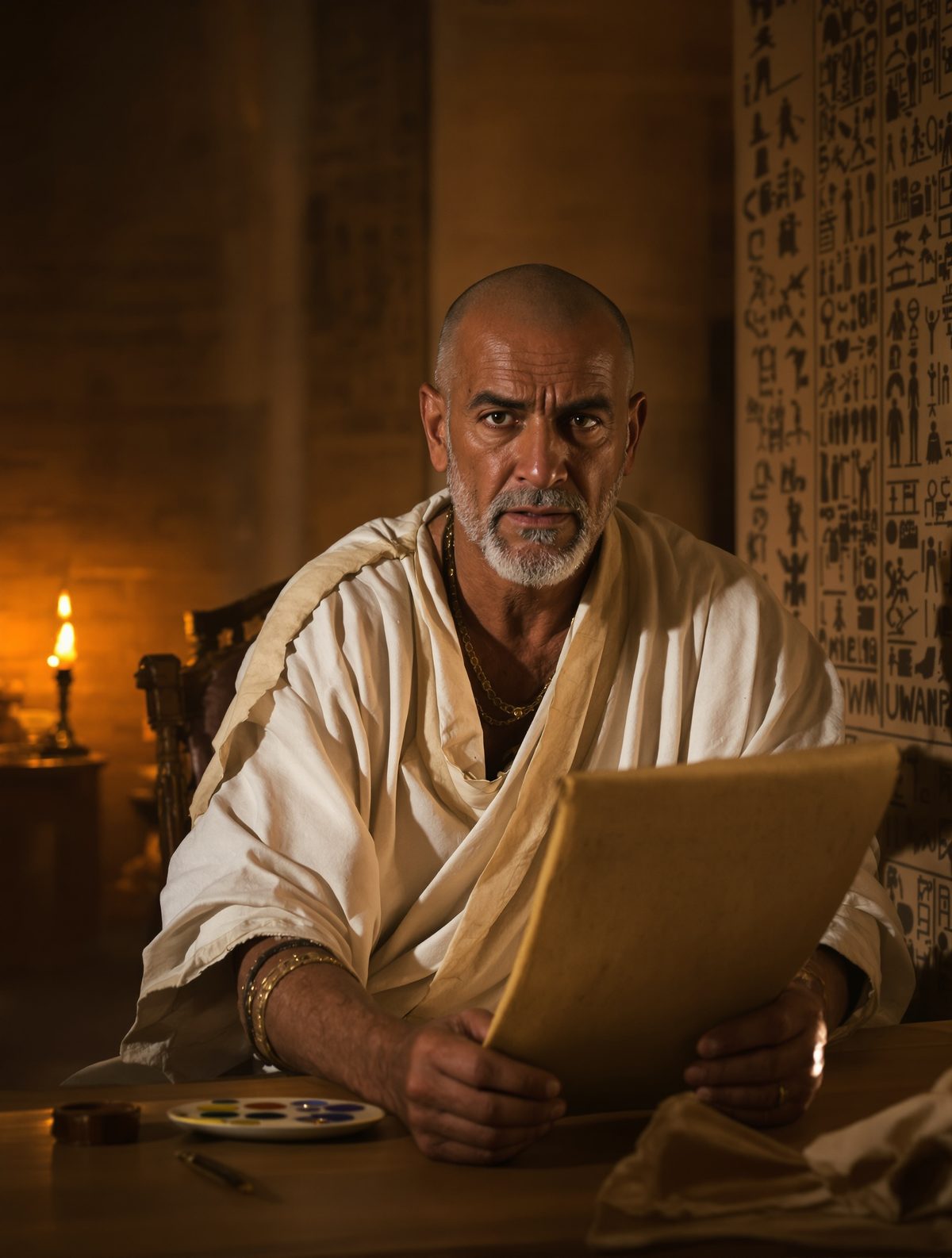
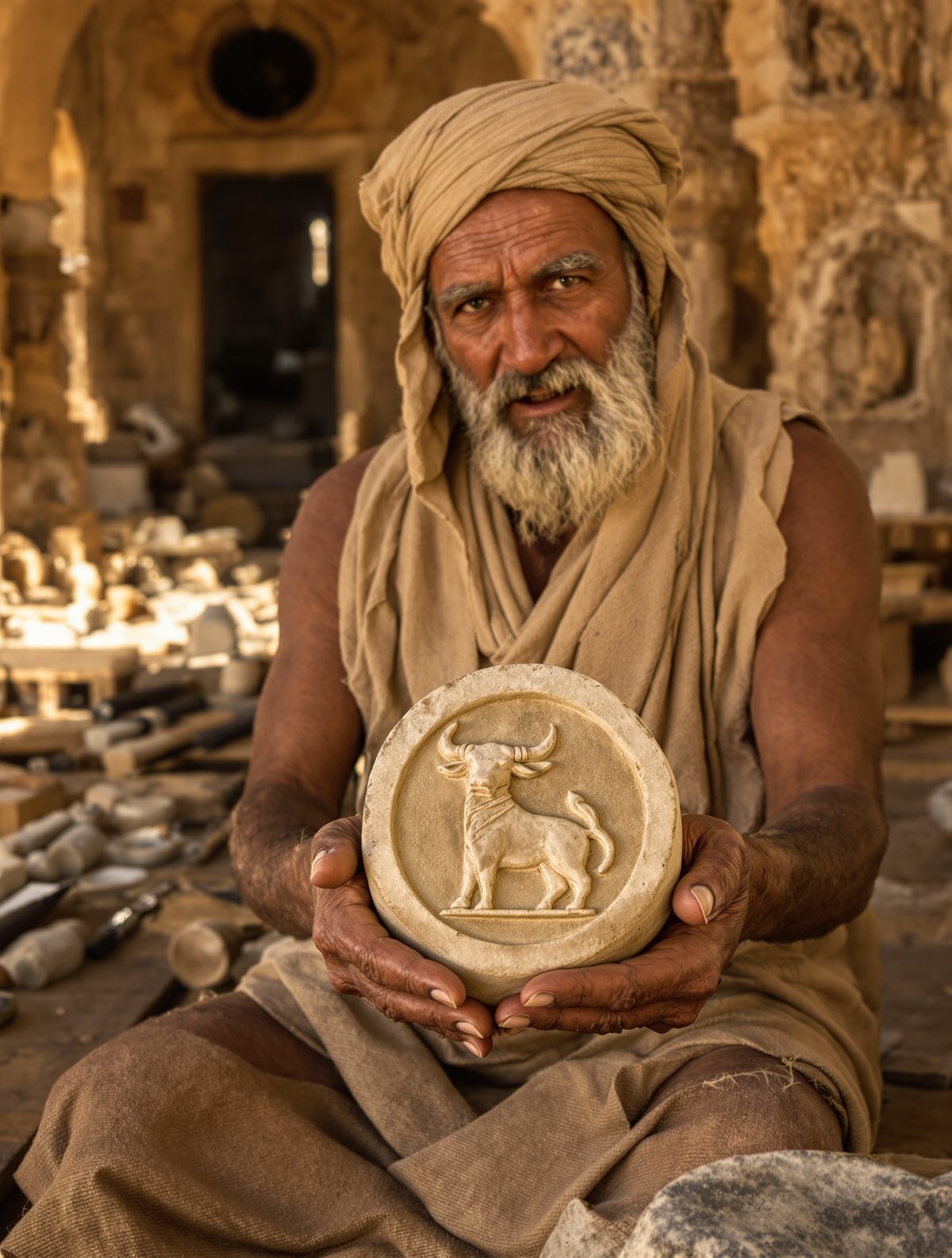
The steady tap-tap-tap of chisel against steatite echoed through the narrow workshop as Indumati carefully carved the final details into what would become his masterpiece—and his death sentence. In the flickering light of oil lamps, the master seal maker of Harappa bent over a small square of soft stone, his weathered fingers guiding the bronze tool with the precision that had made him the most sought-after craftsman in the great city. But in his moment of artistic triumph, he made one catastrophic error that would end his life before the sun set on that fateful day in 2200 BC.
The Forbidden Symbol Hidden in Plain Sight
What Indumati didn't realize as he added the intricate flourishes to his bull seal was that his hand had unconsciously traced the sacred pranava—a mystical symbol reserved exclusively for the priest-kings who ruled the Indus Valley civilization. To the untrained eye, it appeared to be merely decorative scrollwork surrounding the powerful bull figure. But to the religious authorities who controlled every aspect of Harappan society, it was an act of unforgivable blasphemy.
The Indus Valley civilization was a theocracy of the strictest order. Archaeological evidence suggests that these ancient cities—stretching across what is now Pakistan and northwest India—were governed by priest-kings who claimed divine authority. Their power was absolute, and their symbols were sacred. The pranava, resembling what we might recognize today as an early precursor to the Om symbol, was believed to contain the very essence of divine power. Only those chosen by the gods could legally reproduce it.
Indumati's workshop sat in the artisan quarter of Harappa, one of the largest cities in the ancient world with over 40,000 inhabitants. The smell of fired brick and bronze filled the air, mixing with incense from nearby temples. As a master craftsman, he occupied a respected position in society—just below the merchants and officials, but well above common laborers. His seals were works of art, each one telling a story through intricate animal figures, mysterious script, and symbolic patterns that modern archaeologists still struggle to decode.
The Art of Ancient Power
These weren't mere decorative objects. Indus Valley seals were the credit cards, business licenses, and identification papers of their time all rolled into one. Made primarily from steatite—a soft stone that could be carved with bronze tools—each seal was unique to its owner. Merchants used them to mark their goods, stamping wet clay with their personal insignia before shipments left for distant lands. Officials used them to authorize documents. Wealthy families passed them down as heirlooms.
The process of creating a seal required extraordinary skill. First, the craftsman had to cut and shape the stone into a perfect square, typically measuring about one inch on each side. Then came the most challenging part: carving the design in reverse, so that when pressed into clay, it would appear correctly. This reverse-carving technique required not just artistic ability, but also exceptional spatial reasoning—a skill that took decades to master.
Here's what most people don't know: The Indus Valley civilization produced over 4,000 different seals, each with unique imagery. But remarkably, certain symbols and animals appear again and again, suggesting a standardized religious and commercial system that spanned hundreds of miles. The bull—the animal Indumati chose for his fateful seal—was among the most popular, representing strength, fertility, and divine power.
The Moment Everything Changed
The commission had come from Vikramadas, a wealthy grain merchant who wanted a seal worthy of his growing fortune. He had specifically requested the most powerful animal symbol—the zebu bull—surrounded by the finest decorative elements Indumati could create. The seal maker had worked for three days straight, determined to create something that would cement his reputation for generations to come.
As he carved, Indumati fell into the meditative state that all master craftsmen know—that flow where conscious thought disappears and muscle memory takes over. His chisel danced across the stone, creating flowing curves and intricate patterns. In this trance-like state, drawing from half-remembered glimpses of priest-king ceremonies, his hand unconsciously reproduced the sacred pranava.
It was young Pritam, an apprentice seal maker from a neighboring workshop, who first spotted the forbidden symbol. The boy's sharp eyes caught the telltale curves worked into what appeared to be decorative foliage around the bull's feet. Rather than warning Indumati—professional rivalry ran deep among the artisan quarters—Pritam slipped away to inform the temple authorities, no doubt hoping to eliminate a competitor and curry favor with the priests.
Within the hour, three temple guards arrived at Indumati's workshop. They found him polishing the completed seal, admiring what he believed was his greatest work. The lead guard, a stern man with ritual scars covering his arms, examined the seal with growing alarm. There was no mistaking it: the sacred symbol was clearly visible to anyone who knew what to look for.
Swift and Merciless Justice
In Harappan society, religious law was absolute and punishment was swift. There were no trials, no appeals, no mercy for those who violated the sacred order. The unauthorized use of holy symbols was considered not just blasphemy, but a direct threat to the cosmic balance that kept their civilization prosperous. Drought, flood, or invasion could follow such sacrilege, the priests taught.
Indumati barely had time to understand what was happening before the bronze blade found its mark. Archaeological evidence from Harappa suggests that executions were carried out immediately, often in the very location where the crime was discovered. The body was then taken to the "Platform of the Dead"—a raised area outside the city where criminals and outcasts were left for vultures and wild dogs.
But here's the twist that archaeologists discovered in 1946: Indumati's seal wasn't destroyed. Instead, it was carefully preserved and placed in the temple treasury, along with other "cursed" objects that contained divine power but couldn't be used. When Sir Mortimer Wheeler's team excavated this cache, they found dozens of beautifully crafted seals that had apparently been confiscated for religious violations. Each one told a story of an artisan whose skill exceeded their knowledge of sacred law.
The Merchant's Dilemma
Vikramadas, the merchant who had commissioned the seal, faced his own crisis. Harappan law held that anyone who possessed or used a blasphemous seal shared in the maker's guilt. The merchant was forced to undergo an expensive purification ritual that cost him nearly a quarter of his wealth—payment to the priests for ritual sacrifices and ceremonial cleansing that lasted seven days and seven nights.
But Vikramadas was clever. Rather than simply accepting his loss, he commissioned a new seal from another craftsman—one that told the story of his ordeal. This new seal depicted a bull being purified by fire, surrounded by symbols of divine forgiveness. It became his trademark, and actually enhanced his reputation as a merchant blessed by the gods who had survived divine punishment. Sometimes, in the ancient world as today, there was no such thing as bad publicity.
The incident sent shockwaves through Harappa's artisan community. Seal makers began consulting with junior priests before starting any new commission, paying small fees to ensure their designs contained no forbidden elements. This led to a standardization of seal imagery that archaeologists can trace through the archaeological record—a sudden shift toward safer, more conventional designs around 2200 BC.
Echoes Across Millennia
Indumati's story reminds us that the tension between artistic expression and religious authority is as old as civilization itself. In our modern world of copyright laws, trademark disputes, and cultural appropriation debates, we're still grappling with questions of who owns symbols and who has the right to use them. The master seal maker of Harappa paid the ultimate price for unknowingly crossing a line that existed only in the minds of those in power.
Perhaps most remarkably, while the Indus Valley script remains undeciphered after more than a century of scholarly effort, the story preserved in that cursed seal speaks to us across 4,200 years. It tells us that creativity has always carried risk, that knowledge and skill alone aren't enough to navigate the complex rules that govern society, and that a single moment of unconscious artistry can change everything.
The next time you sign your name, use a company logo, or even share a meme online, remember Indumati. In our interconnected world, we're all carving symbols whose meanings we may not fully understand, hoping we haven't accidentally included something that will bring unwanted consequences. The tools have changed, but the fundamental human drama remains the same: the eternal dance between creation and control, between individual expression and collective power.