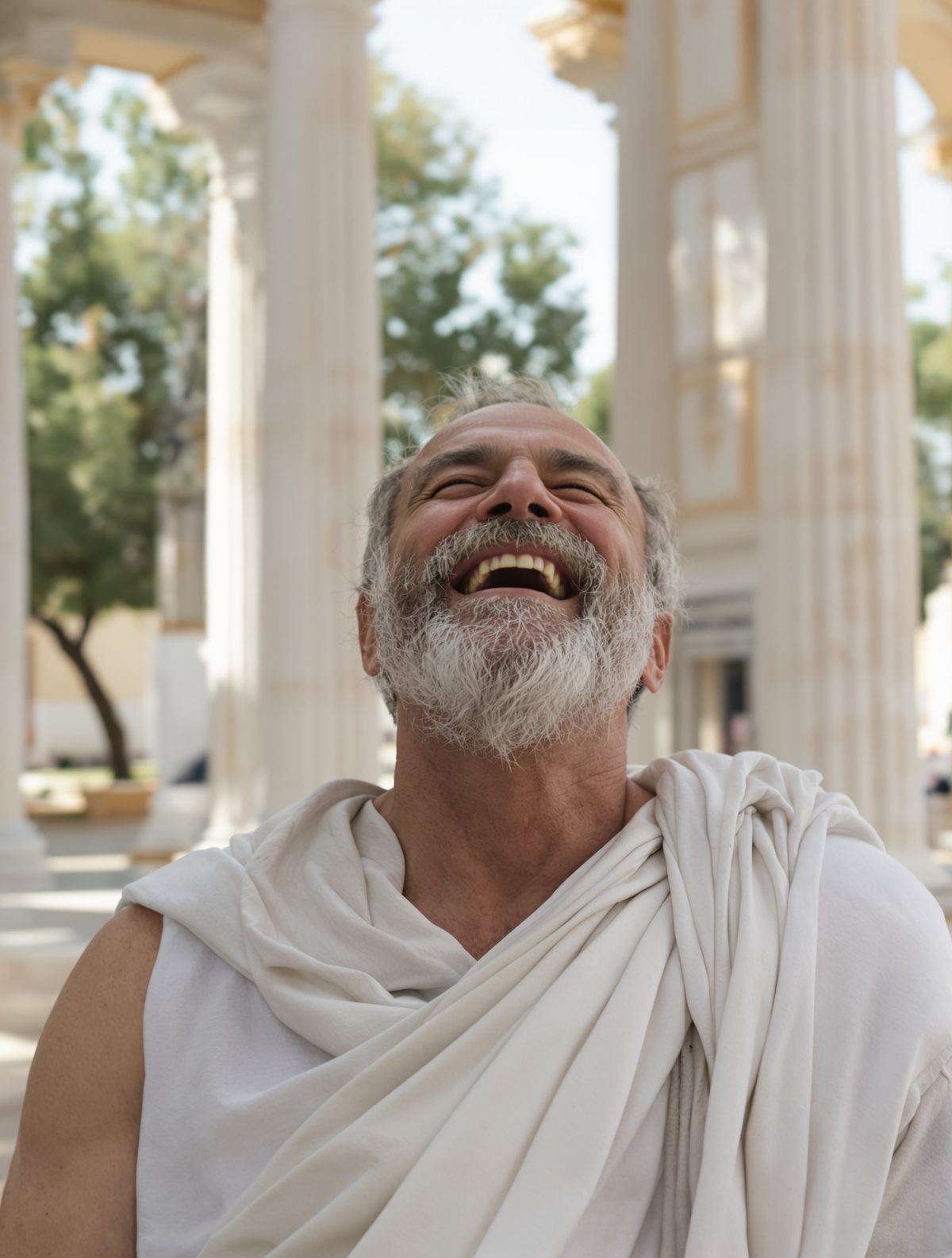
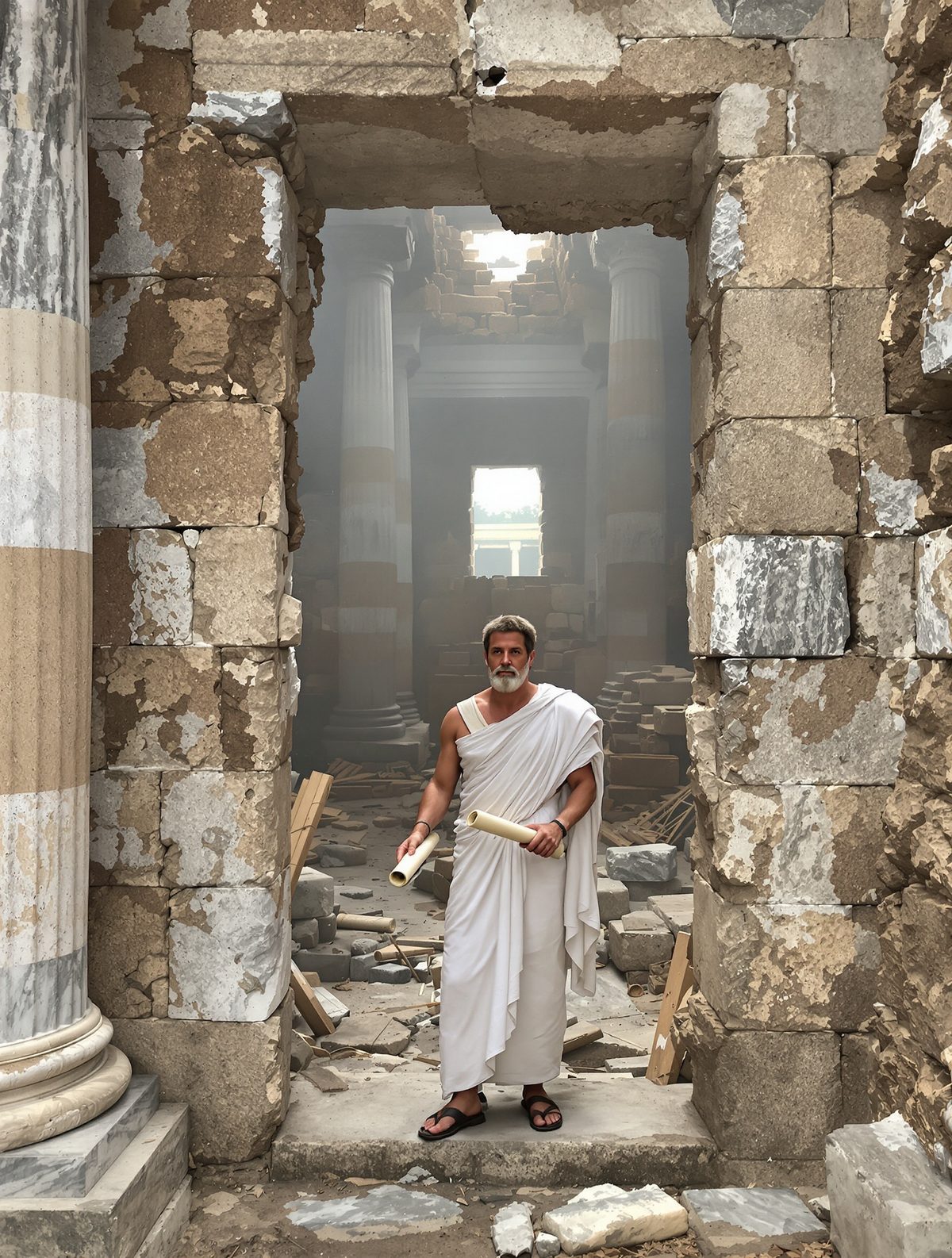
The hammer still bore the warmth of his grip. Fresh mortar clung to the trowel's edge, and rolls of parchment lay unfurled across the makeshift table, weighted down by chunks of marble. A half-eaten fig sat beside a cup of wine that hadn't yet had time to warm in the Syrian sun. But Apollodorus of Damascus—the man who had built wonders that made emperors weep with joy—had simply vanished.
It was the afternoon of March 15th, 67 AD, and the workers at the construction site in Antioch had grown restless. Their master architect hadn't emerged from the inner sanctum of his latest creation in over six hours. When they finally dared to enter the sacred space he'd been perfecting, they found everything exactly as he'd left it. Everything except the man himself.
The Architect of Empires
To understand the magnitude of this mystery, you must first understand who Apollodorus was. Born in Damascus around 60 AD, he wasn't just any architect—he was the architect of the Roman Empire's golden age. While most builders of his era remain nameless shadows in history, Apollodorus had achieved something almost impossible: he'd made emperors depend on him.
Emperor Trajan trusted him with projects that would define Rome's eternal legacy. The magnificent Trajan's Forum, with its soaring 125-foot column that still dominates the Roman skyline today, sprang from Apollodorus's brilliant mind. But perhaps his most audacious achievement was the bridge over the Danube—a stone and wood marvel stretching over 3,700 feet across one of Europe's mightiest rivers. Roman historian Cassius Dio called it "the most remarkable of all his works," and that's saying something for a man who reshaped the face of an empire.
What set Apollodorus apart wasn't just his technical genius, but his almost supernatural ability to solve impossible problems. When Trajan needed to move entire legions across hostile territory, Apollodorus didn't just build a bridge—he built a statement of Roman power so impressive that enemy tribes reportedly surrendered at the sight of it. When the emperor wanted a monument that would immortalize his victories, Apollodorus carved the story directly into a column that served as both art and architecture, its spiral reliefs telling the tale of conquest in stone.
The Antioch Commission
By 67 AD, Apollodorus had reached the pinnacle of his profession. He commanded teams of hundreds, earned fees that would make modern architects jealous, and had the ear of the most powerful man in the world. So when the wealthy merchants of Antioch—then the Roman Empire's third-largest city—commissioned him to build a temple unlike any other, it seemed like just another prestigious project for the master builder.
But this temple was different. The commission came with unusual specifications that puzzled even Apollodorus's experienced crew. The merchants wanted a temple dedicated to Fortuna, the goddess of luck and fate, but they insisted on architectural features that had never been attempted before. The central chamber was to be perfectly circular, with a domed ceiling that would focus sound in ways that defied conventional engineering. Stranger still, they requested that the floor be laid in a specific pattern of black and white marble that formed geometric shapes whose purpose nobody could explain.
Apollodorus threw himself into the project with characteristic intensity. His surviving notes, discovered centuries later, reveal a man obsessed with solving the mathematical puzzles the design presented. He filled scroll after scroll with calculations, sketches, and what appear to be experiments with acoustic principles that wouldn't be fully understood until the Renaissance. Workers reported that he spent days measuring angles with instruments he'd designed himself, muttering in Greek about "the perfect resonance" and "the voice of the gods."
The Day Everything Changed
March 15th, 67 AD started like any other day at the construction site. Apollodorus arrived at dawn, as was his habit, carrying his leather satchel of tools and a breakfast of bread, olives, and figs. Witnesses later told investigators that he seemed excited—more animated than they'd seen him in weeks. He'd apparently solved some crucial problem with the temple's acoustics during the night and was eager to test his theory.
The master architect spent the morning directing workers as they installed the final pieces of the circular chamber's marble floor. By midday, the pattern was complete—a mesmerizing spiral of black and white stones that seemed to draw the eye toward the center of the room. Apollodorus dismissed his workers for their afternoon meal and entered the chamber alone, carrying his measuring instruments and a lit oil lamp.
What happened next is where history dissolves into mystery. Workers stationed outside the temple reported hearing Apollodorus moving around inside, occasionally calling out measurements to himself. Some claimed they heard him speaking to someone, though everyone knew he was alone. One worker, a young stone-cutter named Marcus Flavius, later swore he heard what sounded like multiple voices coming from the sealed chamber, though he admitted that the temple's unusual acoustics might have been playing tricks with sound.
As afternoon stretched into evening, the silence from within became troubling. Apollodorus was meticulous about schedules and had never missed an evening briefing with his foremen. When sunset approached and still no word came from the chamber, the workers finally worked up the courage to investigate.
The Impossible Discovery
What they found defied explanation then, and it defies explanation now. The chamber was exactly as Apollodorus had left it—except for the conspicuous absence of the man himself. His tools lay precisely arranged on a marble block he'd been using as a workbench. His lamp still flickered, casting dancing shadows on the geometric floor pattern. Most unnervingly, his lunch sat half-finished, the fig bearing fresh bite marks.
But Apollodorus had vanished as completely as if he'd never existed.
The chamber had only one entrance—the doorway through which the workers had just entered. The walls were solid stone, and the dome above was incomplete, with an opening to the sky that was both too high and too narrow for a man to reach, let alone escape through. A thorough search revealed no hidden passages, no loose stones, no possible means of exit.
Even more puzzling were Apollodorus's architectural plans, still spread across his makeshift desk. The workers who examined them reported that the drawings showed details of the temple that hadn't been built yet—including sections that appeared to extend far underground in a complex network of chambers and corridors. Yet when they searched for evidence of these underground spaces, they found solid bedrock.
Marcus Flavius, the stone-cutter who claimed to have heard voices, noticed something else that chilled him: the geometric pattern in the floor appeared different somehow. He couldn't say exactly how, but he insisted that the spiraling design now seemed to draw the eye more powerfully toward the center, where a single black marble stone sat like a pupil in a vast stone eye.
Theories and Investigations
Word of the disappearance reached Roman authorities within days, triggering an investigation unlike any in the empire's history. A master architect couldn't simply vanish—especially not one with Apollodorus's connections to imperial projects and state secrets. Governor Lucius Caesennius Paetus personally oversaw the inquiry, bringing in engineers, soldiers, and even practitioners of the mystic arts to examine the scene.
The official investigation uncovered more questions than answers. Engineers confirmed that the chamber was sealed with no means of escape. They also verified that the architectural plans showed structures that didn't exist—or at least, couldn't be found. Most disturbing was their discovery that the chamber's acoustics behaved in ways that shouldn't have been possible. Sounds made at the center of the room seemed to echo from directions where there were no walls to reflect them.
Theories multiplied like weeds. Some suggested that Apollodorus had been murdered by business rivals, his body somehow removed through means the investigators couldn't detect. Others whispered about supernatural intervention—that the architect had somehow offended the gods and been spirited away as punishment. The most rational observers proposed that he'd planned his own disappearance, perhaps to escape debts or political entanglements, though this theory couldn't explain how he'd physically left the sealed chamber.
One theory that gained traction among the more educated Romans involved the temple's dedication to Fortuna. Some scholars argued that Apollodorus had accidentally created a space that served as a portal or gateway—a place where the boundaries between the mortal world and the realm of the gods had worn thin. They pointed to the geometric floor pattern, noting its similarity to mystical symbols found in ancient Eastern religions.
The Legacy of the Vanishing
The temple was never completed. Governor Paetus ordered the site sealed after investigators finished their work, and it remained undisturbed for decades. Local residents reported strange sounds coming from the sealed chamber—whispers, footsteps, and occasionally what sounded like someone calling for help in a voice that might have been Apollodorus's.
The mystery had profound effects on Roman architecture and engineering. Future projects became more conservative, with builders shying away from the kind of innovative designs that had made Apollodorus famous. The incident also contributed to growing superstitions about certain geometric patterns and acoustic effects, leading to regulations about temple construction that would persist for centuries.
More immediately, Apollodorus's disappearance left the Roman Empire without its greatest architectural mind just as it entered a period of massive construction projects. His unfinished works remained frozen in time—the Danube bridge eventually crumbled, Trajan's Forum stood incomplete in several sections, and countless other projects were abandoned or finished by lesser architects who couldn't match his vision.
Perhaps most intriguingly, the mystery inspired a generation of Roman writers and historians to document architectural achievements more carefully. The fear that other master builders might vanish, taking their knowledge with them, led to the creation of the first comprehensive architectural libraries and training schools in the Western world.
Today, as we grapple with our own questions about the boundaries between reality and possibility, Apollodorus's disappearance reminds us that human knowledge—no matter how advanced—still bumps up against the inexplicable. In an age where we can track anyone anywhere through digital footprints and satellite imagery, the story of a man who simply stepped out of existence challenges our assumptions about what's possible. Perhaps that's the real lesson of the vanishing architect: that the universe still holds mysteries that resist our best efforts to solve them, and that sometimes the most brilliant minds among us glimpse truths that the rest of us aren't ready to understand.
The temple chamber in Antioch was eventually destroyed by earthquakes, but the questions it raised echo through history. In our data-driven world, where we believe every mystery can be solved with enough information and processing power, Apollodorus of Damascus stands as a reminder that some puzzles may be unsolvable—and that perhaps they're supposed to be.