
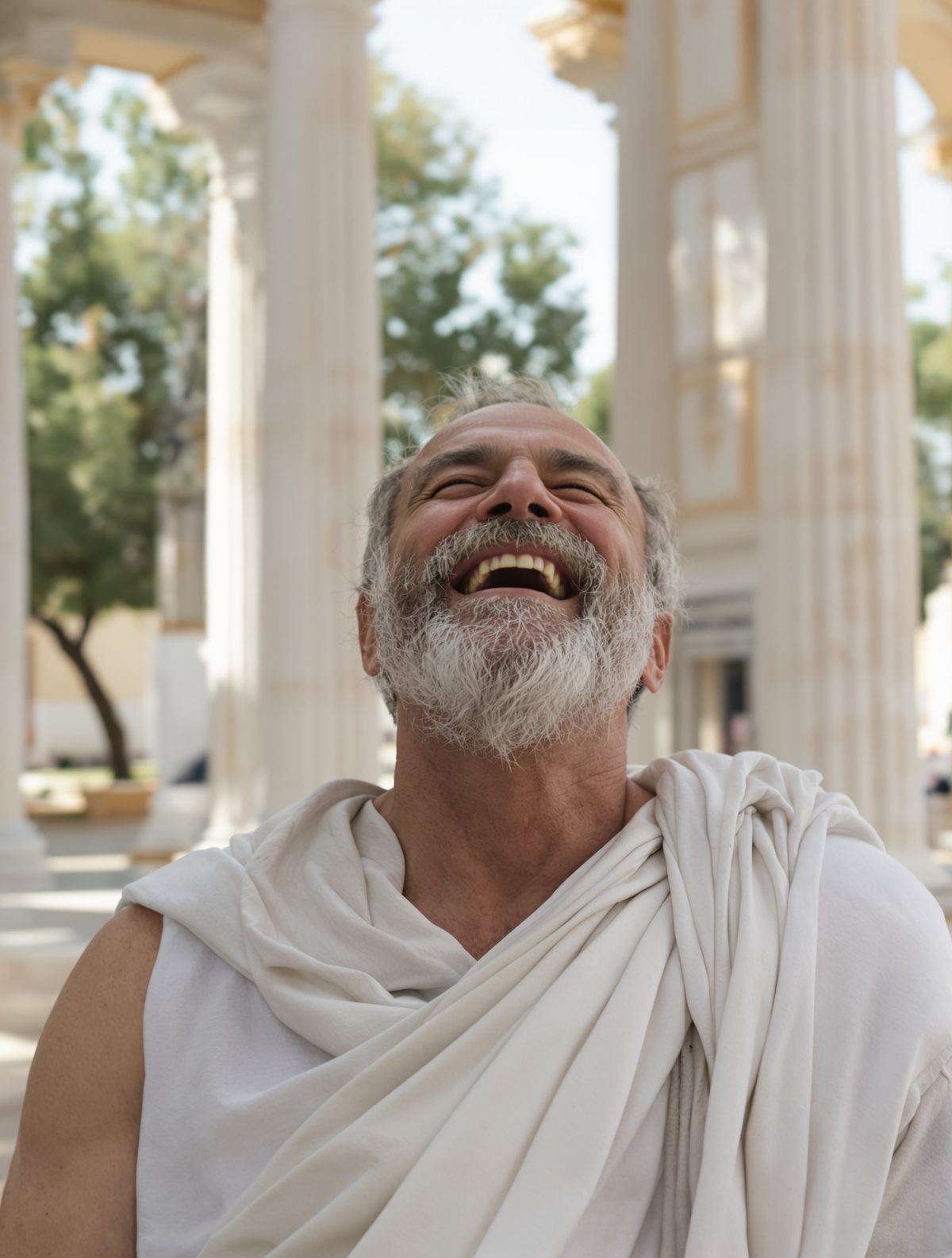
Picture this: It's a sweltering afternoon in 206 BC, and Athens buzzes with the usual philosophical debates that have made the city famous. In one corner of the agora, a crowd has gathered around an elderly man with piercing eyes and a reputation for being able to out-argue anyone on the planet. This is Chrysippus of Soli, the most brilliant logician of his generation, a man who has penned over 700 treatises on virtue, logic, and the proper way to live. But in just a few moments, this titan of intellectual discourse will be dead—killed not by poison like Socrates, not by exile like so many others, but by something far more unexpected: his own sense of humor.
What happened next would become one of history's most bizarre cautionary tales about the deadly power of laughter, proving that sometimes the greatest minds are felled not by their enemies, but by their own wit.
The Titan of Stoic Philosophy
To understand just how shocking Chrysippus's death was, you need to grasp who this man actually was. Born around 279 BC in Soli, a Greek city in what is now Turkey, Chrysippus wasn't just any philosopher—he was the philosopher who essentially saved Stoicism from intellectual extinction.
When Chrysippus arrived in Athens as a young man, Stoicism was struggling. Founded by Zeno of Citium around 300 BC, the school of thought emphasized virtue, wisdom, and emotional resilience, but it faced withering attacks from rival philosophical schools. The Academics, followers of Plato, were particularly brutal in their critiques, poking holes in Stoic logic with surgical precision.
Enter Chrysippus, a intellectual gladiator who relished philosophical combat. Ancient sources tell us he was so prolific that his students used to joke, "If there were no Chrysippus, there would be no Stoa." This wasn't just flattery—it was mathematical fact. Of the 700+ works attributed to him, his writings on logic alone filled entire libraries. He developed sophisticated theories about conditional statements, created complex logical syllogisms, and built philosophical arguments so intricate they're still studied today.
But here's what they don't teach you in philosophy class: Chrysippus was also known for his sharp wit and love of wordplay. Ancient sources describe him as someone who could find humor in the most serious debates, often catching opponents off-guard with unexpected jokes that somehow illuminated deeper truths.
Athens in 206 BC: A City of Words
By 206 BC, Athens had seen better days politically—Rome was the rising power, and Greek independence was largely a memory. But intellectually? The city still reigned supreme. Every day, the agora filled with philosophers, students, merchants, and curious citizens drawn to debates that could last from sunrise to sunset.
The Stoics had claimed a particular section of the agora as their territory, gathering under painted columns that gave their school its name (Stoa means "porch" in Greek). Here, Chrysippus held court daily, now in his early seventies but still sharp as a blade. His white beard had grown long, his voice carried the authority of decades, and his reputation preceded him wherever he went.
On this particular day, the debate was probably following familiar patterns. Chrysippus might have been defending Stoic principles about living according to nature, or perhaps explaining why emotions are really just mistaken judgments. The crowd would have been rapt—this wasn't entertainment, it was Athens's version of must-see intellectual television.
But then something extraordinary happened, something that would transform this routine philosophical discussion into one of history's most memorable exits.
The Donkey That Changed Everything
As Chrysippus spoke, gesturing with the practiced movements of a master orator, a donkey wandered into view. This wasn't unusual—animals roamed freely through ancient Athens, and philosophers had learned to ignore such distractions. But this particular donkey had discovered something irresistible: a vendor's basket of fresh figs.
Now, here's a detail that makes this story even more perfect: figs were considered a delicacy in ancient Greece, associated with luxury and refinement. They were expensive, carefully cultivated, and definitely not donkey food. Watching this humble beast casually munching on what amounted to ancient Greek caviar struck Chrysippus as absurdly funny.
But the philosopher's mind worked differently than most people's. Where others might have simply chuckled and moved on, Chrysippus saw an opportunity for the perfect punchline. He turned to the crowd, his eyes twinkling with mischief, and shouted: "Now give the donkey some wine to wash down those figs!"
The joke was brilliant in its simplicity. In one sentence, Chrysippus had transformed a common donkey into a sophisticated diner, complete with proper wine pairings. It was the kind of observational humor that catches people completely off-guard, made even funnier by the contrast between the philosopher's usual serious demeanor and this moment of pure whimsy.
When Laughter Becomes Lethal
What happened next defies everything we think we know about human physiology. Chrysippus began to laugh—not just chuckle or grin, but laugh with the kind of full-body, overwhelming mirth that seems to take over completely. Ancient sources describe him as being unable to stop, his laughter building on itself like a feedback loop of pure joy.
And then, in front of the stunned crowd, the great philosopher collapsed. Just like that, Chrysippus of Soli, defender of Stoicism, author of 700 treatises, master of logic and reason, was dead.
Modern medicine offers several explanations for what might have happened. Intense laughter can trigger cardiac arrhythmias, especially in elderly individuals. It can cause blood pressure spikes that lead to strokes. There's even a documented phenomenon called "laughter-induced syncope," where excessive laughter causes fainting and, in extreme cases, death.
But here's the detail that makes this story even more incredible: ancient sources suggest Chrysippus may have been drinking wine before his fatal joke. Some accounts mention that he had been "taking part in a feast" or "enjoying wine" during the philosophical discussion. If true, this adds another layer to the story—the alcohol might have both loosened his humor and contributed to his body's inability to handle the extreme laughter that followed.
The Irony That Would Have Made Him Laugh Again
The cosmic joke of Chrysippus's death wasn't lost on his contemporaries, and it shouldn't be lost on us. Here was a man who had spent his entire life preaching Stoic principles about emotional control, rational thinking, and maintaining equilibrium in all circumstances. The Stoics believed that wise people should be unperturbed by external events, maintaining their composure whether facing triumph or disaster.
And yet their greatest teacher died because he couldn't control his laughter at a donkey eating figs.
But perhaps there's a deeper lesson here that goes beyond irony. Chrysippus's death reveals something profound about the human condition that even the most sophisticated philosophy can't quite capture. We are not purely rational beings, no matter how much we might aspire to be. We are creatures capable of being undone by beauty, by surprise, by the simple joy of an unexpected moment.
The donkey eating figs wasn't just funny to Chrysippus—it was a perfect encapsulation of life's absurdity, the kind of moment that cuts through all pretense and reveals something true about existence. In his final seconds, the great logician might have experienced a kind of enlightenment that no amount of systematic reasoning could provide.
Why This Ancient Death Still Matters
In our age of digital distraction and engineered entertainment, there's something almost magical about the idea of finding something so genuinely funny that it could kill you. When was the last time any of us laughed with the kind of abandon that Chrysippus experienced in his final moments?
His death reminds us that humor isn't just entertainment—it's a fundamental part of what makes us human. The ability to find joy in the unexpected, to see connections that others miss, to laugh at the cosmic absurdity of existence might be more important than all our serious philosophical systems combined.
Chrysippus spent seven decades building logical arguments about how to live well, but his final act suggests that maybe the secret was simpler than he thought. Maybe wisdom isn't about controlling our emotions or reasoning our way to virtue. Maybe it's about staying open to wonder, maintaining the kind of childlike delight that can see a donkey eating figs and find in it something worth dying for.
The next time you find yourself laughing uncontrollably at something ridiculous, remember Chrysippus. You're not just experiencing humor—you're touching something essentially human, something so powerful it once killed the smartest man in Athens. In a world that often feels too serious for its own good, that might be exactly what we need.