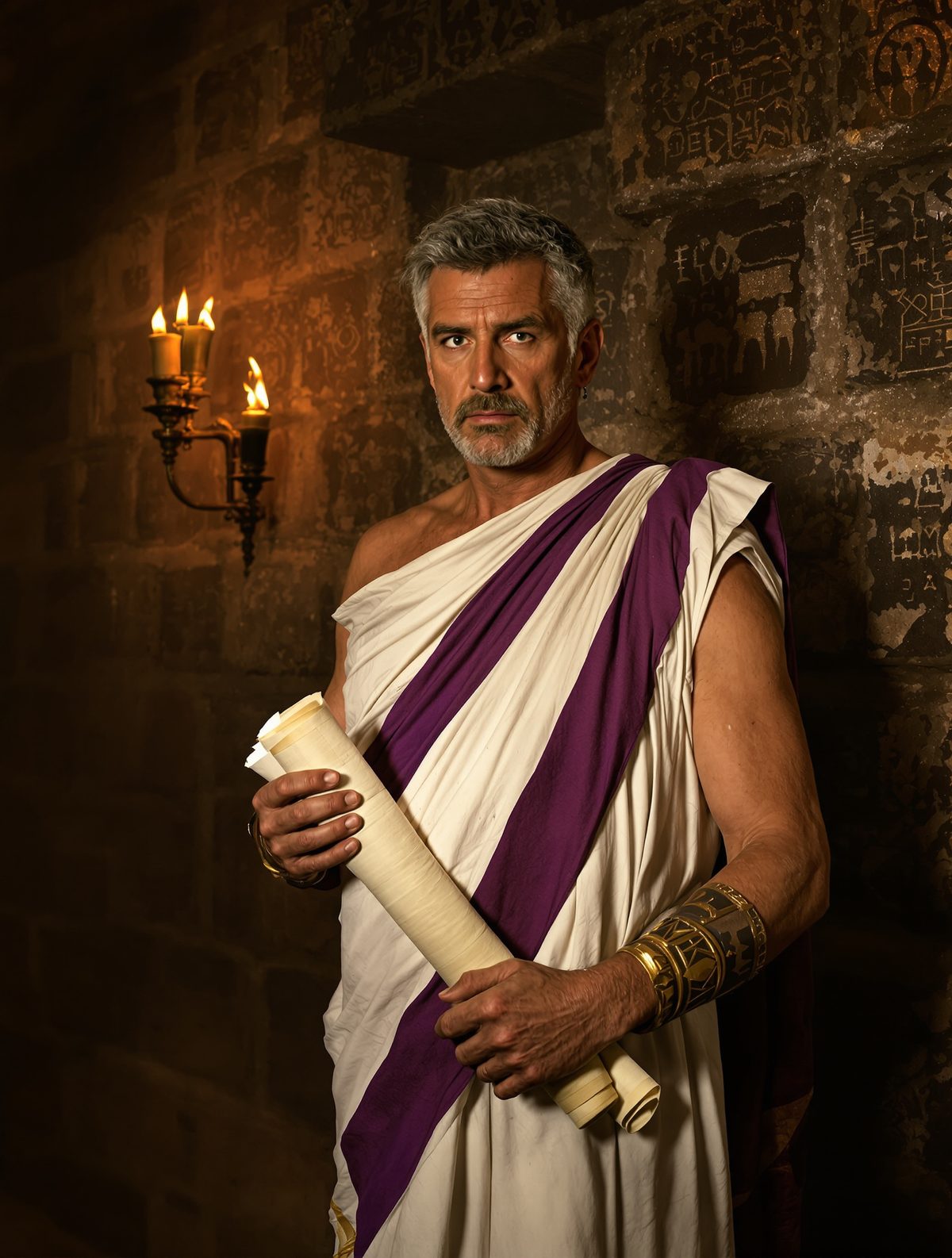
The torches flickered against ancient stone as Senator Marcus Crassus Frugi descended into the bowels of Rome's most sacred temple on a rain-soaked night in 47 AD. Clutched against his chest was a leather satchel containing documents so explosive they could topple an emperor. Behind him, the massive stone door of the Vestal Virgin's secret vault groaned shut with the finality of a tomb. The sound echoed through chambers that hadn't seen daylight since the days of the early Republic. Marcus Crassus Frugi would never be seen again.
What happened in those subterranean depths beneath the Temple of Vesta remains one of ancient Rome's most perplexing mysteries—a disappearance so complete and baffling that it spawned whispered legends for centuries. But the real story is far stranger than any ghost tale, involving imperial conspiracies, sacred oaths, and a hidden world beneath Rome that most citizens never knew existed.
The Senator Who Knew Too Much
Marcus Crassus Frugi wasn't just any senator—he was a descendant of one of Rome's most powerful families and a man who had Emperor Claudius's ear. The grandson of the famously wealthy Marcus Licinius Crassus (the same Crassus who had formed the First Triumvirate with Julius Caesar and Pompey), Frugi had inherited not just vast wealth but also an extensive network of informants throughout the empire.
In the spring of 47 AD, those informants brought Frugi something unprecedented: documented evidence that several of Claudius's most trusted advisors were planning to assassinate the emperor and install his nephew, the young Nero, as a puppet ruler. The conspiracy reached into the highest levels of the Praetorian Guard and even included Claudius's own wife, the ambitious Valeria Messalina.
But here's what makes this story truly extraordinary: Frugi couldn't simply march into the palace and present his evidence to Claudius. Roman law required that accusations of treason against the imperial family be verified by the sacred oath of the Vestal Virgins before they could be formally presented to the emperor. This meant Frugi had to gain access to the one place in Rome more heavily guarded than the palace itself—the inner sanctum of the Temple of Vesta.
Beneath the Sacred Flames
The Temple of Vesta held secrets that would astonish even modern Romans. While most citizens knew about the eternal flame tended by the six Vestal Virgins, few realized that beneath the circular marble temple lay a labyrinthine complex of underground chambers dating back to Rome's founding in 753 BC.
These weren't just storage rooms—they were the repository of Rome's most dangerous secrets. Ancient contracts with foreign kings, the true names of Rome's gods (which were kept secret to prevent enemies from cursing the city), and most importantly, the libri fatales—prophetic books that supposedly contained the destiny of the Roman Empire itself. Access to these chambers was restricted to the Pontifex Maximus, the six Vestal Virgins, and in extraordinary circumstances, senators bearing evidence of crimes against the state.
The entrance to the sacred vault was hidden behind the temple's altar, accessible only through a narrow stone staircase that spiraled down into the earth. What makes Frugi's story so chilling is that the vault's massive stone door—weighing nearly three tons and carved from a single block of travertine—could only be opened from the outside. Once sealed, it required the combined efforts of twelve temple slaves and an elaborate system of bronze pulleys to reopen.
The Night of Vanishing
On the night of May 15th, 47 AD, Frugi arrived at the Temple of Vesta accompanied by the High Priestess Vibidia and two junior Vestals. Contemporary accounts from the temple's daily records (preserved in fragments discovered in 1887) describe an unusual scene: Frugi was visibly agitated and insisted on entering the vault alone, despite protocol requiring at least one Vestal to accompany anyone accessing the sacred chamber.
Vibidia later testified that Frugi claimed his documents were "too dangerous for virgin eyes" and that he needed to consult the libri fatales to determine the proper way to present his evidence to Claudius. She reluctantly agreed to seal him in the vault until dawn, when she would return to escort him out.
But when dawn broke and the massive door was laboriously opened, the vault was empty.
Not just empty of people—completely, impossibly empty. Frugi's body was nowhere to be found. Neither were his documents. Most mysteriously, several of the ancient scrolls that had been stored in the chamber for centuries were also missing, including portions of the prophetic books and what temple records describe as "the true account of Romulus."
The Search That Shook an Empire
Emperor Claudius's reaction to Frugi's disappearance was swift and dramatic. Within hours of receiving word from the Vestal Virgins, he ordered the largest search operation in Roman history. Over 5,000 Praetorian Guards, urban cohorts, and vigiles (Rome's firefighter-police force) scoured every building, sewer, and catacomb in the city.
The search revealed something remarkable: a vast network of tunnels and chambers beneath Rome that connected major temples, government buildings, and even some private homes. Many of these passages dated back centuries and appeared to have been used for everything from religious ceremonies to political assassinations. Some tunnels showed signs of recent use—fresh torch brackets, cleared debris, and most intriguingly, scratched messages in multiple languages including Latin, Greek, and what appeared to be Etruscan.
But despite turning Rome literally upside down, searchers found no trace of Senator Frugi or his explosive documents. The investigation did uncover something else, however: evidence that Frugi's conspiracy theory was accurate. Several of the people he had named in his alleged evidence were quietly arrested and executed over the following months, including two Praetorian officers and a palace scribe who had been forging imperial correspondence.
Theories and Ancient Conspiracies
The official explanation, recorded in Claudius's personal correspondence to the governors of distant provinces, was that Frugi had suffered some kind of accident or medical emergency in the vault and that his body had somehow been consumed or dissolved by "sacred forces." But privately, investigators developed several more intriguing theories.
The first theory suggested that Frugi had discovered a secret passage leading out of the vault—possibly one that connected to the broader network of tunnels beneath the city. This would explain how he could escape from a seemingly sealed chamber, but not why he would abandon his mission to warn Claudius about the conspiracy.
A second theory, whispered among senators but never officially recorded, was that Frugi had been murdered by the very conspirators he was trying to expose. Perhaps they had somehow gained advance knowledge of his plan and arranged for accomplices among the temple staff. The missing ancient scrolls might have been taken to make the crime look like something supernatural rather than political.
The most fascinating theory came from an unexpected source: Claudius himself. In a letter to his brother Germanicus, discovered in Egyptian archives in 1923, the emperor wrote that he believed Frugi had uncovered something far more dangerous than a simple assassination plot. Claudius suspected that certain Roman families had been secretly maintaining alternate versions of Rome's founding myths and laws—versions that could potentially challenge the legitimacy of the entire imperial system.
Echoes Through Time
The disappearance of Marcus Crassus Frugi matters today because it illuminates something profound about power, truth, and the lengths people will go to protect dangerous secrets. In our age of whistleblowers, classified documents, and government transparency debates, Frugi's story feels remarkably contemporary.
Here was a man who possessed information that could change the course of history, but who vanished just as he was about to reveal it. Whether he was silenced by conspirators, fled to protect himself, or simply fell victim to some accident in those ancient tunnels, his disappearance reminds us that some truths are considered too dangerous to survive.
The underground chambers beneath Rome's temples were eventually sealed permanently in the 2nd century AD, their contents lost to history. But sometimes, when construction crews dig foundations for new buildings in central Rome, they still discover fragments of that hidden world—scraps of ancient parchment, carved stones with mysterious inscriptions, and occasionally, human bones that radiocarbon dating places firmly in the 1st century AD.
Perhaps somewhere beneath the eternal city, in chambers that haven't seen light for nearly two thousand years, the documents that Marcus Crassus Frugi died protecting are still waiting to tell us secrets that could rewrite Roman history. The question is: are we ready to hear them?