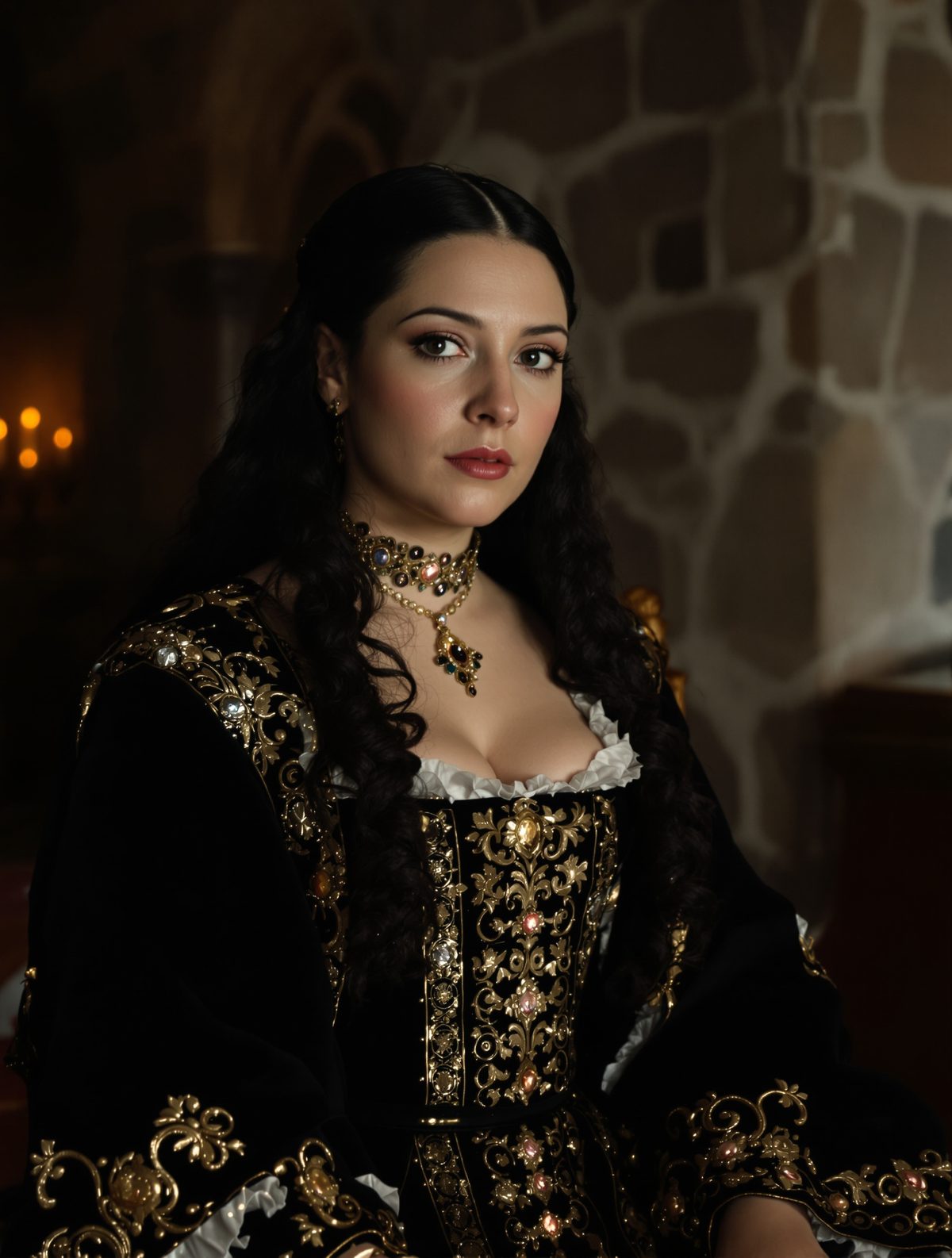
The screams echoing through Čachtice Castle on that cold December night in 1610 would finally bring an end to one of history's most horrifying reigns of terror. As Hungarian authorities burst through the iron-bound doors, they discovered a scene that would haunt them forever: bodies of young women, some still warm, others bearing the marks of unimaginable torture. In the castle's depths, they found the woman responsible—Countess Elizabeth Báthory, her hands still stained with the blood of her victims.
What had begun as the vanity of a noblewoman obsessed with youth had transformed into something far more sinister. For decades, the "Blood Countess" had lured hundreds of young women to her remote castle with promises of work, only to subject them to torture, mutilation, and death—all in pursuit of an elixir she believed would grant her eternal beauty.
The Making of a Monster
Elizabeth Báthory was born into privilege on August 7, 1560, into one of the most powerful noble families in Hungary. The Báthorys weren't just wealthy—they were dangerously wealthy, controlling vast swaths of territory across Hungary and Transylvania. Her family tree reads like a catalog of medieval brutality: her uncle Gábor Báthory was known for his savage military campaigns, while another relative, Anna Báthory, was rumored to have dabbled in the dark arts.
Even as a child, Elizabeth displayed disturbing tendencies. At age 13, she became pregnant by a peasant boy—a scandal that her family handled with characteristic ruthlessness. The boy simply disappeared, and Elizabeth was quietly married off to Ferenc Nádasdy, a fellow aristocrat known as the "Black Knight" for his merciless treatment of Ottoman prisoners.
Ferenc's influence on his young bride cannot be overstated. He reportedly taught her new methods of torture, including a technique involving honey and ants that would become one of her signature methods. When Ferenc died in 1604, Elizabeth was left alone with her obsessions—and with the absolute power to indulge them.
The Fateful Discovery
The legend of Elizabeth's transformation into the "Blood Countess" centers on a single, pivotal moment. According to contemporary accounts, sometime around 1585, Elizabeth struck one of her servant girls so hard that blood splattered onto her hand. When she wiped it away, she became convinced that the skin beneath looked younger, more radiant.
Whether this moment actually occurred or was later fabricated by prosecutors, it became the foundation of Elizabeth's deadly obsession. She began to seek out the counsel of her servant Dorottya Szentes, known as "Dorkó," who claimed knowledge of folk magic and blood rituals. Together with her other accomplices—including her former wet nurse Ilona Jó and the castle steward János Újváry—Elizabeth began to experiment with increasingly horrific methods.
What started with the occasional beating of servant girls soon escalated into systematic torture. Elizabeth became convinced that virgin blood was most potent, and that the younger the victim, the more powerful the anti-aging properties would be. Her methods grew more elaborate and sadistic: she would bite chunks of flesh from girls' faces, burn them with red-hot pokers, and freeze them in the castle courtyard during brutal Hungarian winters.
A Castle of Horrors
Čachtice Castle, perched high in the Carpathian Mountains, became Elizabeth's laboratory of death. The remote location was perfect for her purposes—screams couldn't travel far through the thick stone walls, and the nearest village was too distant and too intimidated to interfere with the affairs of nobility.
The castle's design seemed almost purpose-built for torture. Deep dungeons carved into the rock provided soundproof chambers where Elizabeth could work undisturbed. She installed specially designed torture devices: iron cages suspended from the ceiling where victims could be stabbed from below, and a contraption locals called the "Iron Maiden"—though this may have been a later embellishment to her legend.
Elizabeth's methods were as varied as they were brutal. She would force girls to strip naked in the snow until they froze to death, their skin turning blue as she watched with fascination. She burned girls with coins heated red-hot, and reportedly practiced a form of "star-kicking"—forcing victims to lie naked while she kicked them with spiked shoes until they bled to death.
But it was her bathing rituals that earned her the most notoriety. According to witness testimony from her trial, Elizabeth would have girls suspended above a specially constructed bathtub, their throats slit so their blood would drain directly onto her naked body. She believed that bathing in virgin blood would not only preserve her youth but actually reverse the aging process.
The Web of Accomplices
Elizabeth didn't commit these atrocities alone. She relied on a network of accomplices who enabled her reign of terror for over two decades. Her inner circle included Dorkó, who allegedly taught her blood magic; Ilona Jó, who helped procure victims; and Katalin Beneczky, who assisted with the tortures and helped dispose of bodies.
Perhaps most chilling was how they recruited victims. Initially, Elizabeth targeted peasant girls from nearby villages, luring them with promises of well-paid work as castle servants. These disappearances were largely ignored by authorities—after all, who would investigate the affairs of one of Hungary's most powerful families on behalf of mere peasants?
But Elizabeth's appetite for victims grew, and she began to make a fatal mistake. Around 1609, she started targeting minor nobility—girls from families with enough influence to ask uncomfortable questions. She even established a "finishing school" for young noblewomen, ostensibly to teach them proper etiquette. In reality, it was a hunting ground.
Her accomplices later testified that they helped her torture and kill girls as young as 10 and as old as 26, though her preference was for teenagers between 15 and 18. They described how Elizabeth would personally participate in every aspect of the torture, often becoming sexually aroused by the suffering she witnessed.
The Walls Close In
By 1610, rumors about the Blood Countess could no longer be contained. King Matthias II of Hungary had been receiving reports about Elizabeth's activities for years, but her family's political influence had protected her. However, when she began killing minor nobility, the political calculus changed dramatically.
György Thurzó, the Palatine of Hungary and ironically a cousin of Elizabeth's late husband, was ordered to investigate. What his forces discovered when they raided Čachtice Castle on December 30, 1610, exceeded even the wildest rumors. They found the tortured body of one girl in the main hall, another dying from multiple wounds, and several more imprisoned and bearing signs of abuse.
In the dungeons beneath the castle, investigators uncovered a charnel house. Bodies were stacked like cordwood, some drained of blood, others bearing the marks of systematic torture. The exact number of Elizabeth's victims remains disputed, but witness testimony and her own diary—which she kept with meticulous detail—suggested the death toll exceeded 650 young women.
Most shocking of all was Elizabeth herself. When captured, she showed no remorse, no recognition that her actions were wrong. To her final day, she maintained that she had done nothing unusual—after all, nobles had always had the right of life and death over their peasants. Why should she be punished for exercising that right in pursuit of beauty?
Justice Delayed but Not Denied
Elizabeth's trial began in 1611, but she herself never appeared in court—her noble status protected her from that indignity. Instead, her accomplices were tried and executed. Dorkó and Ilona Jó had their fingers torn off with red-hot pincers before being burned alive. Katalin Beneczky was beheaded, a more merciful death reserved for those who had cooperated with investigators.
Elizabeth's punishment was perhaps more fitting than execution. She was walled up alive in a set of rooms in her own castle, with only small slits for air and food. No trial, no execution—just a slow fade into obscurity and madness. For nearly four years, she lived in these cramped quarters, served by guards who were forbidden to speak to her.
On August 21, 1614, guards found her dead on the floor of her makeshift prison. She was 54 years old. Ironically, for all her efforts to preserve her youth, contemporary accounts describe her final years as a time of rapid aging and declining health.
The Legacy of the Blood Countess
Elizabeth Báthory's story has echoed through the centuries, inspiring countless works of fiction and becoming inextricably linked with vampire mythology. But beneath the gothic horror lies a more disturbing truth about power, privilege, and the human capacity for evil.
Her case reveals how absolute power—combined with isolation, obsession, and a culture that devalued certain lives—can create monsters. For over 20 years, Elizabeth tortured and killed with impunity, protected by her noble status and the indifference of a society that simply didn't care about the lives of peasant girls.
Modern historians debate whether Elizabeth's story has been exaggerated over time, with some suggesting the most extreme accounts may have been propaganda designed to justify seizing her family's vast wealth. Yet even the most conservative estimates place her victim count in the dozens, making her one of history's most prolific serial killers.
Perhaps most unsettling is how Elizabeth's obsession with youth and beauty resonates in our modern age. In a time when cosmetic surgery, anti-aging treatments, and youth obsession dominate popular culture, the Blood Countess serves as a dark mirror reflecting our own vanities and fears of aging. Her story asks uncomfortable questions about how far we might go in pursuit of eternal youth—and what happens when privilege and power remove the normal constraints of conscience and law.
The screams that once echoed through Čachtice Castle have long since faded, but Elizabeth Báthory's legacy endures as a reminder that the most terrifying monsters in history are not the products of supernatural evil, but of very human obsessions taken to their darkest extremes.