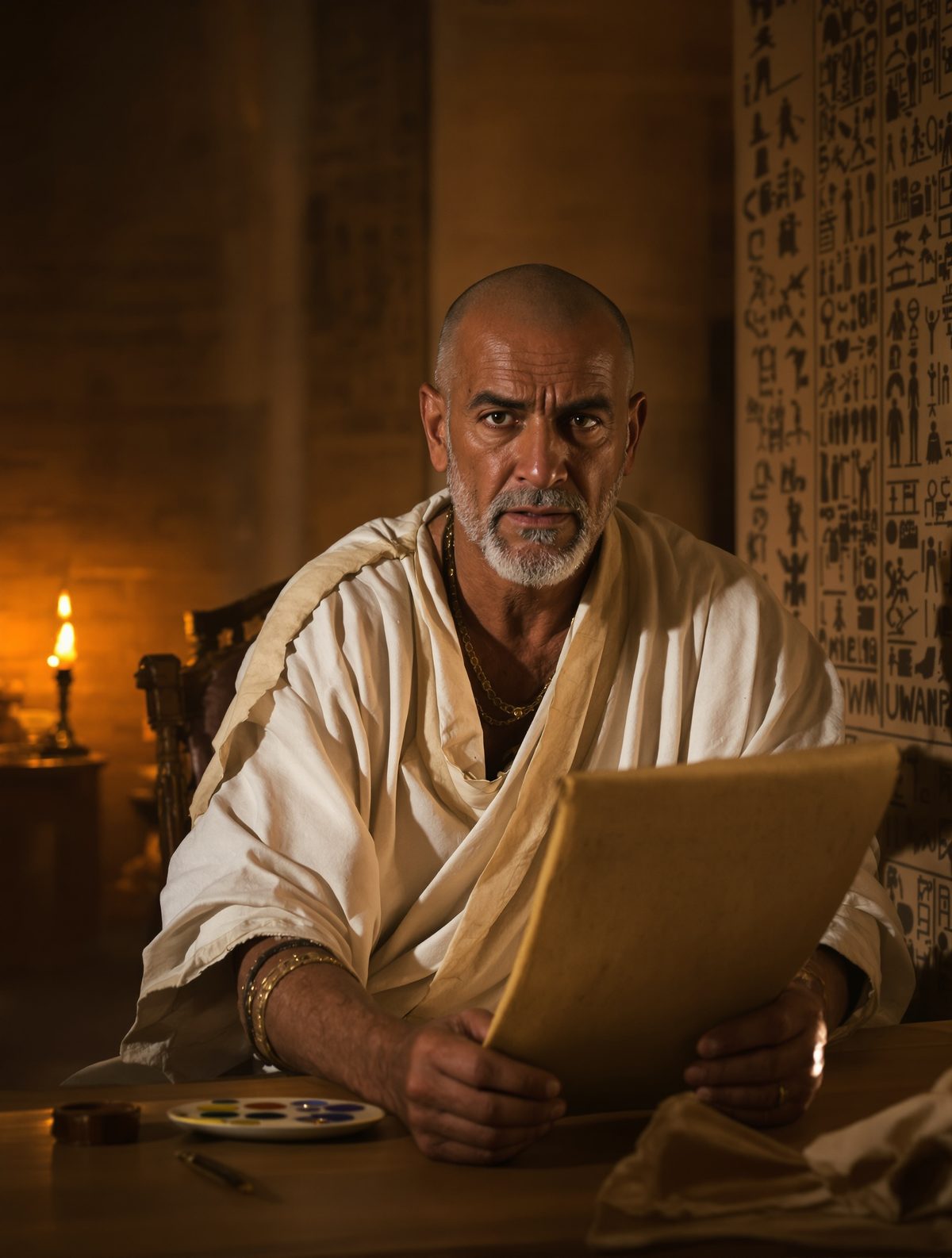
The reed pen trembled in Amenemheb's weathered hands as he stared at the blank papyrus before him. Outside his small chamber in the royal palace of Thebes, the Nile lapped gently against the stone quays, oblivious to the conspiracy unfolding in its shadow. It was the autumn of 1323 BC, and Egypt's most trusted royal scribe had just received an order that would haunt him forever: write the death announcement for Pharaoh Tutankhamun. The only problem? The boy king was still very much alive.
What happened next would become one of ancient Egypt's most dangerous games of political chess—a story of loyalty, betrayal, and a scribe who chose conscience over career in the treacherous final days of the 18th Dynasty.
The Boy King's Dangerous Game
Tutankhamun was barely nineteen years old when the walls began closing in around him. The young pharaoh had spent most of his nine-year reign as a puppet, manipulated by powerful advisors who had grown rich and influential during his minority. But by 1323 BC, something had changed. Palace whispers spoke of the king asserting his independence, making decisions without consulting his council, and—most dangerously of all—questioning the enormous wealth that certain officials had accumulated.
Chief among these threatened power brokers was Ay, Tutankhamun's elderly advisor and possibly his great-uncle. Ay had served as the true ruler of Egypt while Tutankhamun was a child, and he wasn't about to relinquish control to an upstart teenager with ideas about actually ruling his own kingdom. Historical records suggest that tension between the two had been building for months, with Tutankhamun increasingly bypassing Ay's counsel on matters of state and military appointments.
The breaking point came when Tutankhamun announced his intention to investigate the royal treasury. In a kingdom where pharaohs were considered living gods, such financial irregularities weren't just theft—they were sacrilege. For Ay and his conspirators, the young king had become an existential threat.
The Scribe's Impossible Order
Amenemheb had served the royal household for over two decades, his skilled hieroglyphic hand recording everything from diplomatic correspondence to religious decrees. He was what the Egyptians called a sesh—a learned man whose literacy made him invaluable in a world where fewer than one percent of the population could read or write. His position required absolute discretion and unwavering loyalty, qualities that had earned him access to the most sensitive royal communications.
So when Ay's messenger arrived at his quarters that fateful evening, Amenemheb didn't question the order initially. He was to prepare an official announcement of Pharaoh Tutankhamun's death—to be dated three days hence and distributed to provincial governors throughout Egypt. The cause would be listed as a hunting accident, a tragically plausible fate for a young king known for his love of chariot racing and archery.
But as Amenemheb began drafting the decree, the horrifying implications became clear. This wasn't a contingency document or a administrative preparation. This was a death sentence masquerading as a death certificate. By writing the announcement, he was essentially signing Tutankhamun's execution warrant. The logistics were brutally simple: once the provincial governors received news of the king's "death," any subsequent appearance by Tutankhamun could be dismissed as an imposter. The real pharaoh would become politically invisible—and therefore disposable.
Between Loyalty and Survival
Ancient Egyptian scribes lived by a strict code that modern historians have pieced together from various papyrus sources. They were sworn to secrecy, bound by religious oaths, and acutely aware that their privileged position came with mortal risks. Cross the wrong official, and a scribe might find himself reassigned to counting grain in some remote desert outpost—if he was lucky.
Amenemheb spent that sleepless night wrestling with an impossible choice. Refuse the order, and he would certainly face execution for disobedience. Complete it, and he would be complicit in regicide—a crime that ancient Egyptians believed would damn his soul for eternity, preventing his journey to the afterlife.
But there was a third option, one that required extraordinary courage and even more extraordinary cunning. Amenemheb could write the decree as ordered, satisfying his immediate superiors, while simultaneously warning Tutankhamun of the plot against his life. It was a desperate gambit that would require perfect timing and no small amount of luck.
As dawn broke over Thebes, the scribe made his choice. His reed pen moved swiftly across the papyrus, crafting the elegant hieroglyphs that would officially announce the death of Egypt's nineteenth pharaoh. The irony wasn't lost on him—his beautiful calligraphy, honed over decades of faithful service, was now being used to forge one of history's most consequential documents.
The Warning That Changed History
What happened next reads like something from a modern thriller. Amenemheb had a narrow window of opportunity—the death decree wouldn't be dispatched to the provinces for another day, giving him roughly twenty-four hours to reach Tutankhamun before the trap snapped shut. But approaching the pharaoh directly was impossible; the palace was crawling with Ay's supporters, and any unusual activity would be immediately reported.
Instead, Amenemheb turned to an unlikely ally: Ankhesenamun, Tutankhamun's young wife and the daughter of the "heretic" pharaoh Akhenaten. The queen had her own network of loyal servants, women who moved through the palace largely invisible to male courtiers. Through a trusted handmaiden, Amenemheb's warning reached the royal couple just as they were preparing for what Ay had planned to be Tutankhamun's final hunting expedition.
The evidence suggests that Tutankhamun initially didn't believe the warning. After all, Ay had been his advisor and protector for years—the idea that his trusted elder would orchestrate his murder seemed inconceivable. But Ankhesenamun, who had grown up in the paranoid atmosphere of Akhenaten's court, understood palace intrigue better than her husband. She convinced him to take precautions.
Rather than flee immediately, which would have confirmed their knowledge of the plot, the royal couple decided on a more subtle strategy. Tutankhamun would go on the hunting trip as planned, but with a carefully selected group of bodyguards whose loyalty was beyond question. If an "accident" was attempted, he would be prepared.
The Hunt That Never Happened
The hunting expedition departed Thebes on schedule, with Tutankhamun's chariot leading a small procession toward the desert hills west of the Nile. But among the party were several men whose true loyalty lay with Ay, and their instructions were clear: the pharaoh was not to return alive. An arrow from the hunt, a chariot "accident," a fall from a cliff—the method mattered less than the outcome.
What the conspirators didn't anticipate was that their target now knew exactly what they had planned. When the attack came—historical sources suggest it was indeed staged as a hunting accident—Tutankhamun was ready. His loyal guards fought off the assassins, though not without cost. The pharaoh himself was wounded, possibly by an arrow or spear thrust, but he survived the immediate attempt on his life.
However, survival and victory were two very different things. Tutankhamun now found himself in an impossible position: he was a pharaoh whose death had already been announced to the provinces, hunted by conspirators who controlled much of the palace apparatus, and wounded in the bargain. Even if he returned to Thebes, his political position was fatally compromised.
The historical record becomes murky at this point, but most Egyptologists believe that Tutankhamun died from his wounds within days of the failed assassination attempt. Whether this was from the injuries themselves, infection, or a more successful second attempt remains a matter of scholarly debate. What seems certain is that Ay's coup ultimately succeeded—within months, he had married Ankhesenamun (likely against her will) and claimed the throne of Egypt.
The Scribe's Final Chapter
As for Amenemheb, his fate was sealed the moment he chose loyalty over self-preservation. Ancient Egyptian records suggest he disappeared shortly after Tutankhamun's death, almost certainly executed by Ay's supporters who had quickly pieced together his role in warning the king. But the scribe's courage wasn't entirely in vain—by giving Tutankhamun advance warning, he had disrupted the conspiracy enough to leave traces that modern historians could follow.
More importantly, Amenemheb's story illuminates a crucial truth about power in ancient Egypt. For all their divine pretensions, pharaohs were mortal men who could be betrayed, manipulated, and murdered just like anyone else. The difference was that their deaths could be hidden behind elaborate religious ceremonies, magnificent tombs, and carefully crafted official histories that obscured the messy human realities of palace politics.
In our own age of information warfare and manufactured narratives, Amenemheb's dilemma resonates with surprising relevance. He was, in essence, a medieval fact-checker caught between truth and power, forced to choose between professional survival and moral courage. His decision to risk everything for a warning that might save one life reminds us that even in humanity's most authoritarian systems, individual conscience can still light a candle in the darkness—even if that candle burns only briefly before being extinguished forever.
The next time you see Tutankhamun's golden funeral mask in a museum or documentary, remember that behind its serene expression lies a story of betrayal, courage, and a scribe who proved that sometimes the pen truly can be mightier than the sword—even when wielded against pharaohs and gods.