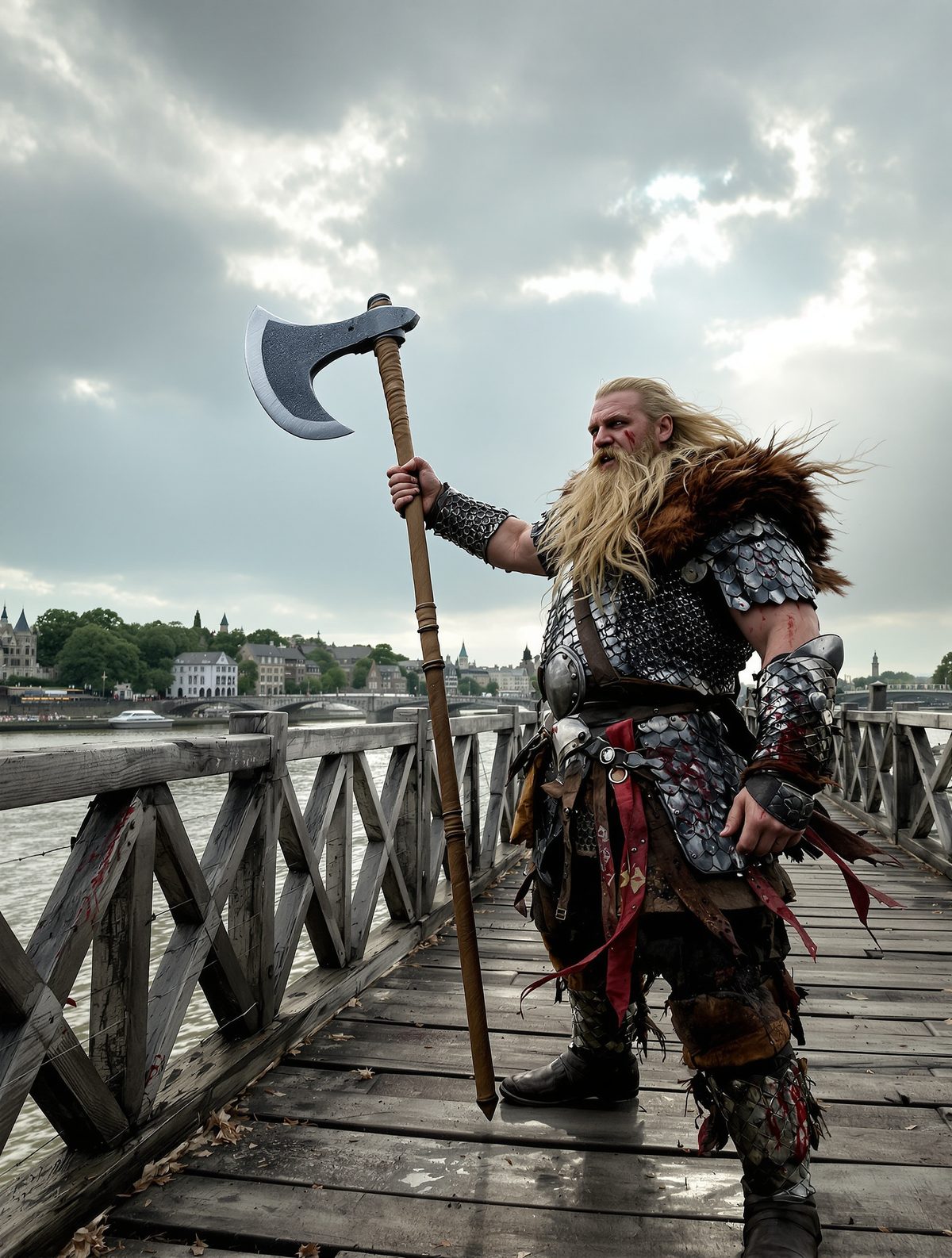
Picture this: a lone Viking warrior, blood-soaked and breathing hard, stands at the center of London Bridge. Behind him, his king's army retreats in chaos. Ahead, twenty thousand English soldiers surge forward like a human tide, their war cries echoing across the Thames. Any rational man would run. But this nameless Norse berserker plants his feet, raises his axe, and prepares to hold the bridge alone.
For hours, he would keep them at bay. One man. One bridge. Twenty thousand enemies.
This isn't the stuff of legend or Hollywood fantasy—it's documented history from the year 1016 AD, when England's fate hung in the balance and a single warrior's stand became the stuff of military legend.
The Battle That Shook Two Kingdoms
To understand how one Viking came to face impossible odds on London Bridge, we need to step back to September 1016, when England was being carved up between two ambitious kings. Edmund Ironside, the Anglo-Saxon king, was locked in a brutal struggle with Canute the Great (also known as Cnut), the Danish king who had arrived with a massive invasion force.
This wasn't just another Viking raid—this was a full-scale conquest. Canute commanded not only his own Danish warriors but also a confederation that included Norwegians and other Norse fighters. These weren't the stereotypical horned-helmet barbarians of popular imagination, but professional soldiers equipped with superior weapons, sophisticated tactics, and an unshakeable belief in dying gloriously in battle.
The Battle of Assandun had just concluded with a devastating defeat for Edmund Ironside's forces. Canute's army, victorious but battered, found themselves on the wrong side of the Thames with Edmund's remaining forces regrouping for a counterattack. The only way across was London Bridge—a narrow wooden structure that would force thousands of warriors into a deadly bottleneck.
As Canute's forces began their strategic withdrawal across the bridge, Edmund Ironside seized his chance. With roughly twenty thousand men, he launched a pursuit that should have ended in a massacre. Instead, it became the stage for one of history's most improbable last stands.
The Anatomy of an Impossible Stand
The London Bridge of 1016 bore little resemblance to the stone monument we know today. This was a wooden structure, probably no more than twelve to fifteen feet wide, supported by timber pilings driven into the Thames riverbed. The bridge's narrow width was both a strategic advantage and a death trap—it could accommodate perhaps four men walking abreast, but it also meant there was nowhere to run.
As the last of Canute's forces crossed to safety, the unnamed Viking warrior made a decision that defied every military manual ever written. While his comrades continued their retreat, he turned around, walked back to the center of the bridge, and faced the approaching English army alone.
What happened next reads like something from the Iliad. Armed with a traditional Viking battle-axe—likely a broad-bladed weapon capable of cleaving through both mail and bone—and a round shield, the berserker began what medieval chroniclers would describe as the most extraordinary display of individual combat prowess they had ever witnessed.
The bridge's narrow confines meant that Edmund's twenty thousand soldiers could only approach a few at a time. The Viking warrior used this to devastating effect, his axe work so ferocious and precise that English soldiers began to pile up in front of him. Chronicles suggest he killed over forty men in the first hour alone, their bodies creating a gruesome barricade that made the footing treacherous for those who followed.
The Psychology of a Berserker
To understand how one man could hold off thousands, we need to delve into the mindset of the Viking berserker. These warriors weren't just brave—they were participants in a religious and psychological tradition that bordered on the supernatural. Berserkers believed they channeled the spirit of bears or wolves in battle, entering a trance-like state called berserksgangr that made them seemingly immune to pain and fear.
Modern historians and psychologists have theorized about what actually triggered this state. Some suggest it involved psychoactive mushrooms or fermented beverages, while others point to a form of self-induced hypnosis combined with extreme physical conditioning. Whatever the mechanism, the effect was undeniable: berserkers fought with a ferocity that terrified even battle-hardened opponents.
But there was more than just rage fueling our unnamed warrior. Viking culture placed enormous emphasis on achieving a glorious death in battle. The concept of Valhalla—the hall of the slain where warriors would feast with the gods—meant that dying well was literally more important than living well. For a Viking warrior, retreating in the face of overwhelming odds was a fate worse than death.
As the hours passed and bodies continued to pile up on London Bridge, something remarkable happened: the English advance began to slow, then stop entirely. Facing an opponent who seemed genuinely unstoppable, Edmund Ironside's soldiers found their courage wavering. This wasn't just military tactics anymore—it was psychological warfare of the highest order.
The Ingenious Solution
By most accounts, the Viking's stand lasted the better part of a day. As the sun began to set over the Thames, Edmund Ironside faced a military crisis that threatened to become a disaster. His massive army was being held at bay by a single enemy warrior, and morale was plummeting with each failed assault.
It was then that an unnamed English soldier—perhaps an engineer or someone familiar with the river—proposed a solution that was as brilliant as it was desperate. If they couldn't get through the Viking warrior, perhaps they could get under him.
Working quickly and quietly, a small group of English soldiers procured a large barrel or small boat (accounts vary) and floated it downstream toward the bridge. The plan required tremendous courage: they would have to position themselves directly beneath the fighting, where falling bodies and weapons could crush them at any moment.
Using long spears, the soldiers thrust upward through the gaps between the bridge's wooden planks. Contemporary accounts suggest they aimed for the warrior's legs and feet—the only parts of his body not protected by mail or shield. The attack came from an angle the Viking couldn't defend against, no matter how skilled he was with his weapons.
The spear thrusts found their mark. Wounded and finally vulnerable, the berserker's incredible stand came to an end. English soldiers surged across the bridge, but by then, Canute's army had successfully completed their withdrawal. One man had bought an entire army the time they needed to escape and regroup.
The Ripple Effects of One Man's Stand
The immediate tactical impact of the Viking's stand was significant enough—Canute's forces lived to fight another day, and the war continued for several more months before ending in a negotiated settlement that divided England between the two kings. But the psychological and cultural impact of the Bridge Stand, as it came to be known, resonated far beyond the battlefield.
For the Vikings, the unnamed warrior's sacrifice became the gold standard for honorable death in battle. Skaldic poems celebrating his stand were recited in halls across Scandinavia for generations. Even the English, despite being his enemies, came to regard the bridge defender with a mixture of respect and awe that bordered on reverence.
The stand also highlighted something crucial about medieval warfare that often gets lost in broader historical narratives: individual acts of extraordinary courage could genuinely change the course of military campaigns. In an age before gunpowder and artillery, when battles were decided by hand-to-hand combat and personal valor, one person truly could make the difference between victory and defeat.
Perhaps most remarkably, the Viking's sacrifice may have indirectly influenced the eventual peace settlement between Edmund and Canute. The sheer audacity of the bridge stand demonstrated to both sides that this war was producing heroes worthy of saga and song—but it was also bleeding both kingdoms white with little strategic gain for either side.
Why This Story Matters Today
In our age of mass warfare and technological combat, it's easy to dismiss the Bridge Stand as an interesting historical curiosity—a relic from a more primitive time when individual heroics could still matter on the battlefield. But that would miss the deeper significance of what happened on London Bridge in 1016.
The unnamed Viking's stand represents something timeless about human nature: the capacity for ordinary people to rise to extraordinary circumstances when their values and beliefs are truly tested. He wasn't a king or a famous hero—just a professional soldier who found himself at a moment where retreat meant abandoning everything he believed about honor, duty, and the proper way to meet death.
In a world where we often feel powerless in the face of vast, impersonal forces, there's something deeply inspiring about one person's decision to plant their feet and say "no further." Whether we're talking about political resistance, moral courage, or simply the determination to stand up for our principles when it costs us something, the spirit of the bridge defender lives on.
The story also reminds us that history's greatest moments of courage often come from people whose names we'll never know. Somewhere in medieval chronicles, there's a brief mention of an unnamed Viking who held a bridge. But the twenty thousand English soldiers who faced him that day, and the thousands of Danish warriors whose lives he saved, never forgot what they witnessed.
Sometimes, that's legacy enough.