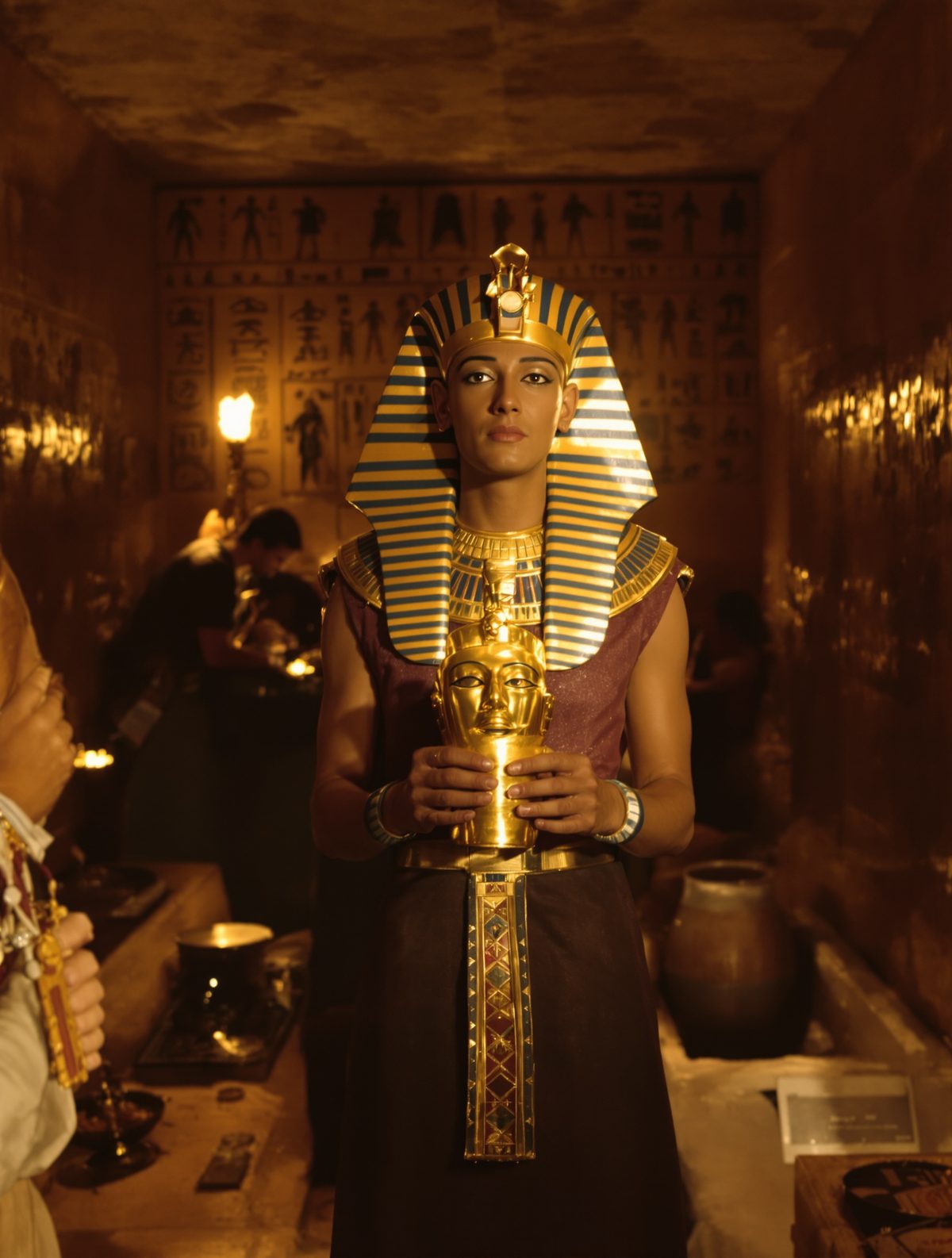
The torchlight flickered across hieroglyphs that hadn't seen illumination for centuries as the masked figures crept through the sacred corridors. These weren't common grave robbers skulking through the Valley of the Kings—they were working under direct orders from Pharaoh himself. In one of history's most shocking acts of desperation, Ramesses VI had done the unthinkable: he'd ordered the systematic looting of his own ancestors' tombs to fund his crumbling empire.
What drove a pharaoh, believed to be a living god, to desecrate the sacred resting places of his royal bloodline? The answer lies in the perfect storm of military pressure, economic collapse, and political survival that gripped Egypt in 1155 BC.
When Gods Went Broke: Egypt's Financial Crisis
By the time Ramesses VI ascended to the throne, the mighty Egyptian Empire was hemorrhaging gold faster than the Nile floods. The once-invincible kingdom that had dominated the ancient world for over a millennium was facing an unprecedented crisis. Foreign invasions by the mysterious Sea Peoples had decimated trade routes, while costly military campaigns in Nubia and the Levant had drained the royal treasury to its last ingot.
The numbers were staggering. Archaeological evidence suggests that Egypt's gold reserves, which had once measured in the tons, had shrunk to almost nothing. Tomb inscriptions from this period reveal that even the pharaoh's own burial preparations were being scaled back dramatically. Where his predecessors' tombs had been filled with solid gold artifacts weighing hundreds of pounds, Ramesses VI was looking at gold-plated wood and copper if he was lucky.
But wars don't pause for empty treasuries. The Meshwesh Libyans were pressing from the west, Nubian tribes were rebelling in the south, and the fragmenting empire needed immediate funding or it would collapse entirely. Ramesses VI faced a choice that no pharaoh before him had ever contemplated: watch his kingdom crumble, or commit an act of sacrilege that would have been unthinkable just decades earlier.
The Sacred Becomes the Profitable: Targeting the Ancestors
The Valley of the Kings held more than just dead pharaohs—it contained the largest concentration of portable wealth in the known world. Generations of rulers had been buried with literally tons of gold, silver, and precious stones, all lying in elaborate tombs just miles from Ramesses VI's palace. The irony was almost cruel: here was a pharaoh sitting on top of unimaginable riches, all of it locked away with the dead while his living empire starved for resources.
Ramesses VI's solution was as brilliant as it was blasphemous. Rather than risk the political disaster of officially opening the royal tombs, he would orchestrate their "robbery" by carefully selected teams working under the cover of darkness. The official records would show tomb robbing—a crime as old as Egypt itself. The unofficial reality would be a state-sponsored salvage operation.
His first target was telling: the tomb of Ramesses II, his great-great-grandfather, whose 66-year reign had been the height of Egyptian power and wealth. Archaeological evidence suggests that Ramesses II's burial chamber contained over 400 pounds of gold artifacts, including his solid gold inner coffin. For Ramesses VI, this wasn't just grave robbing—it was a strategic withdrawal from the family bank account.
The Midnight Heists: How to Rob a Pharaoh
The logistics of secretly looting royal tombs were staggeringly complex. Each operation required trusted teams of workers, priests who could navigate the religious implications, and craftsmen capable of melting down sacred artifacts without leaving evidence. Papyrus records from the period, discovered in the 1930s, reveal that these weren't crude smash-and-grab operations—they were sophisticated extractions that often took weeks to complete.
The teams would enter through hidden passages that only the highest-ranking priests knew existed. They worked by torchlight, carefully removing golden jewelry, ceremonial weapons, and sacred amulets from mummified pharaohs who had been undisturbed for centuries. The most valuable items—solid gold death masks, golden sandals, and jeweled pectoral plates—were immediately transported to secret workshops where they were melted down and recast as military funding.
One particularly detailed account describes the looting of Seti I's tomb, where workers discovered a hidden chamber containing over 200 golden figurines of protective deities. The entire chamber was emptied in a single night, with the gold being transformed into military payroll within 48 hours. The speed was essential—the longer the operation continued, the greater the risk of discovery by loyal priests or court officials who might not understand the desperate necessity of the pharaoh's actions.
The Golden War Machine: Funding Empire with Ancestral Wealth
The results were immediate and dramatic. Ramesses VI's military campaigns in Nubia, which had been stalling due to unpaid soldiers and lack of equipment, suddenly roared back to life with newfound funding. The pharaoh's army, now properly equipped and compensated, managed to push back Libyan incursions and reassert Egyptian control over key gold mines in the south.
But the psychological cost was enormous. Egyptian religion was built on the absolute sanctity of the pharaoh's journey to the afterlife, and tampering with royal burials was considered one of the gravest sins imaginable. Ramesses VI was essentially gambling with his own eternal soul, betting that a strong living empire was worth the risk of divine retribution.
The scale of the operation was unprecedented. Modern estimates suggest that Ramesses VI's tomb-robbing campaign yielded over 2,000 pounds of gold—enough to fund his military operations for nearly three years. At least seven royal tombs were systematically emptied, with their precious contents melted down and redistributed as military resources. The pharaoh had essentially liquidated his family's spiritual assets to pay for earthly survival.
Divine Justice: The Headless Pharaoh's Fate
Ramesses VI's desperate gamble might have worked militarily, but the gods, it seemed, were keeping score. When archaeologists discovered his mummy in 1898, they found something unprecedented and deeply unsettling: the pharaoh's head had been violently severed from his body. The cut was clean and deliberate, made long after death but while the body was still wrapped—a clear sign of intentional desecration.
Even more disturbing was the condition of his tomb. Unlike the elaborate burial chambers of his predecessors, Ramesses VI's final resting place was modest, hastily constructed, and notably lacking in the golden treasures that had filled royal tombs for generations. It was as if his successors had decided that a pharaoh who robbed the dead deserved little protection for his own eternal journey.
The decapitation remains one of ancient Egypt's most chilling mysteries. Some scholars believe it was the work of priests seeking to prevent Ramesses VI's spirit from reaching the afterlife—a form of spiritual execution for his crimes against the ancestors. Others suggest it was the result of later tomb robbers seeking revenge on the pharaoh who had started the systematic desecration of royal burial sites.
Legacy of Desperation: When Survival Trumps Sacred Law
Ramesses VI's story isn't just ancient history—it's a stark reminder of how quickly desperation can override even the most sacred principles. Here was a man raised from birth to believe in the absolute sanctity of royal burials, yet when faced with the collapse of his empire, he chose practical survival over spiritual law.
His actions set a precedent that would haunt Egypt for centuries. The systematic tomb robbing that became epidemic in later periods can be traced directly back to Ramesses VI's decision to treat ancestral graves as emergency funding sources. By breaking the ultimate taboo, he opened the floodgates for the widespread desecration that would eventually see virtually every royal tomb in the Valley of the Kings stripped of its treasures.
Today, as we watch modern leaders make increasingly desperate decisions in the face of economic and political pressure, Ramesses VI's headless mummy serves as a haunting reminder: sometimes the price of short-term survival is measured not just in gold, but in the erosion of the very principles that once made a civilization great. The pharaoh saved his empire by robbing his ancestors, but in doing so, he may have robbed Egypt of something far more precious—the sacred trust that held his world together.