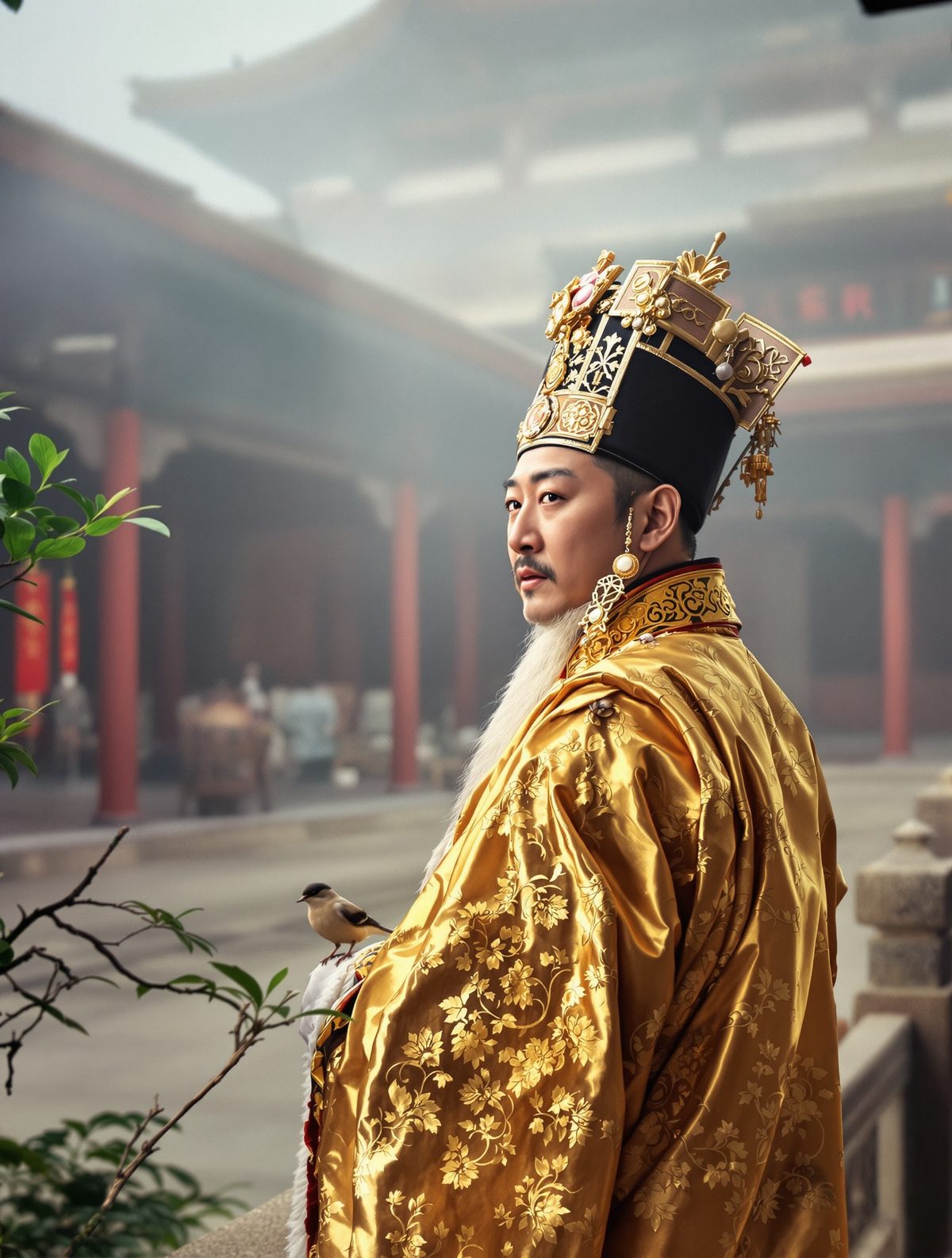
Every morning at dawn, as the first light crept across the Forbidden City's vermillion walls, the most powerful man on Earth would bolt upright in terror at the sound of a single bird's chirp. Emperor Kangxi, ruler of 1.3 billion souls and commander of the world's largest empire, would scramble from his imperial bed and flee to the gardens like a frightened child. His servants knew the routine: prepare the outdoor pavilion, bring fresh robes, and never, ever speak of what drove their mighty emperor from his palace each morning.
The culprit? One small sparrow that had made its nest outside the emperor's window. But this was no ordinary bird in Kangxi's haunted mind—it was the vengeful spirit of his murdered brother, Prince Yin'e, returned to torment the man who had seized the Dragon Throne through blood and betrayal.
The Weight of the Dragon Throne
By 1722, Emperor Kangxi had ruled China for an unprecedented 61 years, making him one of the longest-reigning monarchs in human history. His empire stretched from the frozen steppes of Siberia to the tropical islands of the South China Sea, encompassing roughly one-third of the world's population. Under his rule, China had become the wealthiest nation on Earth, its treasury overflowing with silver from global trade.
Yet for all his earthly power, Kangxi could not escape the ghosts of his past. The Manchu emperor had not inherited his throne peacefully—he had clawed his way to power through a vicious succession war that pitted brother against brother in a deadly game of imperial politics. The Qing Dynasty's succession laws were deliberately vague, allowing the emperor to choose from among his sons based on merit rather than birth order. This system, designed to ensure capable rulers, instead created a pressure cooker of ambition, paranoia, and fratricide.
Prince Yin'e had been Kangxi's most formidable rival among the imperial princes. Intelligent, charismatic, and politically savvy, he had gathered a powerful faction of supporters who believed he would make a better emperor than his brother. The two had engaged in years of careful maneuvering, each building alliances and undermining the other's position at court.
The Brother's Shadow
The breaking point came in 1708, when Kangxi discovered evidence of what he believed was a plot by Yin'e to poison him and seize the throne. Whether the plot was real or imagined remains a mystery that historians still debate, but Kangxi's reaction was swift and brutal. In the pre-dawn hours of March 15th, imperial guards stormed Yin'e's residence in the Forbidden City.
What happened next was carefully concealed from the historical record, but palace whispers spoke of a struggle in Yin'e's chambers, of muffled screams, and of a body that was never seen again. The official announcement stated that Prince Yin'e had died suddenly of a fever, but those close to the palace knew better. Kangxi had eliminated his most dangerous rival, but the victory came at a terrible psychological cost.
Almost immediately after his brother's death, Kangxi began experiencing what court physicians called "dawn terrors." He would wake each morning drenched in sweat, claiming to hear his brother's voice calling his name. The emperor, who had shown no mercy to rebels and enemies throughout his reign, found himself utterly defenseless against the phantoms of his own guilt.
The Sparrow's Arrival
The sparrow first appeared in the spring of 1720, nearly two years after Yin'e's death. Palace records, meticulously kept by the Imperial Household Department, note the curious fact that the bird arrived on the exact anniversary of the prince's demise. It was a common Eurasian tree sparrow, unremarkable in every way except for its behavior: it sang only at dawn, and only outside the emperor's window.
At first, Kangxi tried to ignore the creature. But as days turned to weeks, the bird's persistent morning songs began to unravel the emperor's already fragile mental state. He became convinced that the sparrow's chirping formed patterns—patterns that sounded remarkably like his brother's name being repeated over and over. "Yin'e... Yin'e... Yin'e..."
The emperor's personal eunuch, Liu Mingshan, later wrote in his private diary (discovered in the 1950s during renovations of the Forbidden City) that Kangxi would pace his chambers at night, muttering about "the brother-bird" and its "accusations." The most powerful man in the world had become a prisoner of his own paranoia and guilt.
Flight from the Forbidden City
By early 1722, Kangxi's dawn flights from his palace had become a carefully choreographed routine. At the first hint of the sparrow's song, imperial servants would spring into action like a well-rehearsed theater troupe. Within minutes, they would have prepared the Garden of Peaceful Longevity, a secluded pavilion surrounded by artificial hills and ornamental lakes, where the emperor would spend his mornings until the bird fell silent.
The irony was not lost on court observers: an emperor who commanded over two million soldiers and governed an empire larger than Rome at its peak was being held hostage by a creature that weighed less than an ounce. Foreign diplomats, unaware of the true reason for these morning relocations, were told that the emperor practiced "dawn meditation" in the gardens—a lie that became one of the most closely guarded secrets of the Qing court.
What made the situation even more surreal was that Kangxi's phobia was entirely selective. The Forbidden City was home to hundreds of birds, and the emperor showed no fear of any others. Only this one sparrow, with its peculiar dawn singing and its imagined connection to his dead brother, could reduce the Dragon Emperor to a trembling, fleeing figure.
The Empire's Silent Burden
While Kangxi fled from sparrows, his empire continued to function with remarkable efficiency—a testament to the administrative machine he had built over six decades of rule. Morning court sessions were quietly moved to accommodate the emperor's "garden meditations," and state business carried on as if nothing unusual was happening. The vast bureaucracy of the Chinese empire, with its thousands of officials and intricate hierarchy, adapted seamlessly to their ruler's bizarre schedule.
But the psychological toll on Kangxi was evident to those closest to him. Palace physicians noted that the emperor aged rapidly during this period, his hair turning completely white and his once-straight posture becoming stooped. He began speaking to portraits of his deceased brother, alternately apologizing and angrily defending his actions. The guilt that had been simmering beneath the surface of his consciousness had finally boiled over.
The sparrow's reign of terror lasted nearly two years, until the winter of 1722 when the bird simply disappeared—whether due to natural causes or more sinister intervention remains unknown. Kangxi died just months later, on December 20, 1722, at the age of 68. His final words, according to his personal attendant, were not about his empire or his legacy, but a whispered apology: "Brother, forgive me."
Echoes Across Time
The story of Kangxi and his sparrow reveals a profound truth about power and the human psyche that resonates even today. In our modern world of political leaders and corporate titans, we often forget that those who wield enormous influence are still fundamentally human, still vulnerable to the same fears, guilt, and psychological pressures that affect us all.
Perhaps most remarkably, Kangxi's story demonstrates how personal trauma can coexist with extraordinary public competence. Despite his private torment, he remained an effective ruler until his death, suggesting that the human capacity for compartmentalization knows no bounds—not even at the highest levels of power.
The next time you hear a bird singing at dawn, remember the Chinese emperor who ruled a third of humanity yet could not conquer the guilt in his own heart. Power, it seems, offers no protection against the phantoms we create for ourselves.