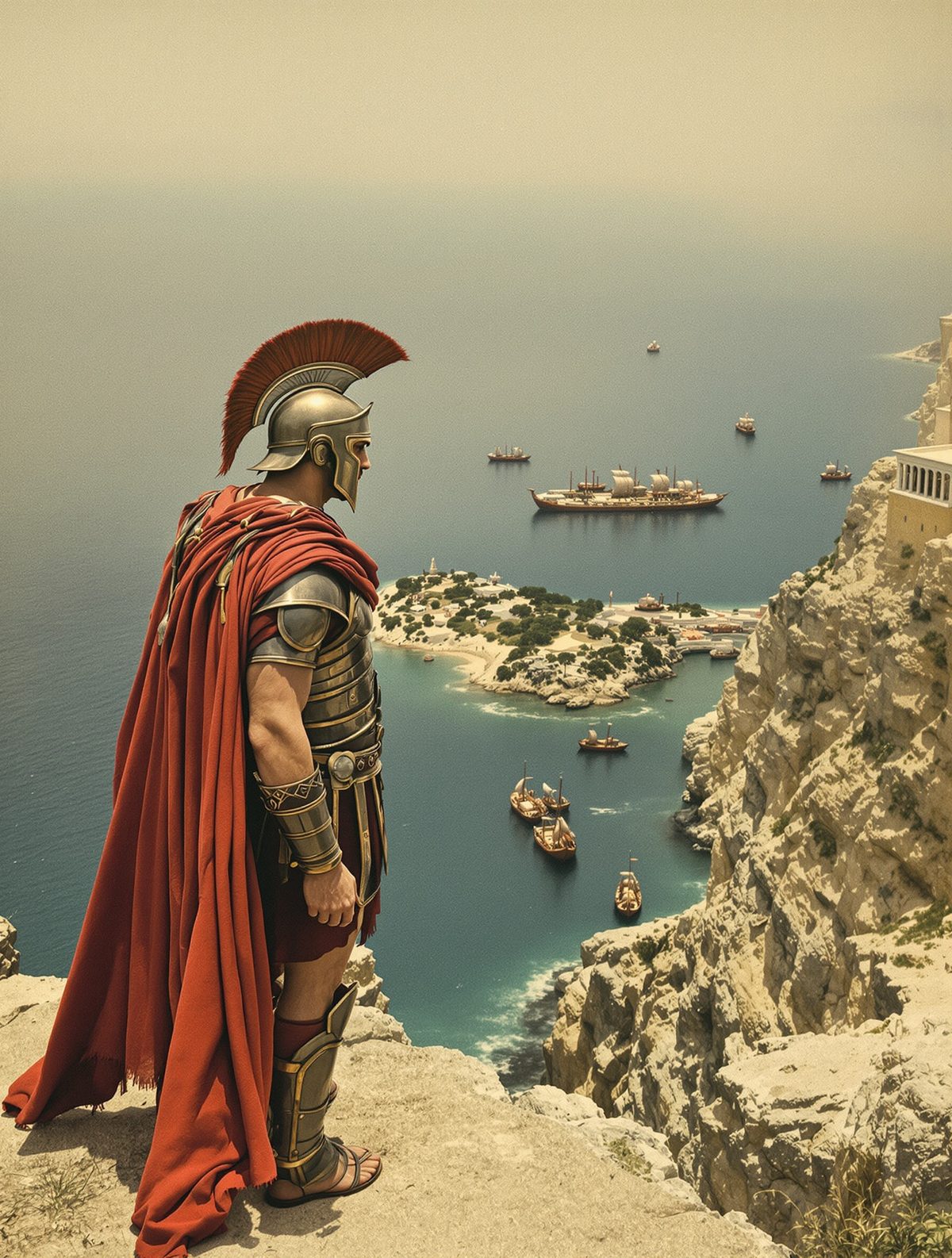
The morning sun cast long shadows across the rocky outcrop of Sphacteria as King Epitadas surveyed his dwindling forces. For weeks, the 120 elite Spartan warriors under his command had gnawed on leather straps and scraped lichen from stones to fill their bellies. Their bronze shields, once mirror-bright symbols of Spartan invincibility, now bore the dull patina of desperation. Across the narrow channel, Athenian ships bobbed like hungry vultures, their crews knowing that time was their greatest weapon.
It was 425 BC, and for the first time in three centuries of legendary warfare, a Spartan commander faced a choice that would shatter the very foundation of his people's identity: surrender or watch his men die of starvation. What happened next would send shockwaves through the ancient world and force even Sparta's enemies to question everything they thought they knew about honor, duty, and the price of survival.
The Perfect Trap: How Athens Caught Sparta's Elite
The disaster began with what should have been a routine operation. The island of Sphacteria, barely three miles long and less than half a mile wide, sat like a natural breakwater protecting the harbor of Pylos on the western coast of the Peloponnese. When an Athenian force under the brilliant general Demosthenes fortified Pylos in the spring of 425 BC, the Spartans responded with characteristic aggression.
King Epitadas led a handpicked force of 420 elite warriors—drawn from Sparta's most prestigious families—to occupy Sphacteria and cut off Athenian supply lines. These weren't ordinary soldiers; they were spartiates, full citizens of Sparta who had endured the brutal agoge training system from childhood. Many wore the red cloaks that marked them as members of the royal guard.
But Demosthenes had set a masterful trap. Athenian triremes suddenly swept into the harbor, cutting off the narrow channels that connected Sphacteria to the mainland. In a single morning, Epitadas found his force completely isolated on a barren rock with no fresh water and rapidly dwindling supplies.
The irony was delicious for Athens: Sparta, the land power that had dominated Greece for generations, was now helpless against naval superiority. The very warriors who had been sent to break an Athenian stronghold now found themselves in a prison of stone and sea.
The Sacred Code: Why Spartans Never Surrendered
To understand the magnitude of Epitadas's dilemma, one must grasp just how deeply the concept of death before dishonor was embedded in Spartan culture. Since the legendary stand of the 300 at Thermopylae in 480 BC, no Spartan force had ever surrendered in battle. Not once. Not ever.
Spartan mothers famously told their sons to "come back with your shield or on it"—meaning return victorious or die fighting, since wounded warriors were carried home on their shields. The Spartan warrior Aristodemus, who survived Thermopylae due to illness, was so ostracized upon his return that he was nicknamed "the Trembler." He ultimately died seeking redemption at the Battle of Plataea, fighting with such desperate fury that his comrades finally forgave his "cowardice."
This wasn't mere bravado. Spartan society was built on a warrior ethos that viewed surrender as a fate literally worse than death. Warriors who fled or capitulated faced social extinction—they couldn't hold public office, marry into good families, or even participate in religious festivals. Their shame extended to their children and grandchildren.
As the weeks dragged on and his men began to weaken from hunger and thirst, Epitadas faced not just military defeat but the complete destruction of everything his culture held sacred.
The Siege That Shocked the Ancient World
News of the trapped Spartans spread across Greece like wildfire. In Sparta itself, the government faced an unprecedented crisis. These weren't just any warriors—among the 420 men on Sphacteria were sons of the most powerful families in Sparta, including members of the royal houses.
The Spartan assembly, normally unshakeable in its resolve, did something that stunned the Greek world: they sent envoys to Athens begging for peace negotiations. The proud warriors who had never asked for quarter in three centuries of warfare were now pleading for their sons' lives.
The Athenian politician Cleon, sensing a once-in-a-lifetime opportunity to humiliate Sparta, rejected the peace overtures and instead launched a direct assault on Sphacteria. Athenian hoplites landed on the island's beaches while archers and javelin-throwers poured missiles down from the heights.
The fighting was brutal and desperate. Spartan warriors, weakened by weeks of starvation, still managed to inflict heavy casualties on their attackers. But sheer numbers and constant missile fire began to tell. Of the original 420 Spartans, 300 had already fallen in the fighting. Epitadas himself lay dead, struck down while leading a final charge.
Command fell to whoever was next in the chain of command, and with it, the most terrible decision in Spartan military history.
The Moment Everything Changed
Surrounded by the corpses of their comrades, the surviving 120 Spartans huddled behind makeshift stone barriers as Athenian arrows whistled overhead. They were beyond exhaustion, their bronze armor dented and bloodstained, their famous red cloaks torn and faded.
Then came the moment that would echo through history: an Athenian herald approached under a flag of truce and offered terms of surrender. The Spartans would be taken to Athens as prisoners, but their lives would be spared.
What happened next shocked even the Athenians. After a brief consultation among themselves, the surviving Spartans laid down their weapons.
The sound of bronze shields hitting stone must have seemed like the collapse of the world itself. For the first time in recorded history, Spartans had chosen captivity over death. When news reached the mainland, many Greeks simply refused to believe it. Surely this was Athenian propaganda—real Spartans would never surrender.
But it was true. The 120 survivors were transported to Athens in chains, where they became the most valuable prisoners of war in the ancient world. Their capture gave Athens tremendous leverage over Sparta, effectively holding the cream of Spartan society hostage.
The Aftermath: When Legends Become Human
The psychological impact of the surrender rippled through the Greek world like an earthquake. The Spartan myth of invincibility lay shattered. If even Spartans could surrender, what did that say about the nature of courage and honor?
In Sparta itself, the reaction was complex and surprising. Rather than disowning the prisoners as cowards, the government worked desperately to secure their release. They offered peace terms, prisoner exchanges, even tribute—anything to bring their warriors home. The same society that had ostracized Aristodemus for surviving Thermopylae now moved heaven and earth to save men who had explicitly chosen surrender.
When the prisoners were finally released in 421 BC as part of the Peace of Nicias, they faced an uncertain homecoming. Some expected disgrace and social death. Instead, they found a society grappling with new questions about the nature of heroism. Many of the survivors went on to hold high office and command troops in later battles.
Perhaps most remarkably, the surrender at Sphacteria didn't destroy Spartan military effectiveness—it humanized it. Future Spartan commanders showed greater tactical flexibility and concern for their men's lives, arguably making them more effective leaders.
Why This Moment Still Matters
The surrender at Sphacteria represents one of history's most profound moments of moral complexity. In choosing life over the rigid demands of honor culture, these 120 Spartans didn't just save themselves—they challenged an entire civilization's understanding of courage.
Their decision echoes through time in every moment when rigid ideology confronts human compassion, when survival instinct clashes with cultural expectations. Modern military ethics, with their emphasis on preserving life while maintaining honor, owe something to that desperate choice made on a rocky island 2,500 years ago.
The Spartans on Sphacteria discovered what countless warriors since have learned: sometimes the most courageous act isn't dying for an ideal, but living to question whether that ideal is worth dying for in the first place. In laying down their shields, they picked up something far more valuable—the right to choose their own definition of honor.