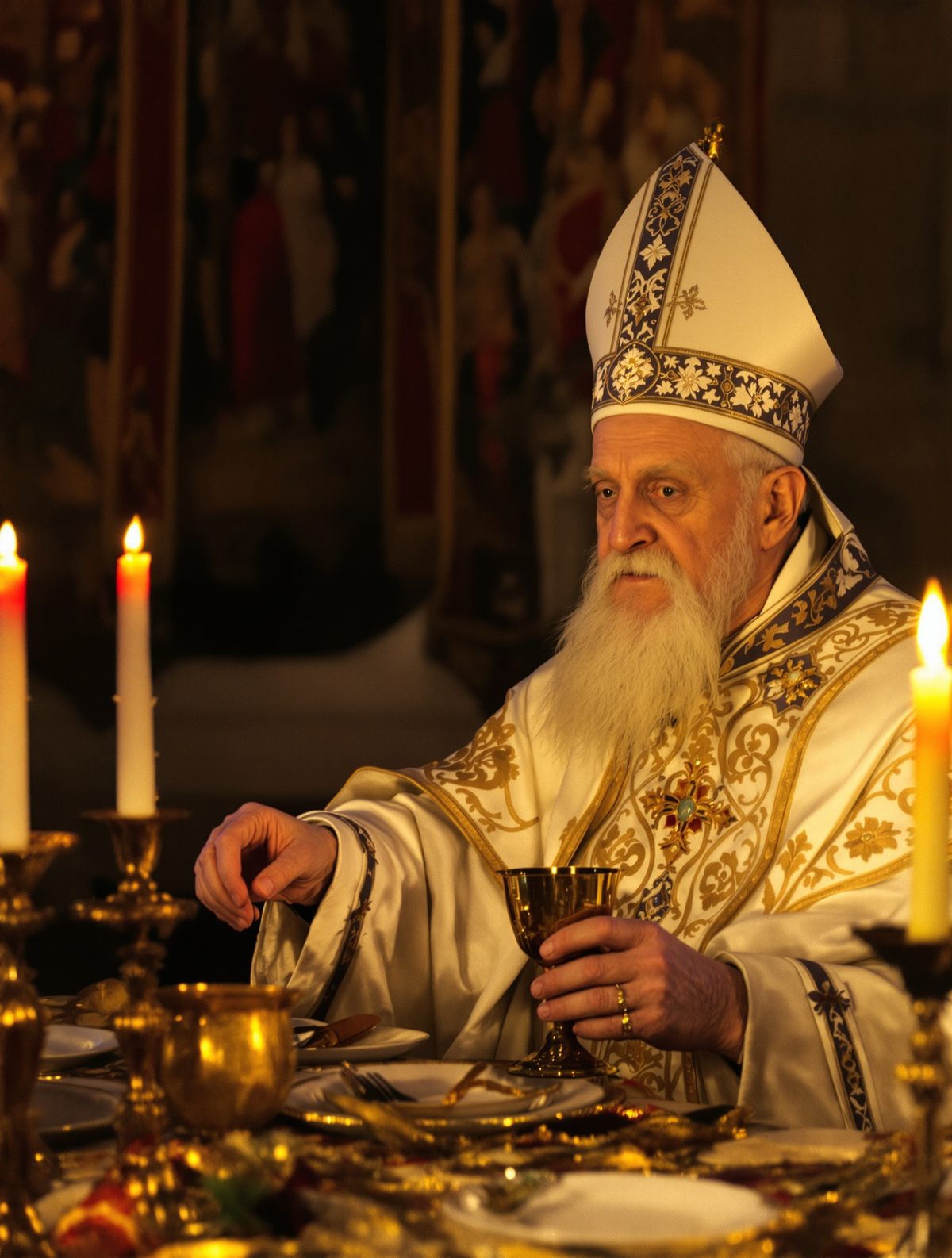
The golden chalice slipped from trembling fingers, clattering against the marble floor of the papal dining hall. Pope Urban VII, the most powerful man in Christendom, clutched his chest as waves of fever and nausea crashed over him like a violent tide. Around him, cardinals in their crimson robes froze mid-conversation, their faces pale with horror. The man who had waited 22 years for this moment—who had finally grasped the keys to heaven itself—was dying at his own coronation feast.
It was September 27th, 1590, and what should have been the pinnacle of Giovanni Battista Castagna's life was about to become one of history's cruelest ironies. In just twelve days, this brilliant theologian had gone from triumphant pope to a man gasping for breath in the Vatican's grandest hall, his papal crown feeling more like a death sentence than a divine blessing.
The Long Road to St. Peter's Throne
Giovanni Battista Castagna wasn't born to papal greatness—he earned it through decades of political maneuvering, theological brilliance, and sheer determination. Born in Rome in 1521 to a family of modest means, young Giovanni watched the Catholic Church convulse through the Protestant Reformation while dreaming of someday wielding enough power to heal Christianity's wounds.
His rise through the Vatican's labyrinthine hierarchy was nothing short of remarkable. By 1553, he had caught the eye of Pope Julius III, who dispatched him as a papal legate to Venice—a posting that would make or break his career. Venice in the 16th century was a powder keg of competing interests: wealthy merchants who chafed under papal authority, Protestant sympathizers smuggling banned books through the port, and Orthodox Christians from the East who viewed Rome with deep suspicion.
Castagna navigated these treacherous waters with the skill of a seasoned diplomat. When Protestant reformers attempted to establish a foothold in the city's universities, he countered not with the Inquisition's typical fire and sword, but with reasoned theological debates that drew crowds of curious Venetians. His approach was revolutionary for its time: convince through intellect rather than coerce through fear.
Pope Pius V took notice. In 1565, he elevated Castagna to cardinal and sent him on increasingly important missions across Europe. For the next 25 years, Cardinal Castagna became the Vatican's go-to diplomat, negotiating with kings and emperors, always with his eyes fixed on the ultimate prize: the papal throne itself.
Rome's Deadly Summer
The summer of 1590 was a nightmare that seemed ripped from the Book of Revelation. Pope Sixtus V had died in August, leaving behind a power vacuum that sent shockwaves through Catholic Europe. Cardinals rushed to Rome from across the continent, but they arrived to find a city in the grip of something far deadlier than political intrigue: malaria.
The disease, which Romans called "bad air" (mal aria), rose from the marshy areas around the Tiber River like an invisible army. The unusually hot, humid summer had created perfect breeding conditions for mosquitoes, though no one yet understood the connection between the insects and the fever that was claiming hundreds of lives each week.
The papal conclave that gathered in the Sistine Chapel was a gathering of frightened men. Cardinals who normally reveled in the political theater of papal elections now rushed through their deliberations, desperate to choose a successor and flee Rome before the mysterious illness claimed them too. Several electors had already fallen sick, and the survivors could hear the constant tolling of church bells announcing new deaths throughout the city.
On September 15th, after just one day of voting, they chose Giovanni Battista Castagna. He took the name Urban VII—a name that hadn't been used for over 200 years. At age 69, after more than two decades of patient waiting, he had finally achieved his life's ambition. But the city celebrating his elevation was also digging mass graves.
Twelve Days of Unfulfilled Dreams
Pope Urban VII's reign began with the energy of a man determined to make up for lost time. Despite the plague ravaging Rome, he immediately set to work on ambitious reforms that would have transformed the Catholic Church. His first planned decree was revolutionary: a complete ban on tobacco in churches and sacred places throughout the Papal States.
This might seem quaint today, but in 1590, tobacco was the cocaine of the Renaissance elite—an expensive, exotic luxury that Spanish conquistadors had brought back from the New World. Wealthy Romans smoked it in long pipes during Mass, creating clouds of aromatic smoke that mixed with incense. Urban VII saw this as a desecration and intended to stamp it out entirely. Had he lived to implement this decree, he would have been the first world leader to enact anti-smoking legislation—nearly 400 years before the U.S. Surgeon General's warning.
But Urban VII had grander visions than tobacco regulation. His private papers, discovered centuries later, reveal plans for a new crusade—not to reclaim Jerusalem, but to reclaim Protestant souls through education and charitable works. He wanted to establish universities in every major European city, staffed with Jesuit scholars trained in both theology and natural philosophy. His dream was to win back Protestant territories through intellectual superiority rather than military conquest.
Even as fever began to take hold of his body during his second week as pope, Urban VII continued working from his private chambers. He met with architects about expanding St. Peter's Basilica, consulted with scholars about calendar reform, and received ambassadors from Catholic monarchs across Europe. Those who saw him during these final days reported that he seemed driven by an almost supernatural energy, as if he sensed time running out.
The Feast of Death
September 27th, 1590, dawned clear and warm over Rome. Pope Urban VII had been feeling unwell for several days, but he refused to postpone his formal coronation banquet. Cardinals, foreign ambassadors, and Roman nobility had gathered in the Vatican's grandest hall, its walls adorned with Raphael's magnificent frescoes depicting the triumph of Christianity.
The feast was a spectacular display of papal power and wealth, designed to show that the Church remained strong despite the Protestant Reformation and the plague stalking Rome's streets. Servants carried in course after course of exotic delicacies: peacocks roasted and re-feathered to look alive, sugar sculptures depicting scenes from the Bible, and wines from the papal vineyards that had been aging since Urban VII was a young priest.
Contemporary accounts describe the pope as appearing weak but determined, raising his chalice to toast the future of the Catholic Church. He spoke briefly about his plans for reform, his voice growing stronger as he outlined his vision for a renewed papacy that would lead through example rather than force. The assembled dignitaries applauded, many wiping away tears of emotion.
Then, without warning, Urban VII's face went ashen. The golden chalice tumbled from his hands, sending red wine spreading across the white marble floor like blood. He tried to stand but collapsed back into his ornate chair, his breath coming in shallow gasps. Cardinals rushed to his side, but there was nothing they could do. The man who had waited 22 years to become pope was dying before their eyes, surrounded by the trappings of power he would never truly wield.
He was carried to his private chambers, where he lingered for several more hours, occasionally mumbling about his unfinished reforms. As midnight approached, Pope Urban VII—the shortest-reigning pope in history—drew his last breath. His reign had lasted exactly twelve days.
The Shortest Shadow in Papal History
Urban VII's death sent shockwaves through the Catholic world that had nothing to do with political implications and everything to do with the sheer tragedy of unfulfilled potential. Here was a man who had spent decades preparing for the papacy, who had revolutionary ideas about how to lead the Church into the 17th century, and who died before he could implement a single reform.
The cardinals, now thoroughly terrified of Rome's deadly air, elected a new pope within days and fled the city. Many of Urban VII's ambitious plans died with him, including his anti-tobacco legislation, his educational reforms, and his vision of intellectual rather than military conquest of Protestant territories. The Catholic Church would not see another reformer of his caliber for generations.
Perhaps most tragically, Urban VII's death meant that the opportunity for a more moderate, intellectual approach to the Counter-Reformation was lost. His successors would return to the more aggressive, militaristic strategies that characterized the religious wars of the early 17th century. One can only wonder how different European history might have been if this brilliant diplomat had lived to implement his vision of a kinder, gentler papacy.
Urban VII's story reminds us that history often turns on the smallest of hinges—a mosquito's bite, a cup of contaminated water, or simply the cruel timing of fate. In our age of modern medicine and extended lifespans, it's sobering to remember that even the most powerful people in history remained vulnerable to forces beyond their control. The pope who waited two decades for his moment in history got exactly twelve days to shape the world—a reminder that our time, no matter how long or short, is never guaranteed, and that our dreams must be pursued with the urgency they deserve.