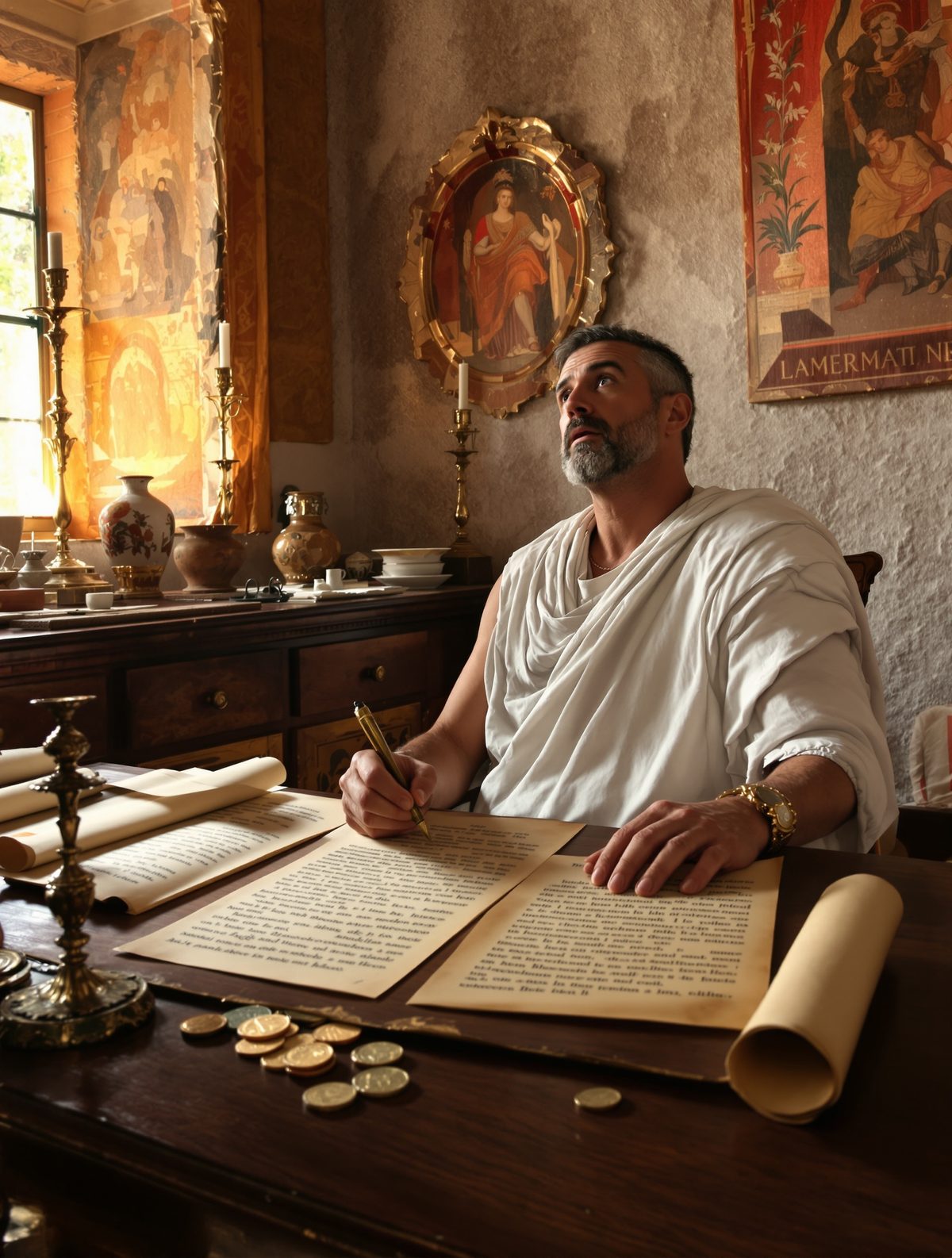
The stylus scratched against wax as Lucius Caecilius Jucundus carefully recorded the morning's first transaction: "Received from Marcus Cerrinius Euphrates, 38,079 sestertii for the auction of Capella's slaves." It was August 24th, 79 AD, and like every other morning for the past decade, this prosperous banker was meticulously updating his business records in his elegant house on Via dell'Abbondanza. The sun streamed through his atrium as he reached for another wax tablet, completely unaware that in mere hours, his ordinary Tuesday would become frozen in time for nearly two millennia.
What Jucundus couldn't know—what no one in Pompeii could know—was that Mount Vesuvius was about to explode with the force of 100,000 atomic bombs, and his hastily abandoned record-keeping would become history's most intimate window into the final hours of the Roman Empire's most famous lost city.
A Banker's Morning in the Shadow of the Mountain
Lucius Caecilius Jucundus wasn't just any businessman—he was Pompeii's most successful argentarius, a combination banker, auctioneer, and financial intermediary who handled everything from slave auctions to rent collection for the city's elite. His house, discovered in 1875 by archaeologists, sat in one of Pompeii's most desirable neighborhoods, complete with marble decorations, frescoed walls, and a private bath complex that screamed success.
On that fateful morning, Jucundus was doing what he did every day: updating his tabulae ceratae—wooden tablets covered in a thin layer of wax that could be written on with a metal stylus, then smoothed over and reused. Think of them as the ancient world's version of a reusable notepad, except these particular notepads were about to become priceless historical artifacts.
The records show he'd already processed several significant transactions before noon. There was a payment for gladiator rental fees (yes, you could rent gladiators like party entertainment), commission from a property auction that netted him 2,501 sestertii, and various loan payments from Pompeii's merchants and landowners. Business was good in the shadow of Vesuvius—the volcanic soil had made the region incredibly fertile, and Pompeii had grown wealthy on wine, olive oil, and the constant flow of trade from nearby Naples.
When the Mountain Roared
Around 1 PM, everything changed in an instant. Vesuvius, which hadn't erupted in living memory, suddenly exploded with a thunderous roar that could be heard 150 miles away in Rome. A towering column of ash and pumice shot 20 miles into the sky—higher than commercial jets fly today—creating an ominous umbrella-shaped cloud that blotted out the sun.
Imagine Jucundus's terror as his house began to shake and the sky turned black as midnight in the middle of the day. Pumice stones, some as large as baseballs, began raining down at a rate of six inches per hour. The carefully organized tablets scattered across his office floor as he grabbed whatever valuables he could carry and fled into streets filled with panicking neighbors.
Here's what makes this story remarkable: in his panic, Jucundus left behind over 150 wax tablets containing the most detailed snapshot of daily Roman commerce ever discovered. These weren't grand historical documents or literary masterpieces—they were the ancient equivalent of receipts, invoices, and accounting ledgers. And that's exactly what makes them extraordinary.
The Business Records That Time Forgot
As Pompeii disappeared under 20 feet of volcanic debris, Jucundus's abandoned tablets were sealed in a perfect time capsule. The ash and pumice created an airtight environment that preserved organic materials that would have rotted away anywhere else. When archaeologists finally uncovered his house over 1,800 years later, they found his business archive exactly as he'd left it—tablets still open to the last entries he'd been making when the mountain exploded.
What they revealed was stunning in its mundane detail. We can see that Jucundus charged a standard 2% commission on auctions, that slave prices varied wildly based on skill and appearance (a beautiful young woman might sell for 6,252 sestertii while an aging farm worker went for just 520), and that he regularly did business with some of Pompeii's most prominent families, including the Julii and the Poppaei—relatives of emperors.
One tablet records a transaction from just days before the eruption: "In the consulship of Vespasian and Titus, on the 12th day before the Kalends of Sextilis [July 21st], Jucundus received from Umbricius Antiocus 790 sestertii, the price of a mule sold at auction." Another shows rent payments for prime commercial properties along Pompeii's busiest streets, revealing that a shop in the forum district could cost 2,500 sestertii per year—roughly equivalent to $25,000 today.
Secrets Hidden in Wax
But the tablets revealed more than just prices and payments—they exposed the intricate social networks that made Roman commerce possible. Jucundus wasn't just moving money; he was the crucial middleman in a complex web of relationships between wealthy landowners, ambitious freedmen, and international traders who moved goods from Britain to Egypt.
The records show that many of his biggest clients were liberti—freed slaves who had used their savings and business acumen to become wealthy merchants and property owners. This challenges the popular image of ancient Rome as a rigid class system. In Pompeii, at least, social mobility was alive and well, and former slaves could accumulate enough wealth to buy multiple properties and dozens of their own slaves.
Perhaps most surprisingly, the tablets reveal that Jucundus regularly did business with women who owned property and conducted complex financial transactions independently. One client, Umbricia Januaria, appears in multiple records as a property owner who regularly collected rent from commercial buildings. This was centuries before women in most of the world would have such economic autonomy.
The Man Behind the Tablets
Who was Lucius Caecilius Jucundus? From his records, we can reconstruct the life of a man who probably never imagined he'd be remembered by history. He was likely the son or grandson of a freed slave—the name Caecilius suggests his family had once been owned by the prominent Caecilius family before earning their freedom. By 79 AD, he was probably in his 50s or 60s, wealthy enough to own a magnificent house and important enough that Pompeii's elite trusted him with their most sensitive financial affairs.
His bronze portrait, found in the house along with the tablets, shows a serious man with the calculating eyes of someone who spent his life evaluating risks and opportunities. He survived the great earthquake of 62 AD that damaged much of Pompeii, rebuilt his business, and prospered for another 17 years before Vesuvius ended everything.
Did Jucundus survive the eruption? We'll probably never know. His body wasn't found in the house, suggesting he at least made it out of the building. But escaping Pompeii that day required not just luck, but the wisdom to flee immediately rather than trying to wait out the disaster. Many who hesitated were trapped when the pyroclastic flows—superheated clouds of gas and rock traveling at 450 mph—swept down the mountain on the eruption's second day.
Lessons from the Ash
Two thousand years later, Jucundus's accidentally preserved business records offer us something priceless: proof that ordinary people's daily lives are just as worthy of remembering as the deeds of emperors and generals. His tablets don't tell us about military conquests or political intrigue. Instead, they reveal how regular Romans made their living, built their fortunes, and navigated the complex economic relationships that held their society together.
In our digital age, when most of our daily transactions leave only electronic traces that could vanish with the next system crash, there's something both humbling and reassuring about Jucundus's wax tablets. His analog record-keeping, preserved by one of history's greatest natural disasters, reminds us that the small details of how we live and work—the receipts we keep, the payments we make, the networks we build—are the real foundation of civilization.
The next time you're updating your own records or balancing your accounts, remember Lucius Caecilius Jucundus, frantically fleeing his collapsing world on that terrifying August afternoon. He thought he was just abandoning some old business paperwork. Instead, he was leaving us the most intimate portrait we have of what it meant to be Roman, prosperous, and utterly human in the shadow of a sleeping volcano.