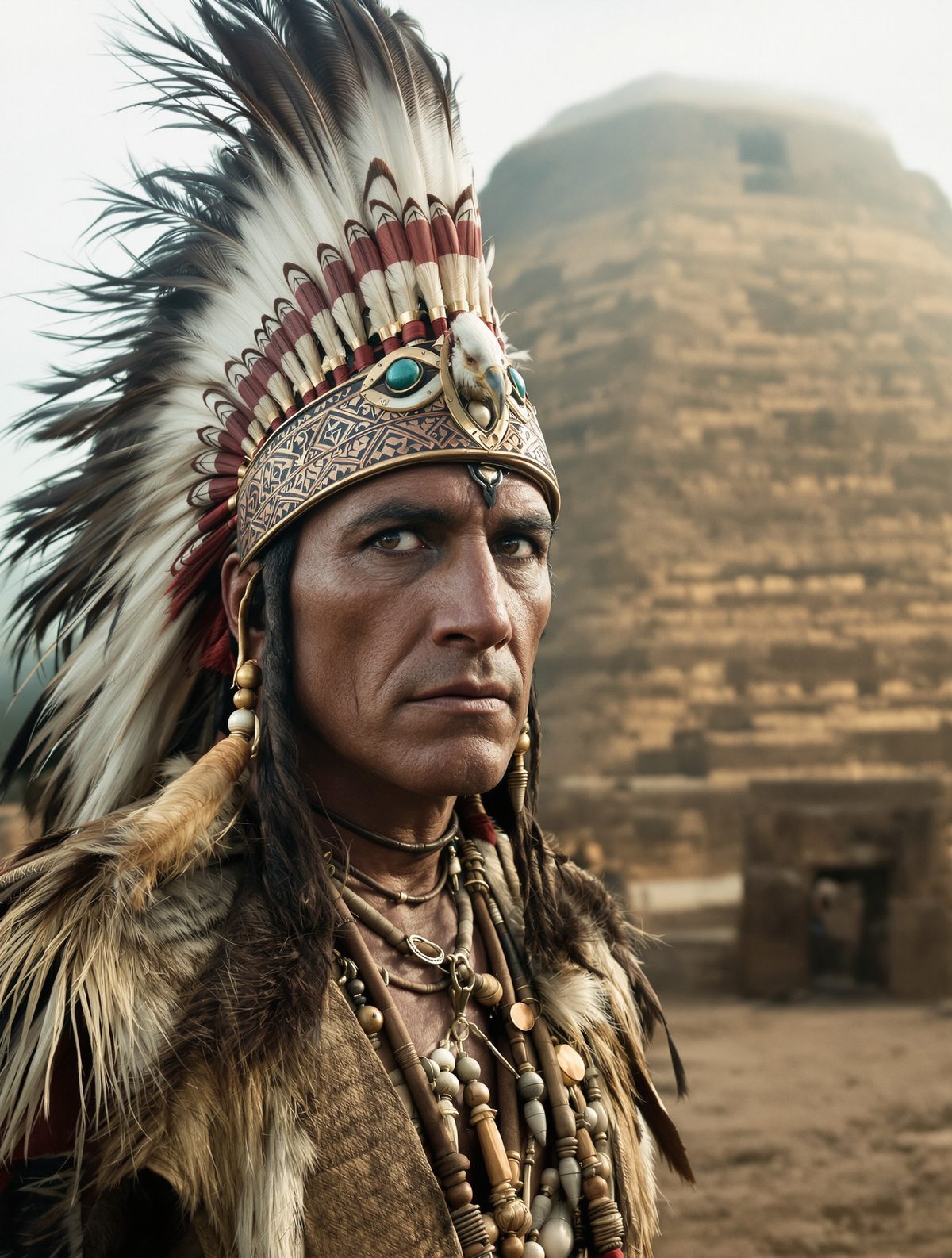
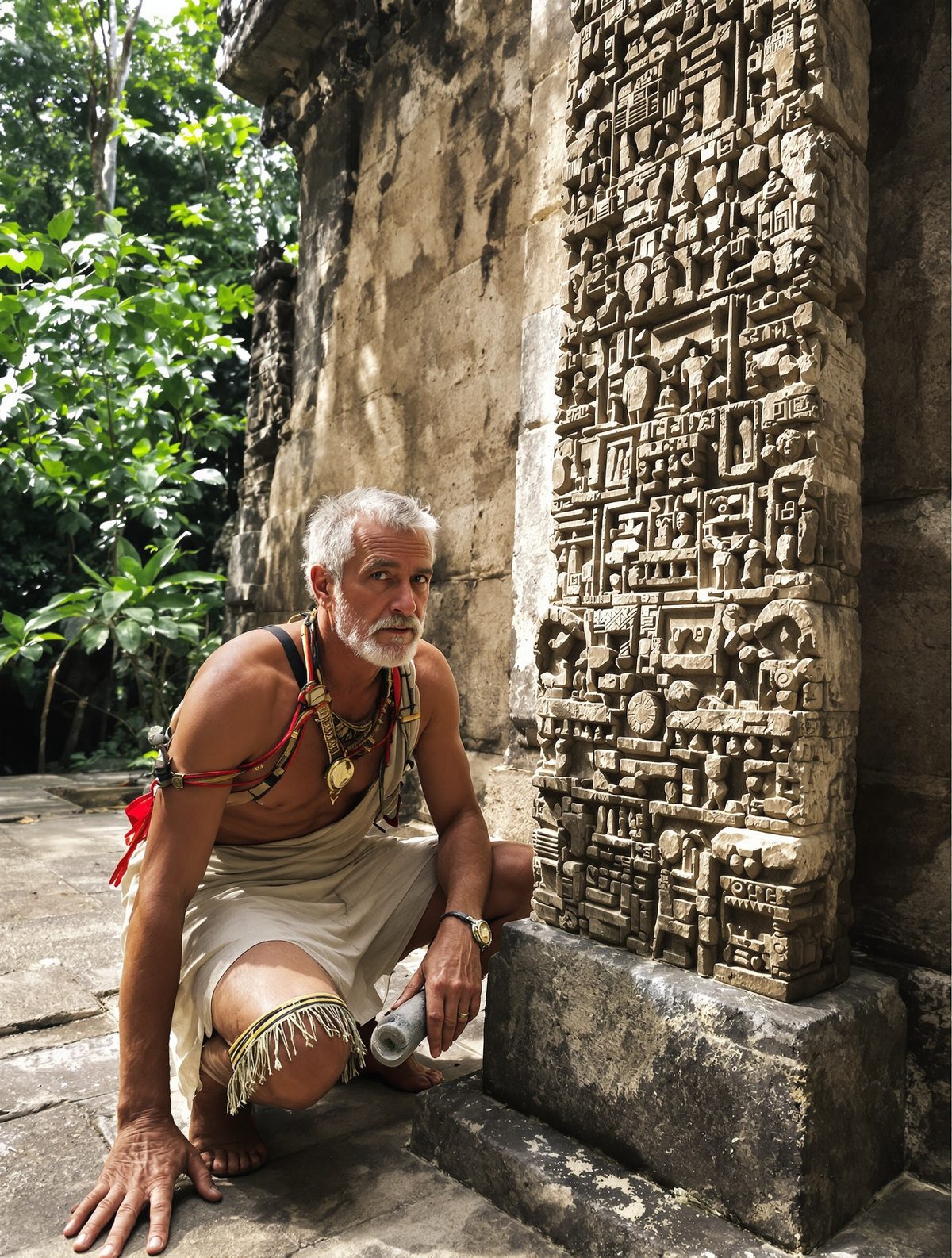
The limestone chisel trembled in Itzamnaaj's weathered hands as he carved what would become one of history's most haunting inscriptions. Deep in the jungle temple of Yaxchilan, surrounded by the humid whispers of the Usumacinta River, this master scribe was putting the finishing touches on a series of sacred hieroglyphs when he suddenly stopped. The royal proclamations were complete, the ritual dates properly recorded, but something compelled him to add one final, chilling detail: the exact date of his own death, just three days away.
What happened next would puzzle archaeologists for over a millennium and challenge everything we think we know about ancient Maya prophecy, astronomy, and the mysterious connection between knowledge and fate.
The Master of Sacred Words
In the year 830 AD, as Europe stumbled through its Dark Ages and the Tang Dynasty flourished in distant China, the Maya civilization was reaching breathtaking heights of intellectual achievement. At the heart of this golden age were the scribes—revered priest-scholars who wielded brushes and chisels like modern scientists wield computers, unlocking the secrets of time itself.
Itzamnaaj was no ordinary scribe. Archaeological evidence suggests he held the prestigious title of aj tz'ib, literally "he of the writing," a position that placed him among the Maya elite. His name, meaning "House of the Wizard," hints at his elevated status in Yaxchilan's complex hierarchy. This wasn't simply a man who could read and write—this was a keeper of cosmic knowledge, trained in mathematics so sophisticated that Maya calendars remain more accurate than our modern Gregorian system.
The temple where Itzamnaaj worked, designated Structure 33 by modern archaeologists, wasn't just any building. Rising 60 feet above the jungle floor, this limestone pyramid served as both astronomical observatory and sacred repository of Maya wisdom. Its walls were covered in intricate hieroglyphs that recorded everything from royal bloodlines to precise planetary movements—a combination of historical record and cosmic textbook that only master scribes could fully comprehend.
The Day Death Spoke Through Stone
On what our calendar marks as February 14th, 830 AD, something extraordinary occurred in the dim chambers of Structure 33. Itzamnaaj had been commissioned to complete a series of hieroglyphic inscriptions celebrating the military victories of Bird Jaguar IV, Yaxchilan's powerful ruler. These weren't mere decorations—they were sacred texts that would preserve the king's deeds for eternity, written in a script so complex that each glyph could represent sounds, concepts, or entire ideas.
But as Itzamnaaj worked by flickering torchlight, his limestone tools suddenly began carving something unplanned. According to the surviving inscription, now catalogued as Yaxchilan Lintel 25 Fragment C, he added a haunting personal note among the royal proclamations: "In three days, when the sun reaches its highest point, Itzamnaaj will join the ancestors in Xibalba."
Xibalba—the Maya underworld, a shadowy realm of trials and transformation that every soul must eventually enter. Why would a master scribe, at the height of his powers and apparently in good health, suddenly prophesy his own demise with such chilling precision?
When Prophecy Became Reality
Three days later, exactly as the inscription predicted, Itzamnaaj was found dead in the temple courtyard. Contemporary glyphs describe temple attendants discovering his body at midday—the precise moment of solar zenith that he had carved into stone just 72 hours earlier. There were no signs of violence, no evidence of illness, no indication of suicide. The great scribe had simply... stopped.
What makes this case even more remarkable is the precision involved. The Maya measured time with obsessive accuracy, dividing their calendar into interlocking cycles that tracked everything from 20-day months to cosmic ages spanning thousands of years. For Itzamnaaj to predict not just his death date but the exact moment—solar zenith on the third day—suggests either supernatural foresight or knowledge so profound it bordered on the mystical.
Temple records, painstakingly translated by modern epigraphers, reveal that Itzamnaaj's death sent shockwaves through Yaxchilan's elite. Here was their most learned scribe, a man who could calculate eclipses decades in advance and decode the movements of Venus, who had somehow seen his own fate written in the cosmic patterns he studied so intensely.
The Science Behind the Supernatural
Modern researchers have proposed several fascinating theories to explain Itzamnaaj's uncanny accuracy. The most compelling involves the Maya understanding of what we now call biorhythms—natural cycles that govern human physiology. Recent studies of Maya medical texts reveal a sophisticated understanding of how celestial movements influence everything from blood flow to mental states.
Dr. Martha Macri, a leading Maya epigrapher at UC Davis, suggests that elite scribes like Itzamnaaj may have possessed medical knowledge so advanced they could literally calculate their own biological endpoints. "These weren't primitive fortune tellers," she explains. "They were the world's first biostatisticians, tracking correlations between astronomical cycles and human health with mathematical precision that we're only now beginning to appreciate."
Consider the evidence: Maya healers recorded over 3,000 medicinal plants and their effects, tracked the relationship between lunar cycles and surgical outcomes, and developed diagnostic techniques based on astronomical observations. If Itzamnaaj had detected signs of an impending heart attack or stroke through methods we don't fully understand, he might have been able to calculate its timing using the same mathematical principles he applied to predicting eclipses.
Alternatively, some researchers propose a darker possibility—that Itzamnaaj's prediction was actually a form of ancient Maya ritual suicide, timed to coincide with cosmically significant moments. Evidence from other sites suggests that elite Maya sometimes chose their own death dates to ensure proper alignment with favorable astronomical conditions for their journey to the afterlife.
The Stone That Defied Time
Today, more than 1,200 years later, Itzamnaaj's final inscription remains clearly visible on the limestone walls of Structure 33. The harsh jungle climate that has eroded countless other monuments somehow spared this particular carving, as if the stone itself recognized the importance of preserving this impossible prophecy.
Visitors to Yaxchilan—now a remote archaeological site accessible only by boat through the Lacandon Jungle—can still trace their fingers over the hieroglyphs that Itzamnaaj carved in his final days. The inscription stands as a testament not just to one man's extraordinary prediction, but to the sophisticated understanding of time, fate, and human mortality that the Maya achieved centuries before European civilization emerged from its medieval darkness.
Recent laser scanning has revealed even more intriguing details. The glyphs recording Itzamnaaj's death prediction show microscopic variations in carving depth and style compared to his earlier work, suggesting they were created in a heightened emotional or spiritual state. Some researchers interpret these variations as evidence of divine inspiration or supernatural influence—the physical manifestation of a man receiving visions from beyond the mortal realm.
Echoes Across Eternity
Itzamnaaj's story forces us to confront uncomfortable questions about the nature of knowledge, consciousness, and human potential. In our age of advanced medicine and scientific materialism, we tend to dismiss ancient accounts of prophecy and supernatural insight as primitive superstition. But what if cultures like the Maya had discovered aspects of reality that our modern worldview blinds us to?
The implications extend far beyond archaeology. If human consciousness can somehow perceive future events—whether through advanced pattern recognition, sensitivity to biological cycles, or mechanisms we don't yet understand—what does that mean for our concepts of free will, determinism, and the nature of time itself? Itzamnaaj's limestone prophecy suggests that the boundary between knowledge and prescience may be far more permeable than we assume.
Perhaps most remarkably, his story reminds us that individual human lives, no matter how distant in time or culture, can still speak to us across the centuries with startling immediacy. In carving his own death date into stone, Itzamnaaj created something unprecedented in human history—a time capsule of mortality that transforms an anonymous ancient scribe into one of the most mysterious figures in the archaeological record.
Every time we stand before those weathered hieroglyphs in the Yaxchilan jungle, we're witnessing the exact moment when a brilliant human mind confronted its own ending with mathematical precision. It's a reminder that death, the great universal constant, can sometimes reveal itself to those with eyes trained to see the hidden patterns that govern all existence.