The morning mist clung to the stone walls of Sacsayhuamán fortress like tears on an ancient face. Princess Chuya Occllo stood at the precipice, her royal robes whipping in the Andean wind, while below her the Spanish commander Diego López de Zúñiga shouted promises and threats in equal measure. In her hands, she clutched the golden sun disc that had adorned her father's temple—the last symbol of an empire that had ruled from Ecuador to Chile. Behind her lay captivity and forced marriage to her conquerors. Before her, only the sacred stones of her ancestors and a drop that would echo through history.
What happened next in that October dawn of 1533 would not just seal the fate of one defiant princess—it would ignite the most brutal and desperate rebellion the Spanish would face in their conquest of the Americas.
The Last Jewel of Tahuantinsuyu
To understand the magnitude of Princess Chuya Occllo's choice, you must first grasp what she represented. She wasn't merely royal blood in a conquered land—she was the última ñusta, the final princess of Tahuantinsuyu, as the Incas called their empire. Born around 1510, she was the daughter of Huáscar, the legitimate heir to Huayna Cápac's throne, who had been murdered by his half-brother Atahualpa's forces just months before the Spanish arrival.
But here's what most history books won't tell you: Chuya Occllo was never supposed to survive the civil war that tore the Inca Empire apart. Atahualpa's generals had ordered the execution of all of Huáscar's family—men, women, and children—to prevent future claims to the throne. The princess escaped death only because her loyal servants smuggled her out of Cusco disguised as a common aclla (chosen woman) bound for the sacred convent of Machu Picchu.
When Francisco Pizarro's men captured Cusco on November 15, 1533, they found more than gold and silver in the temples. Hidden in the Qorikancha—the Temple of the Sun—they discovered the princess, now twenty-three years old, tending to the sacred fires that had burned continuously for over a century. The Spanish soldiers, many of whom had never seen such refined beauty and bearing, immediately recognized her noble status from the fine vicuña wool of her garments and the golden topu pins that secured her anacu dress.
A Marriage of Conquest
Diego López de Zúñiga was not your typical conquistador. Born to minor nobility in Extremadura, he had distinguished himself in the siege of Cusco not just through martial prowess but through his understanding of Inca customs and his ability to speak rudimentary Quechua. More calculating than his contemporaries, he immediately saw the political goldmine that Princess Chuya Occllo represented.
Marriage to the last Inca princess would legitimize Spanish rule in a way that mere force of arms never could. In indigenous Andean tradition, authority passed through both paternal and maternal lines, and any children born of such a union could theoretically claim dominion over the scattered Inca peoples. López de Zúñiga had studied the successful example of Hernán Cortés, who had leveraged his relationship with the indigenous translator Malinche to solidify his position in Mexico.
But Chuya Occllo was no Malinche. Raised in the most sacred traditions of the Inca court, she viewed marriage as a religious ceremony that bound not just individuals but entire ayllu (family groups) and their ancestral spirits. To marry López de Zúñiga would be to betray every huaca (sacred place) in the empire and condemn her soul to wander without rest in the afterlife.
The Spanish commander initially tried persuasion, offering her protection for her surviving relatives and promising to build her a palace in the Spanish style. When that failed, he resorted to threats. Historical chronicles record that he gave her three days to consider his proposal, keeping her under guard in the fortress of Sacsayhuamán—ironically, the same stronghold where Inca warriors had made their desperate last stand against Spanish forces just months earlier.
The Leap That Shook an Empire
What transpired on the morning of October 18, 1533, depends largely on which chronicle you read. Spanish accounts, understandably, tend to minimize the event or paint the princess as tragically misguided. But indigenous oral histories, carefully preserved and passed down through generations, tell a different story entirely.
According to the secret chronicles kept by Inca priests and later transcribed by indigenous historians like Titu Cusi Yupanqui, Chuya Occllo spent her final night in prayer to Inti, the sun god, and Mama Quilla, the moon goddess. She performed the sacred ritual of ayni—reciprocity with the divine—offering her own blood to the stone altars of Sacsayhuamán.
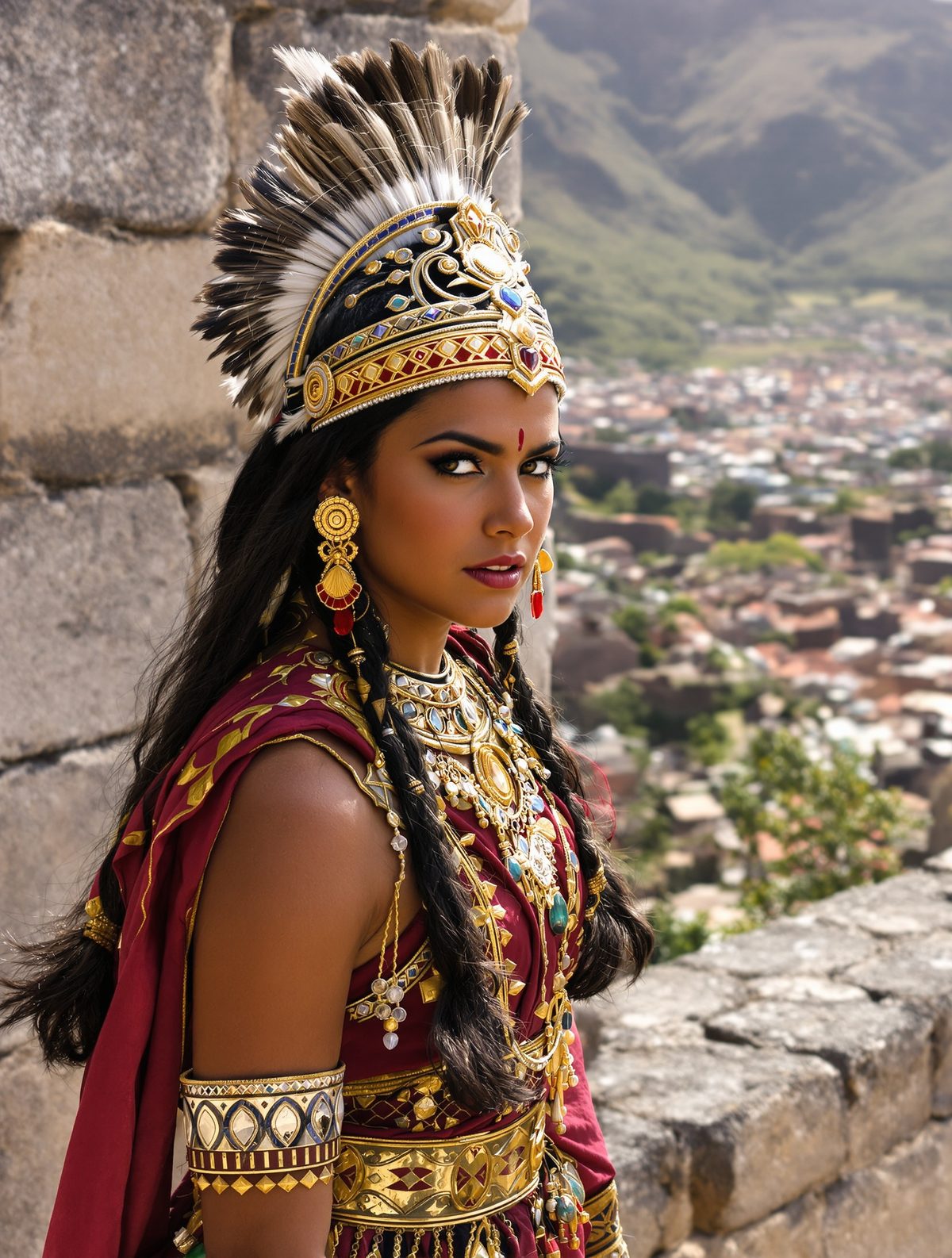
As dawn broke over the Andes, López de Zúñiga arrived with a Spanish priest and several witnesses, expecting to perform the marriage ceremony. Instead, he found the princess standing at the highest point of the fortress walls, some 100 feet above the rocks below. Contemporary accounts describe her as radiant, having painted her face with the sacred achote pigment and adorned herself with the few royal ornaments that hadn't been melted down by Spanish goldsmiths.
In fluent Spanish—a skill that surprised her captors—she delivered what witnesses called a speech "so eloquent it would have moved stones to weep." She denounced the Spanish as destroyers of the natural order, condemned their god as a deity of greed and violence, and proclaimed that her death would awaken the sleeping power of the mountains themselves.
Then, clutching the golden sun disc to her chest, Princess Chuya Occllo stepped into empty air.
The Fury of the Mountains
If López de Zúñiga thought the princess's death would end the matter quietly, he was catastrophically wrong. Within hours, drums began echoing across the Andes—not the celebration drums of Inca festivals, but the deep, thunderous war drums that hadn't been heard since the civil war between Huáscar and Atahualpa.
Here's the remarkable part that most histories gloss over: the news of Chuya Occllo's death traveled over 500 miles through the Inca road system in less than three days. The chasqui messenger runners, who the Spanish thought they had subdued, revealed a communication network that was not only intact but actively coordinating resistance across the entire former empire.
The rebellion that erupted was unlike anything the Spanish had faced. This wasn't the organized warfare of European battlefields or even the guerrilla tactics they'd encountered in Mexico. This was warfare waged by the landscape itself. Inca forces, led by the princess's cousin Manco Inca, didn't just attack Spanish garrisons—they systematically dismantled the infrastructure that supported Spanish occupation.
Bridges across mountain gorges vanished overnight. The carefully maintained Inca roads that had allowed Spanish forces to move rapidly through the empire were blocked by landslides that seemed to occur with supernatural timing. Most unnervingly for the conquistadors, their indigenous allies began deserting en masse, often taking crucial supplies and intelligence with them.
The siege of Lima in 1536, which nearly drove the Spanish from Peru entirely, was planned in caves beneath Cusco where Inca priests kept mummies of ancient emperors and told stories of the princess who had chosen death over dishonor. Spanish chronicler Pedro Cieza de León wrote that captured rebels often claimed they fought not for Manco Inca, but to avenge "la princesa que voló con el sol"—the princess who flew with the sun.
The Princess Who Became a Mountain
The most fascinating aspect of Chuya Occllo's story isn't what happened during her lifetime, but how her death transformed her into something far more powerful than any living princess could ever be. In Andean cosmology, dramatic deaths—especially those involving high places and religious devotion—could transform individuals into apu, protective mountain spirits.
Within a generation of her death, indigenous communities throughout Peru had begun incorporating Princess Chuya Occllo into their sacred geography. The peak of Sacsayhuamán, where she made her final stand, became known as Ñusta Phuyu (Princess Cloud), and pilgrimages to the site continued secretly throughout the colonial period.
Spanish colonial authorities, recognizing the subversive power of her legend, attempted to suppress her memory entirely. Colonial records show repeated attempts to ban indigenous ceremonies at Sacsayhuamán and to destroy oral traditions that preserved her story. In 1572, Viceroy Francisco de Toledo ordered that any mention of the "rebel princess" be punished as heresy against the Spanish Crown and the Catholic Church.
But here's what makes her story truly remarkable: the more Spanish authorities tried to erase Chuya Occllo from history, the more deeply indigenous communities embedded her memory in their landscape and culture. Her story became woven into farming songs, healing ceremonies, and coming-of-age rituals. Even today, Quechua speakers in remote Andean villages can recite poems about the princess who "married the wind rather than the invaders."
The Echo of Defiance
Why does the story of Princess Chuya Occllo matter today, nearly five centuries after her death? In our age of cultural erasure and corporate conquest, her choice speaks to something fundamental about human dignity and the power of individual resistance against seemingly insurmountable odds.
The princess understood something that modern psychology is only beginning to recognize: that some forms of defeat are actually victories, and some deaths are more powerful than any life of compromise could ever be. Her leap from Sacsayhuamán wasn't an act of despair—it was a strategic decision that transformed her from a political pawn into an eternal symbol of resistance.
In contemporary Peru, indigenous rights activists often invoke her memory when fighting against mining companies that threaten sacred sites or government policies that ignore indigenous voices. Her story reminds us that cultural survival isn't just about preserving languages or traditions—it's about maintaining the fierce inner dignity that refuses to be commodified or conquered.
Perhaps most importantly, Princess Chuya Occllo's story challenges our comfortable narratives about historical inevitability. The Spanish conquest of the Americas wasn't the smooth, predetermined process that many textbooks suggest. It was contested at every step by individuals who chose to resist even when resistance seemed futile. Their choices, like hers, continue to echo through time, reminding us that the most powerful empires are still vulnerable to the simple, devastating power of someone who refuses to surrender their soul.