Deep beneath the rolling hills of southern Illinois, archaeologists working in the summer of 1967 made a discovery so extraordinary that it challenged everything they thought they knew about ancient America. As they carefully brushed away centuries of dirt from what would become known as Mound 72, they uncovered something that defied explanation: the remains of 272 people arranged in the unmistakable shape of a massive falcon, wings spread wide across the burial chamber. At the center lay a figure archaeologists would later call "Chief Birdman" – a ruler who had orchestrated the most dramatic mass sacrifice in North American history.
The Forgotten Metropolis of Ancient America
A thousand years ago, while medieval Europe struggled through the Dark Ages, the largest city in North America thrived along the Mississippi River. Cahokia, located near present-day St. Louis, was home to nearly 20,000 people at its peak around 1050 AD – making it larger than London at the time. This wasn't some primitive village of tepees and campfires. Cahokia was a sophisticated urban center with a complex social hierarchy, advanced agricultural systems, and monumental architecture that rivaled anything being built in Europe.
The city sprawled across six square miles, dominated by more than 120 earthen mounds that served as foundations for temples, elite residences, and burial sites. The largest of these, Monks Mound, rose 100 feet into the sky and covered 14 acres at its base – larger than the Great Pyramid of Giza. From its summit, the paramount chief could survey a bustling metropolis of thatched-roof houses, ceremonial plazas, and wooden palisades that protected the city's core.
The people of Cahokia weren't just impressive builders – they were master traders whose influence stretched from the Great Lakes to the Gulf of Mexico. Archaeological evidence reveals shells from Florida, copper from Minnesota, and mica from the Appalachian Mountains, all flowing through Cahokia's markets. They had developed their own writing system, sophisticated astronomical observations, and even primitive forms of urban planning with residential districts organized by social class.
The Rise of Chief Birdman
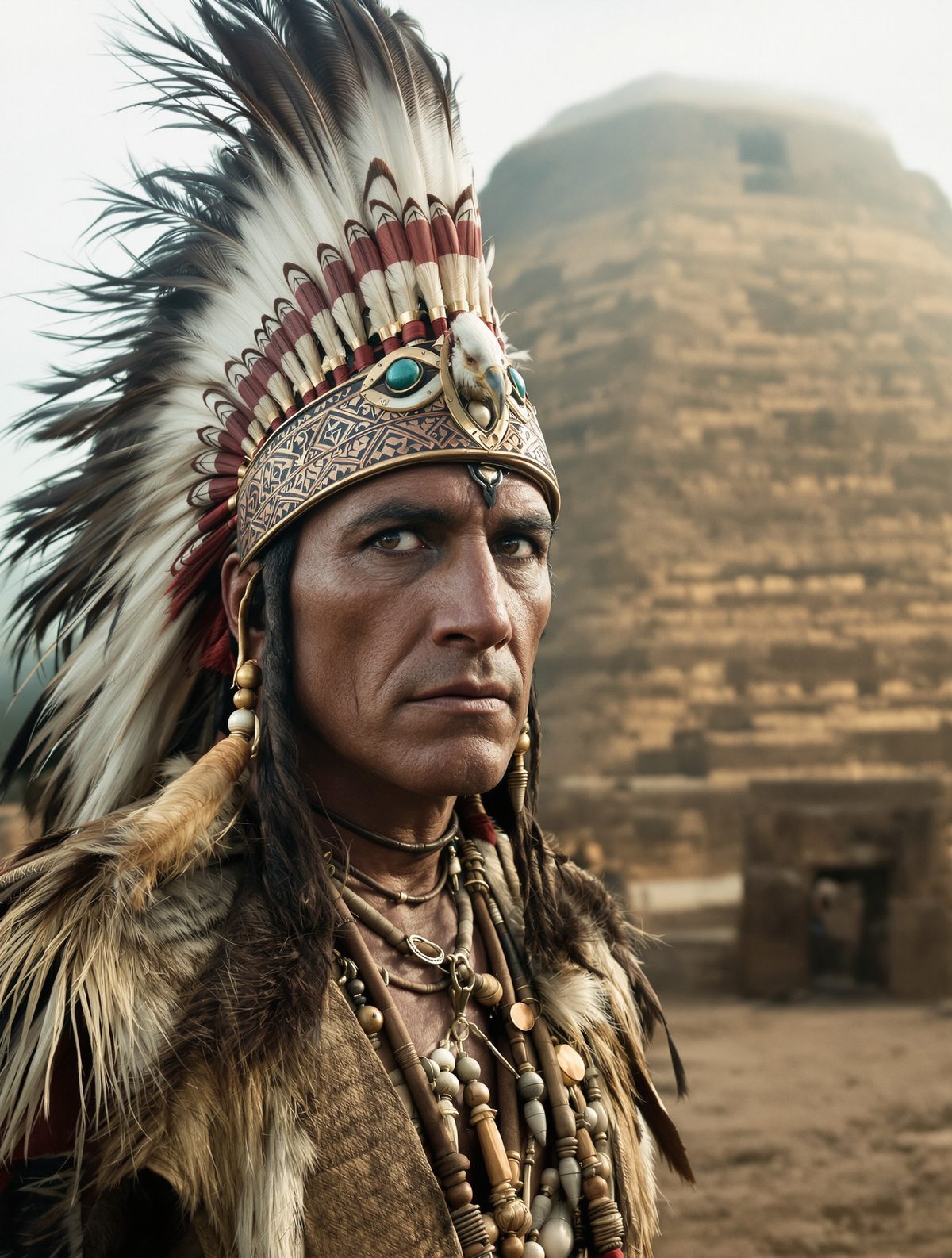
In this remarkable civilization, one man rose to unprecedented power around 1040 AD. History knows him only by the name archaeologists gave him: Chief Birdman, named for the falcon imagery that dominated his burial and appears to have been central to his identity and rule. Unlike the more egalitarian leadership structures of earlier periods, Chief Birdman wielded absolute authority over Cahokia and its satellite communities.
Evidence suggests he wasn't just a political leader but also served as the city's high priest, embodying the connection between the earthly realm and the spirit world. The falcon, his totemic animal, was sacred to Cahokian religion – a powerful hunter that soared between earth and sky, making it the perfect symbol for a ruler who claimed divine authority.
Under Chief Birdman's rule, Cahokia reached its zenith. The city's population swelled as people from across the Midwest migrated to this urban center, drawn by its prosperity and the chief's promise of protection and prosperity. Archaeological evidence suggests that during his reign, Cahokia controlled trade routes spanning over 1,000 miles and collected tribute from dozens of smaller settlements.
When Death Came to Paradise
But even the mightiest civilizations are vulnerable to forces beyond human control. Around 1048 AD, disaster struck Cahokia in the form of what archaeologists believe was a devastating epidemic. While we can't identify the specific disease after a millennium, the evidence of its impact is unmistakable. Hastily dug burial pits from this period show a mortality rate that suggests a catastrophic plague swept through the city.
Tree ring data from the period indicates that the epidemic coincided with several years of crop failures caused by flooding and drought. Food stores dwindled, trade networks collapsed as neighboring settlements also succumbed to disease, and the once-mighty city found itself facing an existential crisis. The situation grew so desperate that some districts of Cahokia were simply abandoned as survivors fled to less populated areas.
For Chief Birdman, this catastrophe represented more than just a public health crisis – it was a spiritual catastrophe that threatened the very foundation of his divine authority. In Cahokian belief, the paramount chief was responsible for maintaining the balance between the physical and spiritual worlds. The plague wasn't just bad luck; it was evidence that the spirits were angry, and only the most dramatic action could restore harmony.
The Ultimate Sacrifice
What Chief Birdman decided to do next would be considered unthinkable by modern standards, but in the context of Cahokian religious beliefs, it represented the ultimate act of leadership and spiritual responsibility. According to the archaeological evidence, he made the decision to sacrifice himself and his closest followers in a massive ritual designed to appease the spirits and save his people.
The logistics alone of what happened next are staggering. 270 people – men, women, and even children – willingly joined their chief in this final ceremony. These weren't prisoners of war or slaves, but members of Cahokia's elite who chose to follow their leader into death. Archaeological analysis of their remains shows they were well-fed and healthy, suggesting they were among the city's upper class rather than expendable members of society.
The burial site itself reveals the incredible planning that went into this event. The participants were arranged in the precise shape of a falcon with a wingspan of nearly 72 feet. Chief Birdman lay at the center, surrounded by his closest advisors and family members. The outer "wings" of the formation consisted of younger followers, their bodies positioned to create the perfect outline of the sacred bird.
Evidence suggests that most of the participants died by drinking a poison made from water hemlock, a plant that grows abundantly in the Mississippi River valley. They would have lost consciousness within minutes and died peacefully – a mercy that speaks to the careful planning of this extraordinary event.
The Falcon's Final Flight
After the mass sacrifice, Chief Birdman and his 270 followers were carefully buried beneath tons of earth and sand in what became Mound 72. But the story doesn't end there. Archaeological evidence suggests that the ritual may have achieved its intended purpose – at least temporarily. The epidemic appears to have subsided shortly after the burial, and Cahokia experienced a brief resurgence under new leadership.
However, the sacrifice of so many elite members of society may have fatally weakened the city's governing structure. Within a generation, Cahokia began its final decline, and by 1200 AD, the once-great metropolis was largely abandoned. The survivors scattered across the Midwest, eventually becoming ancestors of various Native American tribes including the Osage, Omaha, and Ponca peoples.
The discovery of Mound 72 in 1967 revolutionized our understanding of pre-Columbian North America. For decades, archaeologists had assumed that complex, hierarchical societies didn't exist north of Mexico before European contact. The falcon burial proved that ancient America was far more sophisticated and dramatic than anyone had imagined.
Echoes Across Time
The story of Chief Birdman and his 270 followers challenges our assumptions about leadership, sacrifice, and the lengths to which people will go to save their communities. In an age when we face our own existential challenges – from pandemics to climate change – there's something both inspiring and terrifying about a leader willing to make the ultimate sacrifice for his people.
More importantly, this discovery reminds us that the history of the Americas didn't begin with European colonization. For thousands of years before Columbus, sophisticated civilizations rose and fell across this continent, leaving behind stories as dramatic and complex as anything from ancient Egypt or Rome. Chief Birdman's sacrifice represents just one chapter in a vast, largely untold story of human achievement, tragedy, and resilience that played out beneath the prairie grass of the American heartland.
Today, visitors to Cahokia can climb Monks Mound and look out over the Mississippi River valley, imagining the bustling city that once thrived here. But the most profound monument to this lost civilization lies buried beneath Mound 72, where a chief and his people chose to face eternity together, their bodies forever arranged in the shape of a falcon taking flight toward the spirit world.