
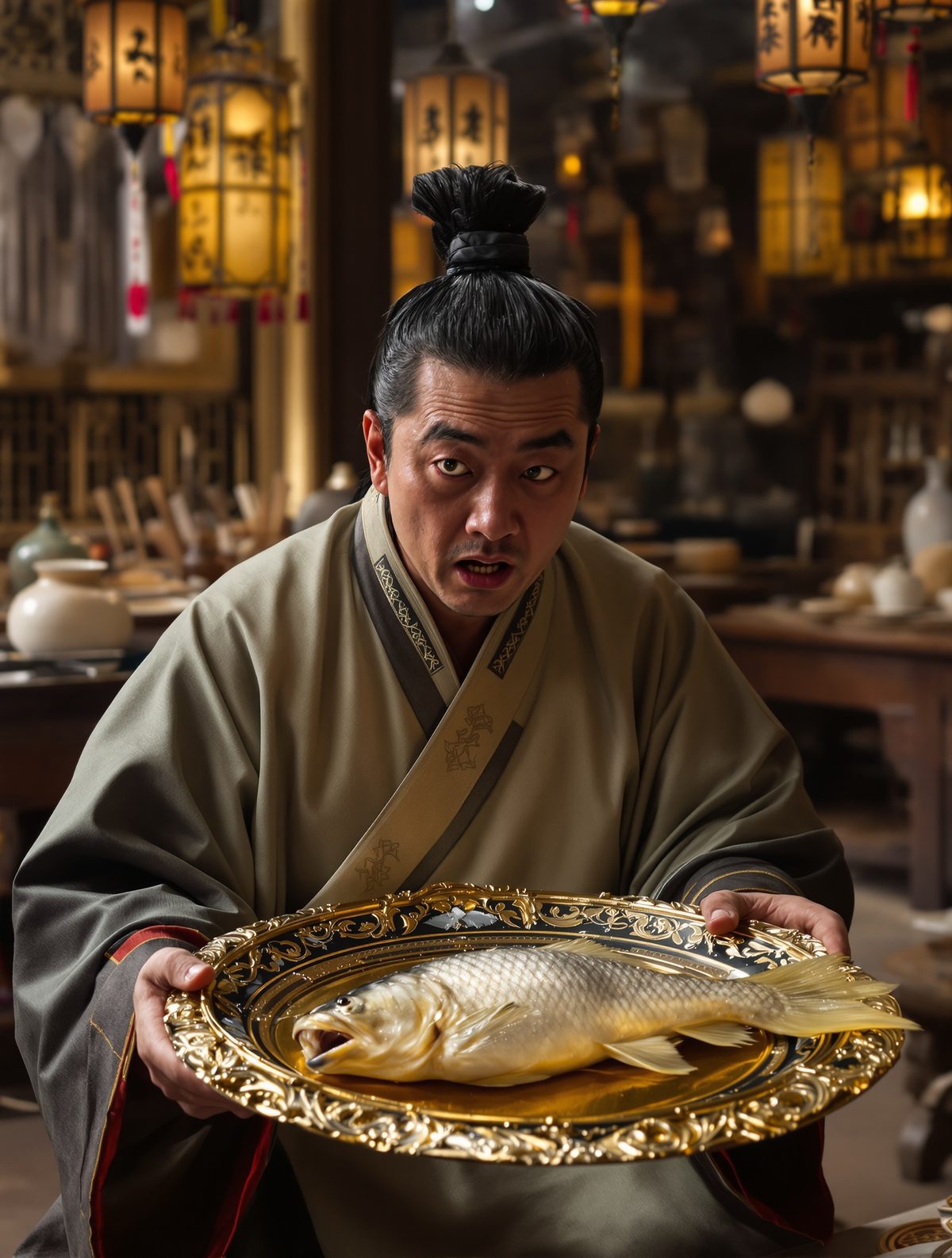
The silver chopsticks trembled in the emperor's hand as he lifted the delicate morsel of carp to his lips. It was the autumn of 1387, and in the opulent dining hall of the newly constructed Imperial Palace in Nanjing, Emperor Hongwu was about to taste what would become the most expensive fish in Chinese history. As the founder of the Ming Dynasty examined his meal with the intensity of a jeweler appraising diamonds, a single, translucent scale—no larger than a child's fingernail—caught the flickering candlelight. In that moment, the fate of Master Chef Li Shanqing was sealed.
What happened next would send shockwaves through the Forbidden City's kitchens and serve as a chilling reminder that in imperial China, perfection wasn't just expected—it was a matter of life and death.
The Peasant Who Became the Dragon Throne's Most Feared Occupant
To understand how a single fish scale could trigger an execution, one must first understand the man who sat upon the Dragon Throne. Zhu Yuanzhang, who would take the imperial name Hongwu, had clawed his way from absolute poverty to absolute power in one of history's most remarkable rises. Born to destitute peasants in 1328, he had survived famines that killed his parents and brothers, lived as a beggar monk, and fought his way through decades of brutal warfare to overthrow the Mongol Yuan Dynasty.
By 1387, Emperor Hongwu had ruled for nearly twenty years, and his paranoia had reached legendary proportions. He had already executed tens of thousands of officials, ministers, and servants for real or imagined slights. His childhood of starvation had left him with an obsessive relationship with food—every meal was both a symbol of his triumph over poverty and a test of his subjects' loyalty.
The emperor's daily dining rituals were elaborate affairs involving over forty different dishes, each prepared by specialized chefs who had trained for decades. Master Chef Li Shanqing, a man who had served three generations of nobility, oversaw a kitchen staff of 300 and was personally responsible for the emperor's main courses. He had survived nineteen years in Hongwu's service—a remarkable feat considering the emperor's reputation for sudden, violent outbursts.
The Kitchen Where Perfection Was Life or Death
The Imperial kitchens of 1387 were a world unto themselves, sprawling across multiple courtyards and employing over 2,000 people. Every ingredient was tested for poison by official tasters before preparation began. The carp served to Emperor Hongwu came from a specific pond in Jiangsu Province, transported alive in specially designed tanks and kept in the palace's own fishponds until needed.
The preparation of imperial carp was an art form that took Master Chef Li three hours to complete. Each scale had to be removed with surgical precision using ivory knives that had been blessed by court astronomers. The fish was then prepared using a secret recipe that combined twenty-three different spices, each measured to the exact grain. A single carp dish required the coordinated efforts of twelve kitchen staff members, each responsible for a specific aspect of the preparation.
What made this particular day fateful was a moment of human error that would have been insignificant anywhere else in the world. As Li's assistant, a young cook named Wang Deshi, was performing the final inspection of the carp, he missed a single scale hidden beneath the fish's gill. It was a mistake that would have warranted nothing more than a gentle correction in any other kitchen. In Emperor Hongwu's palace, it would cost two men their lives.
The Moment That Changed Everything
Contemporary court records, preserved in the Imperial Archives, describe the scene with chilling detail. Emperor Hongwu had been discussing border defenses with his minister of war when the carp was presented on a golden platter adorned with lotus flowers. The emperor's food taster, following protocol, took the first bite and nodded approval. Hongwu then lifted a portion with his chopsticks, and the forgotten scale, loosened by the heat of preparation, became visible against the white flesh of the fish.
The court chronicle records that the emperor's face "turned the color of autumn storms" as he set down his chopsticks. The dining hall, which moments before had been filled with quiet conversation, fell into absolute silence. Every person present—ministers, servants, and guards—understood that they were witnessing one of Hongwu's legendary rages building like a gathering typhoon.
"Bring me the chef who prepared this insult," the emperor reportedly said, his voice barely above a whisper. In the Imperial Court, Hongwu's quiet anger was far more terrifying than his screaming fits. Within minutes, Master Chef Li was dragged before the emperor, still wearing his kitchen robes and covered in flour from the evening's bread preparation.
The Swift and Brutal Justice of the Dragon Throne
What followed was not a trial in any recognizable sense, but rather a demonstration of absolute imperial power. Emperor Hongwu held up the offending scale with a pair of silver tweezers, displaying it to the assembled court like a prosecutor presenting evidence of treason. "This," he announced, "is how my subjects show their devotion to their emperor. With carelessness. With contempt. With scales."
Master Chef Li, according to the court records, attempted to explain that it was an oversight, a simple human error after decades of faithful service. He mentioned his years of loyalty, his perfect record, and even offered to accept lesser punishment such as the loss of his position. Emperor Hongwu listened in silence, then delivered a response that would become infamous throughout the palace: "The Son of Heaven does not eat the mistakes of mortals. Your carelessness insults not just your emperor, but Heaven itself."
The execution was carried out within the hour in the Palace courtyard. Master Chef Li was beheaded by the Imperial Guard while the entire kitchen staff was forced to watch. His assistant Wang Deshi, who had missed the scale during inspection, was strangled immediately afterward. Their bodies were displayed for three days as a warning to other palace servants.
Perhaps most chillingly, Emperor Hongwu ordered that the offending carp be preserved and displayed in the kitchens with a placard reading: "The fish that ended two lives through one scale." Kitchen staff were required to bow to it each morning as a reminder of the price of imperfection.
The Ripple Effects of Imperial Paranoia
The execution of Master Chef Li sent shockwaves far beyond the palace walls. Within a month, seven more kitchen staff had fled the capital rather than risk similar fates. The emperor's remaining chefs became so paralyzed by fear that meal preparation times doubled as every dish was inspected and re-inspected multiple times. Some chefs reportedly used magnifying glasses imported from Arab traders to examine their work.
This incident was far from isolated in Hongwu's reign of terror. Historical records suggest that he executed over 100,000 people during his thirty-year rule, often for infractions that would seem absurdly minor to modern minds. A minister was executed for using the wrong brush stroke in a character while writing an official document. A palace gardener lost his head for allowing a single weed to grow in the Imperial flower beds. A tailor was skinned alive for sewing a button slightly off-center on an imperial robe.
The fish scale incident became a cautionary tale that spread throughout China and even reached foreign courts through diplomatic channels. Korean and Japanese ambassadors reported back to their own rulers about the Chinese emperor who would kill for culinary imperfection, adding to Hongwu's fearsome international reputation.
Legacy of a Single Scale
The story of Master Chef Li and his fatal fish scale reveals something profound about the nature of absolute power and its corrupting influence on human psychology. Emperor Hongwu, who had once starved as a child, had become so removed from ordinary human experience that he could no longer distinguish between genuine threats and trivial mistakes. His obsession with perfection—born perhaps from his traumatic early years—had transformed him into a monster who measured loyalty in fish scales and devotion in the absence of human error.
Today, as we live in an age of social media perfectionism and cancel culture, where a single mistake can destroy careers and reputations in minutes, the tale of Emperor Hongwu's fish scale carries uncomfortable contemporary relevance. It reminds us that the demand for absolute perfection, whether from emperors or internet mobs, inevitably leads to cruelty and injustice. Sometimes the most important lessons from history come not from great battles or grand political movements, but from the small, human moments when power reveals its true face—and a single fish scale becomes a mirror reflecting the darkness that absolute authority can bring to the human soul.
Master Chef Li's grave marker, discovered by archaeologists in 1987 exactly 600 years after his death, bears a simple inscription: "He served with perfection, but perfection was not enough." It stands as an eternal reminder that in the pursuit of flawless order, humanity itself can become the first casualty.