
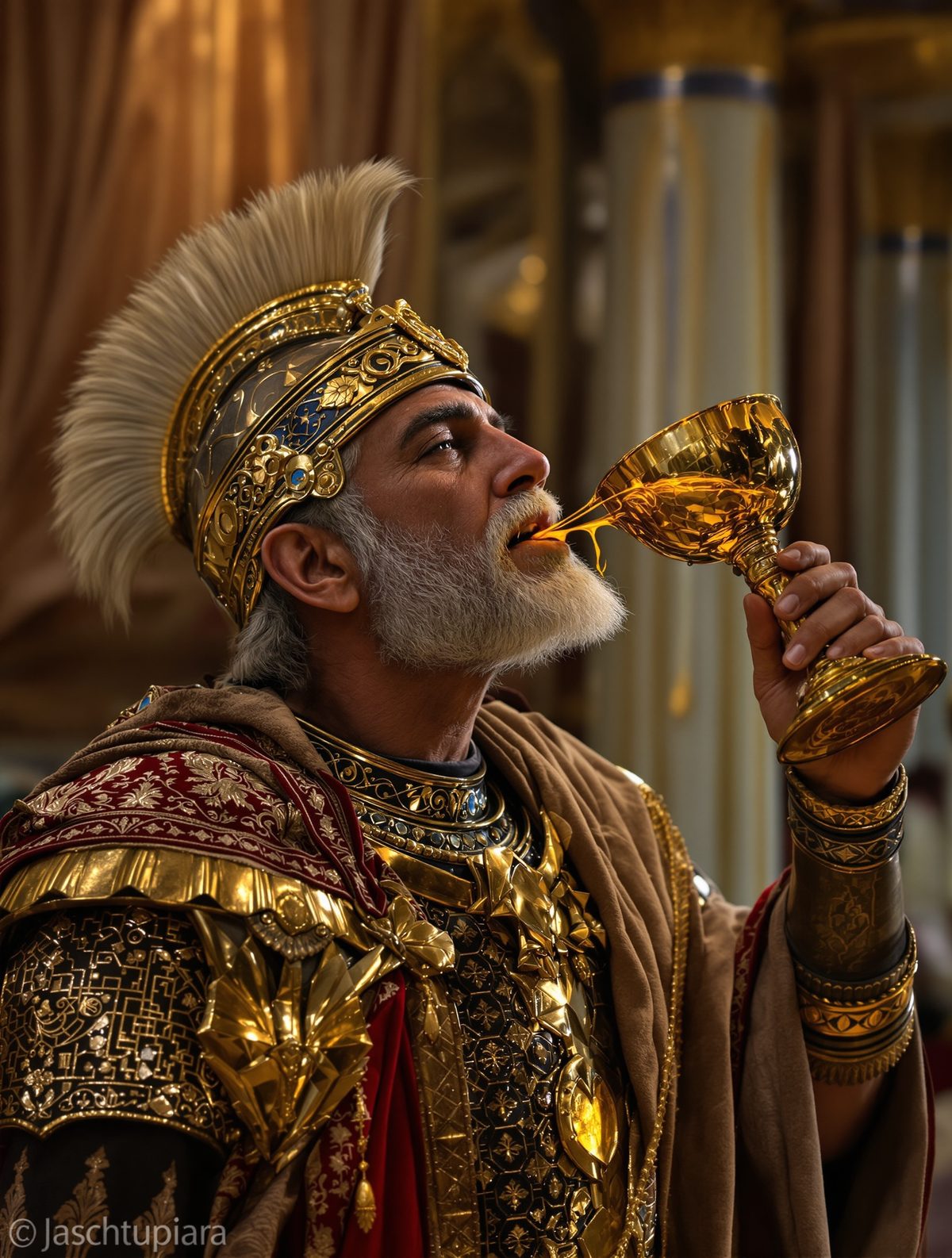
The golden cup trembled in the Persian general's weathered hands as molten metal, heated to nearly 2,000 degrees Fahrenheit, glowed like liquid sunlight within its rim. Across from him, the defeated King Croesus—once the wealthiest man in the known world—watched in stunned silence as General Harpagus raised the cup to his lips. "You call us gold-hungry barbarians," Harpagus declared, his voice echoing through the conquered palace of Sardis. "Then watch how a Persian treats your precious gold." What happened next would become one of the most shocking displays of defiance in ancient history—and challenge everything we think we know about the legendary Persian Empire.
The King Who Thought He Couldn't Lose
To understand this extraordinary moment, we must first meet King Croesus of Lydia, whose very name became synonymous with unimaginable wealth. In 560 BC, Croesus ruled from his magnificent capital of Sardis in what is now western Turkey, commanding an empire that controlled the world's most lucrative trade routes between Europe and Asia. His kingdom was literally built on gold—the nearby Pactolus River ran thick with gold dust, and Lydian craftsmen had invented the world's first gold coins around 650 BC.
Croesus wasn't just wealthy; he was obscenely wealthy. Ancient historians reported that foreign dignitaries would travel thousands of miles just to witness his treasure rooms, where gold bars were stacked like firewood and precious gems overflowed from countless urns. The Greek historian Herodotus wrote that when the Athenian statesman Solon visited Croesus, the king spent days parading his riches, expecting to be declared the happiest man alive.
But wealth bred arrogance, and by 547 BC, Croesus had made a fatal miscalculation. The Persian Empire under Cyrus the Great was rapidly expanding westward, and Croesus convinced himself that his gold could buy victory against these "barbaric" newcomers from the east. He consulted the Oracle at Delphi, who cryptically warned that if he attacked Persia, "a great empire would fall." Naturally, Croesus assumed it would be Cyrus's empire.
When Persian Steel Met Lydian Gold
The clash between these two civilizations was as much about philosophy as it was about territory. Croesus represented the old world of city-states and merchant kingdoms, where power flowed from accumulated wealth and established bloodlines. Cyrus the Great embodied something entirely new—a meritocratic empire that promoted based on ability rather than birth, and valued loyalty and courage above material riches.
The Persian military machine that rolled toward Sardis in 547 BC was unlike anything the ancient world had seen. Cyrus's forces included the legendary Immortals—an elite guard of exactly 10,000 warriors who were instantly replaced when killed or wounded, making the unit appear truly immortal to terrified enemies. But the Persians' real weapon wasn't their numbers or their equipment; it was their revolutionary approach to conquest.
Unlike other ancient empires that ruled through fear and exploitation, the Persians offered religious tolerance, local autonomy, and the chance to join their expanding civilization as equals. This strategy had already won them Babylon without a single siege—the city's gates were opened from within by citizens who preferred Persian rule to their own king's tyranny.
Croesus, however, remained confident that his gold could purchase victory. He had hired the finest Greek mercenaries, forged alliances with Egypt and Sparta, and assembled what he believed was an unbeatable coalition. The decisive battle came at Pteria, a fortress city on the border between the two empires, where Croesus learned a harsh lesson about the limitations of wealth-based power.
The Fall of the Golden King
The Battle of Pteria was a brutal stalemate that left both armies bloodied but unbroken. Croesus, assuming the Persians would retreat for the winter, dismissed his expensive mercenaries and returned to Sardis to regroup. It was a catastrophic miscalculation. Cyrus pursued immediately, catching the Lydian army completely off guard.
What followed was one of ancient warfare's most innovative tactical displays. Facing Croesus's legendary cavalry—the finest horse warriors in the ancient world—Cyrus deployed an unexpected secret weapon: camels. The Persian baggage train's camels were repositioned to the front lines, and the unfamiliar scent caused the Lydian horses to panic and flee. Ancient sources describe the chaos as Croesus's "invincible" cavalry turned tail and galloped away from the battlefield, leaving their dismounted riders to face Persian infantry on foot.
Sardis itself fell after a remarkable siege. The city was considered impregnable, built on a steep acropolis with walls that seemed to merge seamlessly with the cliffsides. But a young Persian soldier named Hyroiades noticed that birds roosted on one section of the supposedly unclimbable wall. Realizing this meant handholds existed, he led a daring night assault up the cliff face. By dawn, Persian banners flew from the walls of the wealthiest city in the world.
Enter General Harpagus, one of Cyrus's most trusted commanders and a man with his own complex relationship with gold and power. Unlike the stereotypical greedy conqueror, Harpagus was a Persian noble who had risen through merit rather than birth, embodying the empire's revolutionary values. He had been chosen personally by Cyrus to oversee the final capture of Croesus and the securing of Lydia's legendary treasures.
The Insult That Ignited History
When Harpagus entered Croesus's throne room in early 546 BC, he found a broken king sitting among the ruins of his golden empire. Persian soldiers had systematically catalogued the royal treasures—not for looting, but for incorporation into Cyrus's imperial treasury. The methodical Persian approach to conquest, treating captured wealth as administrative rather than personal assets, clearly frustrated Croesus.
According to the ancient historian Nicolaus of Damascus, whose account was later referenced by Byzantine chroniclers, Croesus couldn't resist one final insult. "Look at them," he reportedly sneered to Harpagus, gesturing at the Persian soldiers carefully inventorying his treasure rooms. "Your barbaric troops eye my gold like starving dogs. You Persians are nothing but crude brigands dressed in imperial robes."
The words cut deeper than Croesus probably intended. Harpagus, like many Persian nobles, was acutely aware that Greeks and other "civilized" peoples viewed them as upstart barbarians. Despite building the largest, most tolerant empire the world had ever seen, Persians constantly faced condescension from the very peoples they had conquered or sought to incorporate into their civilization.
But what happened next revealed the true character of Persian leadership. Instead of responding with anger or violence, Harpagus saw an opportunity to make a philosophical statement that would resonate far beyond the walls of Sardis.
Liquid Fire and Molten Courage
Harpagus ordered his soldiers to bring Croesus's ceremonial crown—a masterpiece of Lydian goldsmithing that weighed nearly three pounds and was studded with precious gems. As palace servants fired up a bronze brazier, the Persian general began what would become one of history's most dramatic demonstrations of ideological superiority.
"You believe we crave your gold," Harpagus declared as the crown began to melt in the intense heat. "You think wealth is power, and that we Persians are merely better brigands than our predecessors. Today, I will show you the difference between your civilization and ours."
The physics of what happened next are genuinely terrifying. Molten gold reaches temperatures of nearly 2,000 degrees Fahrenheit—hot enough to cause instant third-degree burns and death within moments of ingestion. Yet ancient sources consistently report that Harpagus not only consumed the molten metal but survived the experience.
Modern historians have proposed several explanations for this apparent impossibility. Some suggest the account was embellished over time, or that Harpagus used some form of ancient "special effects" to create the illusion of drinking molten gold. Others point to rare historical instances of individuals surviving brief contact with molten metals through extreme physiological reactions or protective techniques unknown to modern science.
But perhaps the most intriguing theory comes from metallurgical analysis of ancient Persian and Lydian goldworking techniques. Some scholars believe Harpagus may have used a complex chemical mixture that created the appearance of molten gold while actually consuming a less dangerous substance that would still cause dramatic physical effects—enough to convince observers while not proving fatal.
The Echo Across Empires
Whether Harpagus actually consumed molten gold or performed an elaborate deception matters less than the profound impact his demonstration had on both Persian and world history. The story spread rapidly throughout the ancient Mediterranean, becoming a powerful symbol of Persian values that directly challenged Greek and Lydian assumptions about "barbarian" motivations.
Croesus himself was reportedly so shaken by the display that he became one of Cyrus's most valuable advisers, helping the Persians understand and govern the complex web of Mediterranean trade relationships. Rather than executing his defeated enemy, Cyrus followed Harpagus's recommendation to spare Croesus, demonstrating the Persian principle that former enemies could become valuable allies.
The broader implications of this moment extend far beyond ancient geopolitics. Harpagus's actions represented a fundamental challenge to the idea that material wealth equals civilization—a concept that resonates powerfully in our modern world of economic inequality and cultural assumptions about success and sophistication.
In an age where we continue to struggle with questions about the relationship between wealth and worth, between material success and moral authority, the Persian general's dramatic gesture offers a timeless reminder that true strength often lies not in what we possess, but in what we're willing to sacrifice for our principles. The man who drank liquid fire to prove his contempt for gold created a moment that burns as brightly today as it did 2,500 years ago.