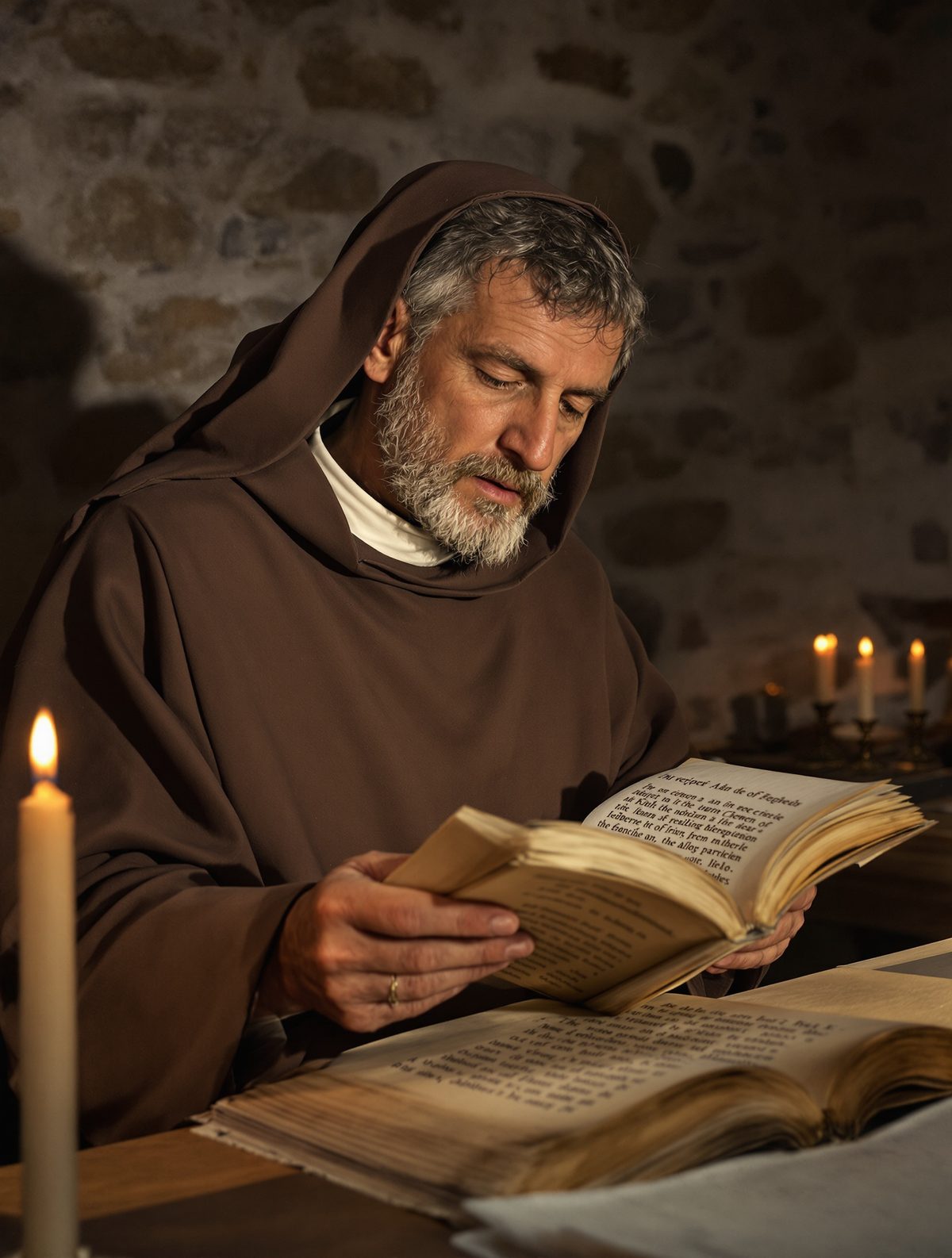
The autumn mist clung to the stone walls of Cluny Abbey like a shroud on October 14th, 1147, when Brother Thomas made the most devastating trade in medieval history. In exchange for a single manuscript written in fading Greek letters, he handed over the abbey's entire treasury—gold chalices blessed by saints, jeweled reliquaries containing holy bones, and silver crosses that had adorned the altar for three centuries. The Byzantine merchants who accepted this fortune could hardly believe their luck. The monks who discovered Thomas's betrayal three days later could hardly believe their eyes.
What drove a man who had devoted fifteen years to God's service to commit such an unthinkable act? The answer lies in forty-seven pages of parchment that would revolutionize European medicine—and destroy one man's soul in the process.
The Merchant Caravan That Changed Everything
Brother Thomas of Cluny was thirty-four years old when destiny arrived at his monastery's gates in the form of a Byzantine trading caravan. These merchants, traveling the dangerous route from Constantinople to Paris, had stopped at the great abbey seeking food and shelter—a common enough occurrence in medieval Europe, where monasteries served as hotels for weary travelers.
Thomas, who served as the abbey's treasurer and spoke fluent Greek thanks to his aristocratic education before taking vows, was assigned to negotiate payment for their lodging. What he discovered among their wares would haunt him forever: a manuscript titled "Chirurgia Magna" by an unknown Byzantine physician named Kallinikos the Elder.
The book was ancient even by medieval standards—written sometime in the 9th century, it contained detailed surgical procedures that had been completely lost to Western Europe after the fall of Rome. While European physicians still relied on bloodletting and herbal remedies, this manuscript described how to perform cataract surgery, set compound fractures, and even remove kidney stones through precise incisions.
Most shocking of all, it contained illustrations. In an age when medical knowledge was passed down through oral tradition and crude drawings, Kallinikos's manuscript featured over sixty detailed anatomical diagrams drawn from actual dissections—a practice forbidden by the Christian church but still secretly practiced in the Byzantine Empire.
The Forbidden Knowledge That Consumed a Holy Man
Thomas spent three sleepless nights poring over the manuscript by candlelight, using his position as treasurer to access the merchants' goods. What he read challenged everything he believed about medicine, science, and even God's plan for human suffering.
One passage described a surgical procedure to repair a cleft palate in children—a condition medieval Europeans believed was God's punishment for sin. Another detailed how to safely deliver a breached baby using instruments rather than prayers. Most revolutionary of all, Kallinikos wrote about using wine and vinegar to clean wounds, a practice that reduced infection rates dramatically compared to the standard medieval treatment of applying animal dung and mud.
Thomas began to see the faces of every person he'd watched die in the abbey's infirmary—victims of treatable conditions that this manuscript could have cured. Brother Benedict, who died screaming from kidney stones. Young Sister Mary from the nearby convent, who bled to death in childbirth. The dozens of pilgrims who arrived with infected wounds that inevitably turned gangrenous.
The moral weight was unbearable. How could he let this knowledge disappear into some Parisian nobleman's library to gather dust? How could he face God knowing he'd allowed countless souls to suffer when salvation lay written on these pages?
The Treasury Vault and a Soul's Betrayal
On the night of October 13th, 1147, Thomas made his choice. Using his keys to the abbey's treasury, he gathered items worth approximately 400 pounds of silver—a staggering sum equivalent to nearly $200,000 today. The haul included the Golden Chalice of Saint Hugh, donated by the French royal family in 1109, and a reliquary containing what was believed to be a piece of the True Cross.
Contemporary records from the abbey's chronicler, Brother William, describe the treasury as "the glory of all Christendom, collected through two centuries of devotion." Thomas was stealing not just objects, but centuries of faith, sacrifice, and community devotion.
The Byzantine merchants, led by a trader named Constantine Paleologus, initially refused the trade. Even by medieval standards, the exchange seemed wildly unbalanced. But Thomas, speaking in fluent Greek, convinced them by explaining his medical knowledge and his desperate need for the manuscript. Perhaps sensing they were dealing with a man on the edge of madness, they eventually agreed.
By dawn, the caravan was gone, carrying with them treasures that had adorned Cluny's altar since before the First Crusade. In their place sat one manuscript—and Brother Thomas, who hadn't slept in four days.
Exile, Disgrace, and an Unlikely Legacy
The theft was discovered on October 16th when Brother William went to retrieve a ceremonial cross for morning prayers. The empty treasury vault told its own story, and Thomas made no attempt to deny his actions when confronted by Abbot Peter the Venerable—one of the most powerful religious figures in 12th-century Europe.
The trial was swift and brutal. Thomas was formally excommunicated, stripped of his robes, and banished from the abbey grounds forever. In medieval society, this was effectively a death sentence—excommunicated individuals couldn't work, couldn't receive aid from other religious institutions, and were often attacked by townspeople who saw them as cursed by God.
But Thomas had prepared for this fate. Before his trial, he had already begun translating and copying the Byzantine manuscript, working feverishly to preserve its knowledge in Latin. He settled in a abandoned leper colony outside the town of Mâcon, where his medical skills—now enhanced by Kallinikos's techniques—made him invaluable to society's most desperate outcasts.
For three years, Thomas lived among the diseased and dying, perfecting the surgical techniques described in his precious manuscript. He successfully performed Europe's first recorded cataract surgery in 1149, restoring sight to a blind pilgrim. His success rate with kidney stone removal was unprecedented—nearly 80% of patients survived, compared to the usual rate of less than 20%.
Death of a Revolutionary
Brother Thomas died alone on March 15th, 1150, likely from tuberculosis contracted from his patients. He was found in his simple hut with quill in hand, having spent his final hours completing his translation of Kallinikos's manuscript into Latin. His finished work, which he titled "Ars Chirurgica" (The Art of Surgery), contained not only the complete Byzantine text but also his own additions based on three years of practical experience.
The manuscript should have died with him, buried with a disgraced monk in an unmarked grave. Instead, it was discovered by a traveling physician named Master John of Salisbury, who recognized its revolutionary potential. Within a decade, copies of Thomas's translation were circulating through Europe's nascent university system, fundamentally changing how medicine was taught and practiced.
By 1200, the University of Bologna was using Thomas's work as a primary surgical textbook. The University of Paris established Europe's first formal surgical program based on his translations. Even more remarkably, Thomas's careful documentation of his own surgical successes provided the empirical evidence that convinced the Church to gradually lift its prohibitions on dissection and surgery.
The Price of Knowledge
Today, Brother Thomas of Cluny remains unknown to most people, overshadowed by more famous medical pioneers like Vesalius and Harvey. Yet his sacrifice fundamentally altered the course of European medicine, potentially saving millions of lives over the centuries that followed.
The moral complexity of his story resonates powerfully in our modern age of information. In a world where life-saving knowledge can be locked behind paywalls, patents, and institutional barriers, Thomas's desperate gamble raises uncomfortable questions about the ethics of hoarding versus sharing knowledge. Was he a thief who violated sacred trust, or a revolutionary who understood that some knowledge belongs to all humanity?
The answer, perhaps, lies in the countless patients who lived because Thomas chose forty-seven pages of medical wisdom over fifteen years of monastic comfort. In the end, he proved that sometimes the most profound act of faith isn't blind obedience—it's the courage to sacrifice everything for the chance to heal a broken world.