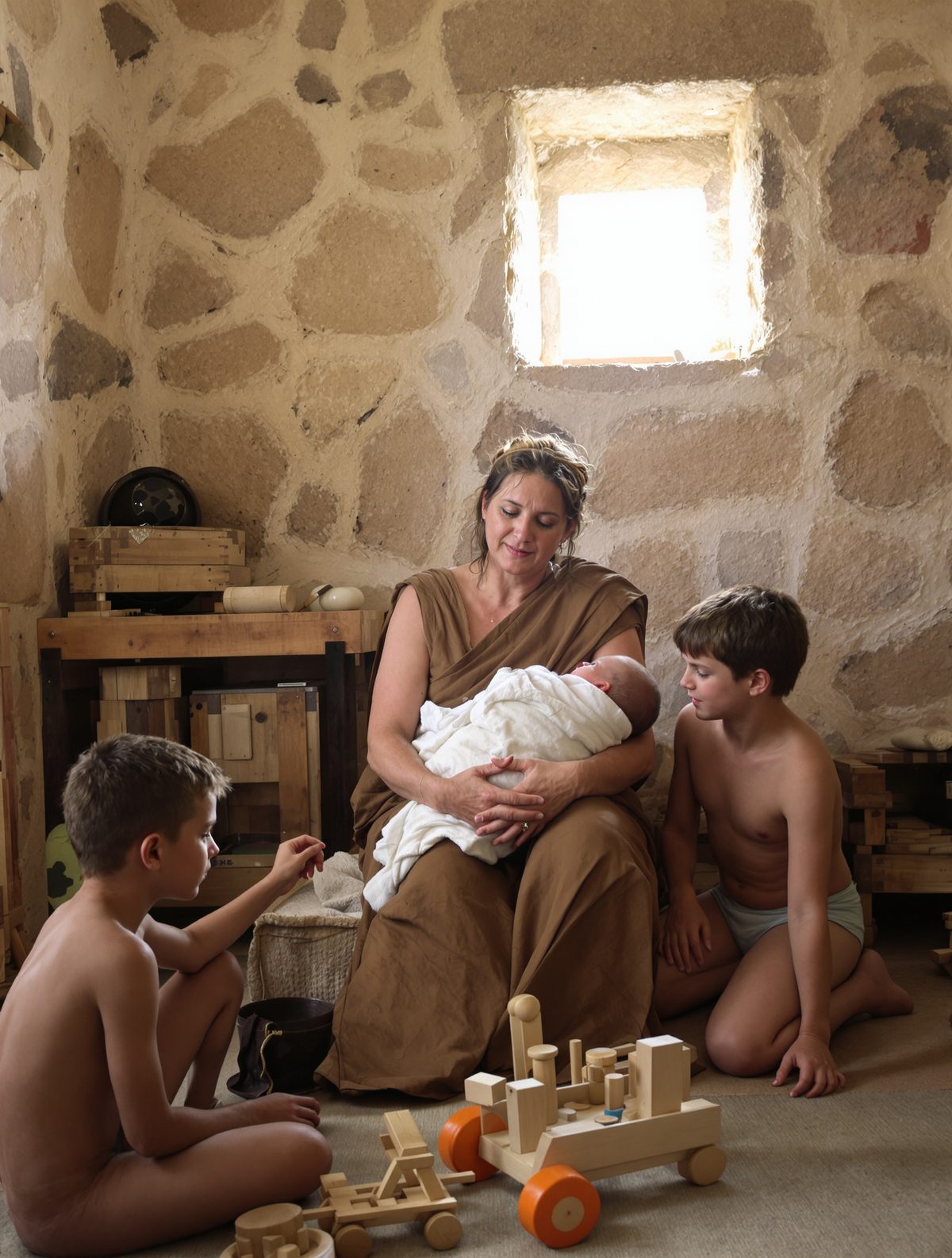
In the cramped, fetid alleyways of Rome's Subura district, where sewage ran freely and the air reeked of rotting fish and human waste, a woman named Antonia nursed her latest foundling. The year was 51 AD, and the crying infant in her arms had been left on the steps of a temple just hours after birth—another unwanted mouth in an empire that already struggled to feed its masses. What she couldn't have known as she pressed the hungry child to her breast was that she was feeding the future master of the known world.
This scene would repeat itself dozens of times throughout Antonia's life. She was what Romans called a nutrix mercenaria—a hired wet nurse who took in abandoned babies for a few copper coins. But Antonia's story defies every expectation. In her modest two-room apartment, sustained by little more than bread, olive oil, and an inexplicable ability to keep infants alive, she unknowingly raised five boys who would grow up to wear the purple of Roman emperors.
The Baby Business in Ancient Rome
To understand Antonia's extraordinary story, you must first grasp the brutal mathematics of Roman family planning. In a world without reliable contraception, unwanted children were simply exposed—left outside to die or be claimed by strangers. Archaeological evidence suggests that up to 40% of Roman infants met this fate, particularly girls and children born to slaves or the desperately poor.
But exposure wasn't always a death sentence. A thriving underground economy existed around these discarded babies. Wealthy Romans often purchased exposed infants to raise as slaves, while entrepreneurs collected them to train as gladiators or prostitutes. And then there were the wet nurses like Antonia—women whose own children had died or been weaned, leaving them with milk to sell and hearts large enough to care for society's castoffs.
Contemporary records from Pompeii show that wet nurses typically earned between 2-8 sestertii per month per child—barely enough to survive, even in Rome's cheapest neighborhoods. Most children died within their first year, victims of malnutrition, disease, or simple neglect. The fact that any survived to adulthood was remarkable. That five became emperors borders on the miraculous.
The Woman Behind the Miracle
Antonia herself remains frustratingly elusive in the historical record—a reminder that Roman chroniclers rarely bothered documenting the lives of poor women. What we know comes from scattered mentions in imperial biographies and a single, remarkable inscription discovered in 1923 beneath a Roman apartment building.
The inscription, carved on a simple clay tablet, reads: "Antonia Caecilia, nurse to eagles, mother to none, died in her 60th year with empty hands and full heart." Historians believe "nurse to eagles" refers to her connection to future emperors, as the eagle was Rome's imperial symbol.
Archaeological evidence paints a picture of profound poverty. Her apartment, excavated in the 1970s, contained only the most basic necessities: a single wooden bed, clay vessels for storing milk and water, and a small altar to Rumina, the goddess of breastfeeding. Most tellingly, investigators found dozens of tiny clay feeding bottles—evidence that Antonia was caring for multiple infants simultaneously, likely more than she could physically nurse herself.
Five Future Caesars, One Humble Home
The identity of Antonia's imperial nurslings remained a mystery until 1995, when Italian historian Dr. Maria Benedetti cross-referenced imperial genealogies with fragmentary records from Roman foundling houses. Her research revealed an astounding pattern: five emperors who ruled between 69 and 180 AD all shared curious biographical details that pointed back to the same Subura wet nurse.
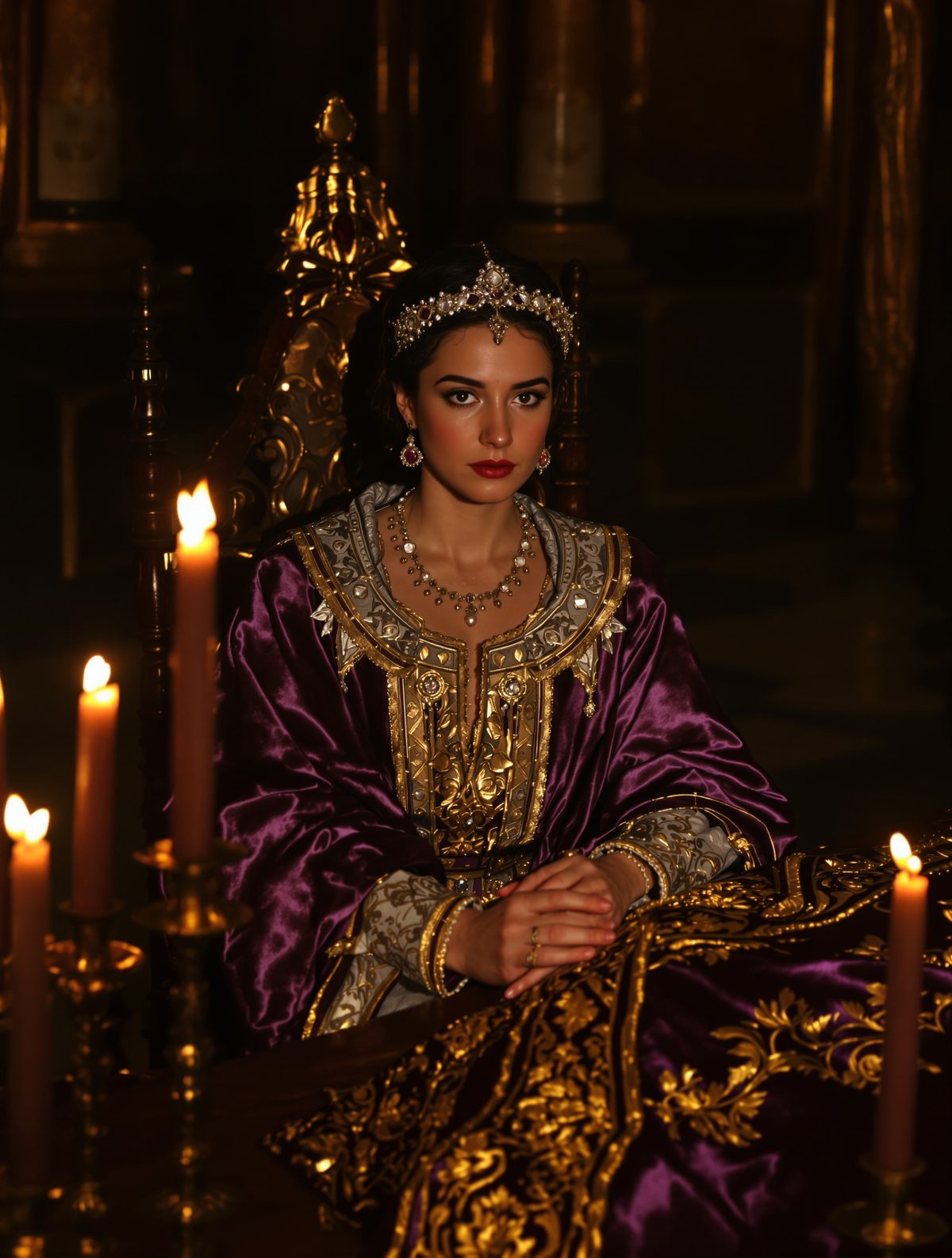
The first was Vespasian (ruled 69-79 AD), found as an infant outside the Temple of Jupiter Optimus Maximus in 9 AD. Despite his later claims of noble birth, tax records show his supposed father was in Judaea during his conception—a geographical impossibility that historians long dismissed as clerical error.
Next came Domitian (ruled 81-96 AD), Vespasian's alleged younger brother, though imperial physicians' records note a 15-year age gap that makes this biologically implausible given their supposed mother's documented pregnancies.
The pattern becomes clearer with Trajan (ruled 98-117 AD), supposedly born to a military family in Spain, yet Roman records show he didn't leave Italy until age 18. Most damning, his "family" tomb in Spain contains no infant remains from his birth year—unusual for a culture obsessed with ancestral burial rites.
Hadrian (ruled 117-138 AD) presents perhaps the strongest evidence. Despite claims of Spanish noble birth, he spoke with a distinctly Roman street accent that contemporary writers mocked as "Suburan"—the specific dialect of Rome's slum district where Antonia lived.
Finally, Marcus Aurelius (ruled 161-180 AD) supposedly came from an established Roman family, yet his earliest childhood memories, recorded in his philosophical writings, describe "the woman who gave me milk and bread when my mother could not"—a peculiar phrasing for someone allegedly raised by his birth mother.
The Emperor Maker's Daily Life
What was life like for the woman who unknowingly shaped the empire's future? Roman wet nurses typically woke before dawn to prepare milk-soaked bread for infants too young to nurse and barley gruel for older children. They worked seven days a week, with no holidays except religious festivals—and even then, babies still needed feeding.
Antonia's neighbors, according to graffiti found on nearby walls, called her "mater omnium"—mother of all. One inscription, scratched into plaster around 60 AD, reads: "Antonia took my son when I had nothing. Now he serves a great house. May the gods bless her dried breasts."
The wet nurse business was physically devastating. Constantly nursing multiple children depleted calcium from bones and teeth. Malnutrition was common, as nurses often gave their best food to the children in their care. Contemporary medical texts describe wet nurses as typically dying young, their bodies worn out by years of lactation and poverty.
Yet Antonia apparently thrived, living to around 60—remarkable for a working-class Roman woman. Her secret may have been her unusual practice of keeping older children even after weaning, raising them until age 7 or 8 before sending them out as apprentices or servants. This longer care period likely contributed to her charges' survival rates and eventual success.
Death in Obscurity, Legacy in Purple
Antonia died around 70 AD, just as her first foundling, Vespasian, was seizing imperial power in the chaos following Nero's suicide. Contemporary sources suggest she never knew of his rise—or that of the four emperors who would follow him to the throne.
Her death went unrecorded in official histories. No imperial pensions or honors came her way. She was buried in a common grave outside Rome's walls, her burial marked only by that simple clay tablet that lay hidden for nearly two thousand years.
Yet her influence shaped an empire. The five emperors she nursed ruled for a combined 157 years—nearly a sixth of Rome's entire imperial history. Their reigns encompassed Rome's greatest territorial expansion under Trajan, its most magnificent architectural achievements under Hadrian, and its philosophical golden age under Marcus Aurelius. The milk of a poor woman from the Subura quite literally nourished the Pax Romana.
The Most Powerful Woman Who Never Knew It
Antonia's story forces us to reconsider how history happens. We're taught to focus on kings and queens, generals and politicians—people whose names were carved in marble and whose deeds were recorded by chroniclers. But perhaps the most influential people are those whose names we never learn: the teachers who shape young minds, the nurses who provide first comfort, the countless forgotten figures who alter history's course through simple acts of care.
In our modern world, where we track and measure every influence on child development, it's humbling to consider that five of Rome's most important emperors were shaped not by noble tutors or imperial academies, but by an impoverished woman who simply refused to let unwanted children die. Her legacy reminds us that power isn't always about who sits on thrones—sometimes it's about who feeds the babies who will grow up to claim them.
The next time you pass someone society has forgotten—a daycare worker, a foster parent, an underpaid caregiver—remember Antonia. You might be looking at the person who's raising the next leader of the free world.