
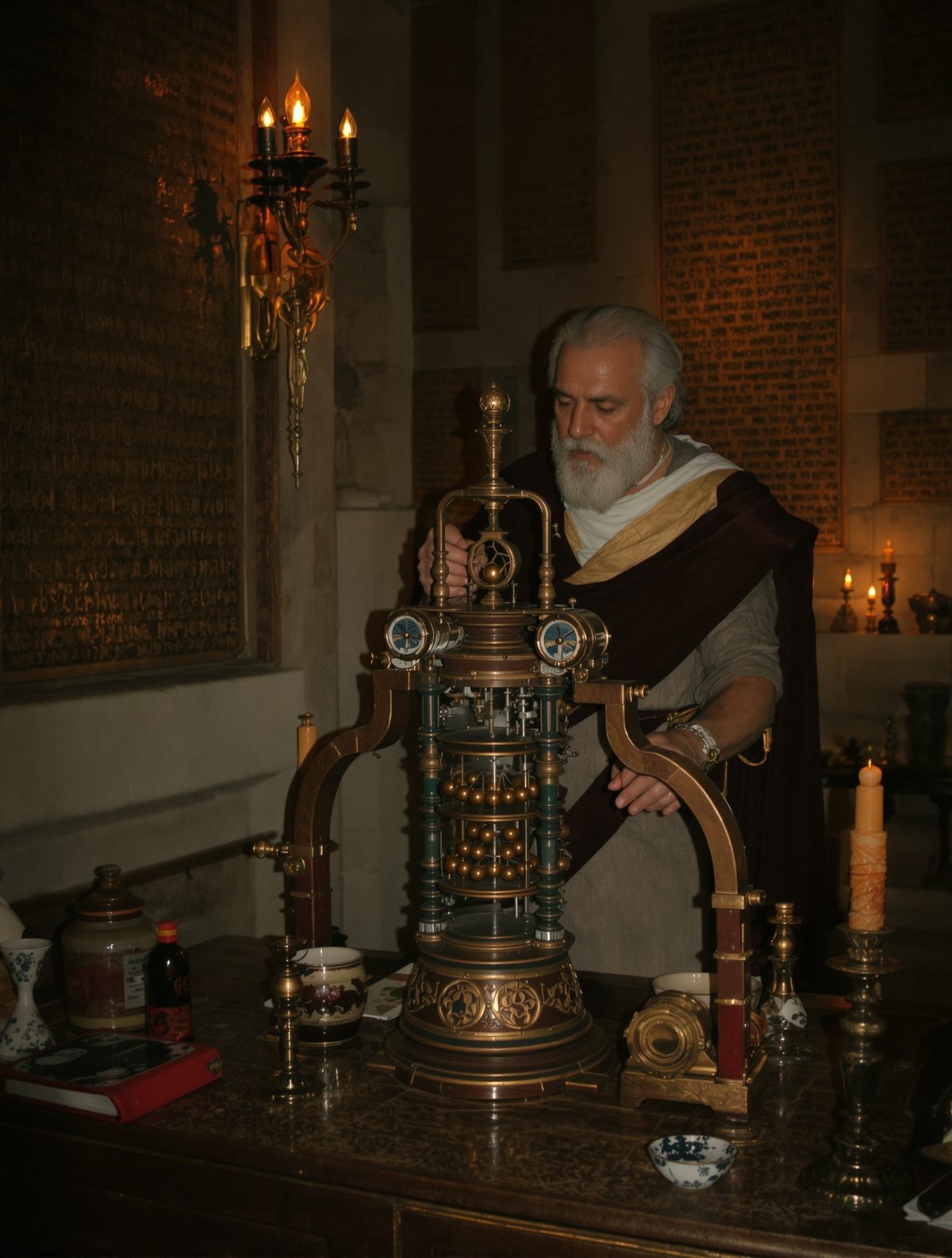
The bronze ball struck the metal plate with a sharp clang that shattered the pre-dawn silence of ancient Babylon. In his modest chamber near the great ziggurat, astronomer Nabu-rimanni jolted awake, exactly as he had planned. It was 1500 BC, and he had just accomplished something no human in history had ever done before: he had set an alarm clock.
While the rest of the world relied on roosters, sunrise, or sheer luck to wake at specific times, this brilliant mathematician had cracked a problem that had plagued humanity since the dawn of civilization. How do you wake up when you need to, not when nature decides? His ingenious solution wouldn't just change his own life—it would alter the course of human timekeeping forever.
The Astronomer's Dilemma
Nabu-rimanni faced a challenge that would stump most people even today. As a royal astronomer in the court of Babylon, he was tasked with tracking the movements of planets, stars, and celestial bodies with extraordinary precision. The Babylonians were obsessed with astronomy—not just for calendar-making or agricultural planning, but because they believed the heavens directly influenced earthly events. Kings made military decisions based on planetary positions, and farmers planted crops according to lunar cycles.
But here's the problem: the best astronomical observations happened at different times throughout the night, and these times changed constantly as the seasons shifted. Venus might be perfectly positioned for observation at 2 AM in summer, but 4 AM in winter. Mars could require monitoring every two hours during opposition. The stars Nabu-rimanni needed to track didn't care about human sleep schedules.
Other astronomers of his era simply stayed awake all night, relying on assistants or junior priests to keep watch. But Nabu-rimanni was different—he was a mathematician as much as an astronomer, and he approached problems with systematic precision. He needed to sleep to maintain his accuracy, but he also needed to wake at exact, predetermined times. In a world without mechanical clocks, this seemed impossible.
The Genius of Babylonian Engineering
The Babylonians were already masters of water-based timekeeping. They had perfected the clepsydra—water clocks that measured time by the steady flow of water from one container to another. These devices could track hours with remarkable accuracy, but they were silent. They could tell you what time it was, but they couldn't tell you when it was time to wake up.
Nabu-rimanni's breakthrough came from combining Babylonian hydraulic engineering with basic physics. He designed a multi-chambered water clock system that was far more sophisticated than anything that had come before. Picture this: a series of bronze vessels connected by precisely calibrated holes, with water flowing from one to the next at carefully calculated rates.
But here's where his mathematical genius shone. Instead of just measuring time, his system was designed to announce specific moments. As the water level in the final chamber reached predetermined heights, it would trigger a mechanical release mechanism. Small bronze balls, no larger than walnuts, would drop from concealed compartments onto a bronze plate positioned directly beside his sleeping area.
The system was so ingenious that he could set multiple "alarms" for a single night. By calculating the water flow rates and adjusting the trigger mechanisms, Nabu-rimanni could wake himself up at 11 PM to observe Jupiter, 1 AM for Venus, and 4 AM for Mars—all from a device he had set before going to sleep.
Precision in an Age of Guesswork
What makes Nabu-rimanni's invention even more remarkable is the level of precision it achieved. Modern reconstructions of his water clock system, based on cuneiform tablets describing his methods, show that it could maintain accuracy to within roughly 15 minutes over an eight-hour period. In an era when most people measured time by the sun's position or the length of shadows, this was extraordinary precision.
The bronze balls weren't chosen randomly—Nabu-rimanni had calculated their exact weight and drop distance to create optimal sound. Too light, and they wouldn't wake him reliably. Too heavy, and they'd dent his bronze plate, affecting the acoustics for future use. Archaeological evidence suggests he used balls weighing approximately 2.3 ounces, dropped from a height of roughly 18 inches.
His cuneiform records, discovered on tablets in the ruins of ancient Babylon, show meticulous calculations for seasonal adjustments. He understood that water flow rates changed with temperature, so he developed correction factors for summer and winter months. During Babylon's scorching summers, when temperatures could reach 120°F (49°C), water flowed more quickly, requiring smaller vessel openings. In winter, he widened the apertures to compensate for slower flow.
Perhaps most impressively, Nabu-rimanni created what was essentially a programmable alarm system. By inserting or removing bronze balls from different chambers, he could customize his wake-up schedule for any given night. His tablets record over 200 different "programs" he used throughout various astronomical observation cycles.
The Ripple Effect Through History
Word of Nabu-rimanni's invention spread throughout the ancient world faster than news of military victories. Within decades, modified versions of his alarm system appeared in Egypt, where priests used them for pre-dawn religious ceremonies. Greek philosophers adopted the technology for their midnight contemplations, and Chinese astronomers developed their own variations by 1200 BC.
But the impact went far beyond astronomy. For the first time in human history, people could control when they woke up, rather than being controlled by natural rhythms. This seemingly simple innovation helped enable the development of more complex societies. Military watches could be precisely timed. Religious ceremonies could begin at exact moments. Craftspeople could maximize daylight hours by starting work before dawn.
The Romans eventually refined Nabu-rimanni's design, creating portable alarm clocks for military campaigns. These compact water-and-bronze-ball systems allowed Roman generals to coordinate pre-dawn attacks with unprecedented precision. Some military historians argue that the Roman Empire's famous discipline and timing can be traced back to technologies derived from this Babylonian astronomer's quest for better sleep.
Interestingly, the basic principle of Nabu-rimanni's alarm—using mechanical triggers activated by time-based processes—remained essentially unchanged for over 3,000 years. Medieval monastery bells, grandfather clock chimes, and even early electric alarm clocks all operated on variations of his original concept: measure time precisely, then create sound at predetermined moments.
Beyond the Bronze Balls
Nabu-rimanni's influence extended far beyond timekeeping. His systematic approach to problem-solving—identifying a need, understanding the underlying physics, and engineering a practical solution—became a model for Babylonian innovation. His students went on to develop improved astronomical instruments, more accurate calendars, and better mathematical techniques for predicting eclipses.
The tablets recording his work reveal a mind that thought centuries ahead of his time. He didn't just invent an alarm clock; he created a complete time-management system. His records include schedules for optimizing sleep between observations, dietary recommendations for maintaining alertness during long nights, and even notes on the best materials for consistent sound production.
Archaeological evidence suggests that specialized craftsmen in Babylon began manufacturing alarm clocks based on Nabu-rimanni's designs for wealthy merchants and government officials. By 1400 BC, owning a personal alarm system had become a status symbol in Babylonian society—much like owning the latest smartphone today.
What's truly remarkable is how Nabu-rimanni viewed his invention. According to his own writings, he saw the alarm clock not as an end in itself, but as a tool for better understanding the universe. By controlling when he woke, he could observe celestial patterns with greater consistency, leading to more accurate predictions and deeper astronomical insights.
The Morning That Changed Everything
Today, as millions of people around the world reach for their smartphones to silence their morning alarms, few realize they're participating in a ritual that began with bronze balls dropping onto metal plates in ancient Babylon. Nabu-rimanni's innovation didn't just solve his immediate problem—it fundamentally changed humanity's relationship with time itself.
Before his invention, humans were largely passive observers of time, waking when their bodies or the environment dictated. After 1500 BC, we became active controllers of our temporal destiny. We could decide not just how to spend our waking hours, but when those hours would begin. In many ways, Nabu-rimanni's alarm clock was humanity's first step toward the precise, scheduled, productivity-obsessed world we inhabit today.
The next time your alarm jolts you awake at 6 AM for an important meeting, remember that you're experiencing a direct descendant of a Babylonian astronomer's quest to catch Venus at the perfect moment in her celestial dance. Some innovations change how we do things; others change how we think about what's possible. Nabu-rimanni's bronze balls falling in the Mesopotamian darkness did both, one precisely timed clang at a time.