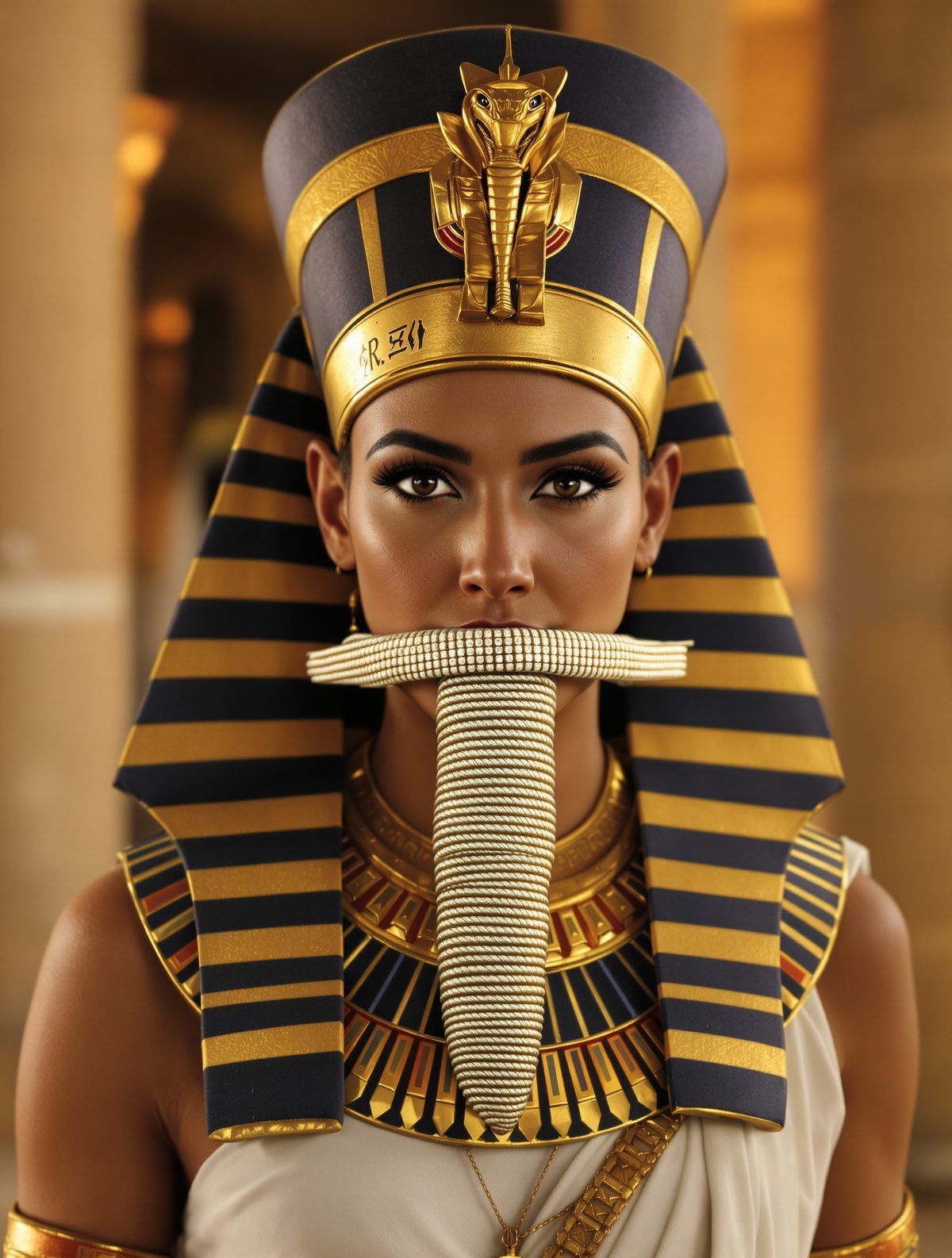
In the stifling heat of an ancient Egyptian palace, a queen stood before her bronze mirror, methodically strapping a ceremonial false beard to her chin. The year was 1479 BC, and Hatshepsut was about to commit one of history's most audacious acts of political theater. With each careful adjustment of the golden pharaonic symbols—the crook, the flail, the sacred uraeus serpent crown—she wasn't just getting dressed. She was transforming herself from woman to man, from queen to king, in defiance of three thousand years of Egyptian law.
What happened next would make her one of the most successful pharaohs in Egyptian history. But it would also, according to whispered palace rumors, require her to eliminate anyone who dared question her divine masculine authority—including, some say, her own stepson.
The Throne That Should Never Have Been Hers
When Pharaoh Thutmose II died around 1479 BC after a brief and unremarkable reign, Egyptian succession law was crystal clear: the throne belonged to his son, Thutmose III. There was just one problem—the boy was barely ten years old, hardly ready to command the most powerful empire on earth.
Enter Hatshepsut, the dead pharaoh's half-sister and widow, a woman who had already proven herself as a capable administrator during her husband's frequent illnesses. Egyptian custom dictated that she should serve as regent until young Thutmose III came of age. But Hatshepsut had bigger plans brewing behind those kohl-lined eyes.
For the first few years, she played by the rules. Official inscriptions show her standing dutifully behind the boy king, performing the traditional female role of supporter and advisor. But something extraordinary was happening in the royal workshops during this time. Sculptors were receiving unusual commissions—statues of Hatshepsut, but with increasingly masculine features. The soft curves of her face were being chiseled into harder, more angular lines. Her traditional queen's crown was being replaced with the pharaoh's ceremonial headdresses.
By 1473 BC, the transformation was complete. In a move that shocked the ancient world, Hatshepsut declared herself pharaoh—not queen, but king of Egypt. The inscriptions changed overnight: she was now Maatkare Hatshepsut, and the hieroglyphs describing her used masculine pronouns exclusively.
The Divine Deception: Becoming a God-King
Ancient Egyptians didn't just see their pharaoh as a political leader—he was literally a living god, the earthly incarnation of Horus. The idea of a female pharaoh wasn't just politically problematic; it was theologically catastrophic. The gods themselves, according to Egyptian belief, were masculine rulers of the cosmic order.
Hatshepsut's solution was as brilliant as it was unprecedented. She didn't just dress like a man—she rewrote her entire divine origin story. In the magnificent temple she built at Deir el-Bahari, her artists carved an astonishing tale: the god Amun-Ra himself had chosen her before birth to rule Egypt. In these reliefs, she's shown as unambiguously male, with the pharaoh's traditional false beard and masculine regalia.
But the most shocking part of her reinvention was how thoroughly she committed to the charade in public. Contemporary accounts describe a pharaoh who appeared before crowds wearing the traditional pharaonic kilt, the sacred false beard made of plaited gold, and the double crown of Upper and Lower Egypt. She bound her breasts, deepened her voice, and even adopted the ritualized masculine stride that pharaohs used in religious ceremonies.
The deception worked so well that some Egyptian texts from her reign refer to her as "he" and "his majesty" without any hint of irony or acknowledgment that the pharaoh had been born female. She had successfully hacked the ancient world's most rigid gender binary.
The Stepson Who Waited—And Waited
Meanwhile, Thutmose III was growing up in Hatshepsut's shadow, and by all accounts, he wasn't happy about it. Historical records suggest that tensions between stepmother and stepson were escalating throughout the 1460s BC. The young man who should have been pharaoh was instead relegated to military service, leading campaigns in Nubia while his stepmother ruled from Thebes.
This is where the story takes a darker turn. Palace records from Hatshepsut's reign mention several mysterious deaths among court officials who had questioned the legitimacy of her rule. While direct evidence of murder is scarce—ancient Egyptian criminal records weren't exactly comprehensive—several historians have noted the suspicious timing of these deaths.
Most intriguingly, chemical analysis of mummified remains from Hatshepsut's court has revealed unusually high levels of toxic substances in several individuals who died during her reign. While this could be explained by medical treatments of the time (many Egyptian medicines were highly toxic), some researchers suggest it points to a more sinister pattern.
The most persistent rumor involves Thutmose III himself. Some accounts suggest that Hatshepsut made multiple attempts to eliminate her stepson, fearing that his supporters would eventually organize a coup. If true, it would mean that one of Egypt's most successful pharaohs was also one of its most ruthless family murderers.
An Empire Built on Borrowed Masculinity
Whatever dark deeds may have secured her throne, there's no denying that Hatshepsut's reign was spectacularly successful. For 22 years, she ruled an empire that stretched from Nubia to the Euphrates, oversaw massive construction projects, and brought Egypt unprecedented prosperity through trade rather than conquest.
Her trading expeditions to the mysterious land of Punt (likely modern-day Somalia) brought back gold, ivory, myrrh trees, and exotic animals that filled the Egyptian treasury. Unlike many pharaohs who focused on military expansion, Hatshepsut built Egypt's wealth through commerce and diplomacy. The temple reliefs at Deir el-Bahari show boats loaded with treasures, exotic giraffes walking down gangplanks, and foreign dignitaries bringing tribute to the gender-bending pharaoh.
She also launched the most ambitious building program in Egyptian history. Her mortuary temple, carved directly into the limestone cliffs at Deir el-Bahari, remains one of architecture's greatest achievements—a three-tiered wonder that seems to grow organically from the desert rock itself. She erected more obelisks than any pharaoh except Ramesses II, including two massive granite spires at Karnak Temple that still bear her inscriptions today.
The Mysterious End and Attempted Erasure
Around 1458 BC, Hatshepsut simply vanished from the historical record. No tomb inscription describes her death, no funeral relief shows her mummification, no official announcement explains her disappearance. One day she was pharaoh of Egypt; the next, Thutmose III was suddenly sole ruler after decades of waiting.
What happened next suggests that whatever ended Hatshepsut's reign, it left her stepson with a burning desire for revenge. Thutmose III embarked on a systematic campaign to erase his stepmother from history. Her name was chiseled off monuments, her statues were smashed and buried, her cartouches were replaced with those of her husband or son. In some reliefs, her figure was literally carved out of the stone, leaving ghostly gaps where the female pharaoh once stood.
For over three thousand years, this attempted erasure worked. Hatshepsut was largely forgotten until 19th-century archaeologists began piecing together her story from damaged inscriptions and hidden statues. Even today, many of her monuments bear the scars of Thutmose III's vengeful chisels.
As for her mummy, it remained missing until 2007, when DNA testing identified her remains in a modest tomb in the Valley of the Kings. The body showed evidence of diabetes, cancer, and possibly poisoning—though whether the latter was from medical treatment or something more sinister remains a mystery.
The Queen Who Rewrote the Rules
Hatshepsut's story resonates across the millennia because it reveals something timeless about power, gender, and the lengths people will go to break barriers that seem unbreakable. In an age when women had virtually no political rights, she didn't just challenge the system—she completely reimagined it, turning herself into the kind of ruler her society could accept: a man.
Her methods may have been extreme, possibly even murderous, but her results were undeniable. Under her rule, Egypt flourished like never before. She proved that effective leadership had nothing to do with the gender of the leader, even as she felt compelled to hide her true identity behind a golden beard.
In our own time, as we continue to grapple with questions about gender, power, and representation in leadership, Hatshepsut's story serves as both inspiration and cautionary tale. She showed that barriers can be broken through sheer audacity and brilliant reinvention. But she also revealed the psychological toll of living a lie so complete that it required erasing your very identity to achieve your goals.
The next time you see a woman breaking ground in politics, business, or any field where she's the first of her kind, remember the ancient Egyptian queen who strapped on a fake beard and convinced an empire she was a man. Sometimes the most revolutionary act is refusing to accept the limitations others place on your ambitions—even if it means becoming someone else entirely.