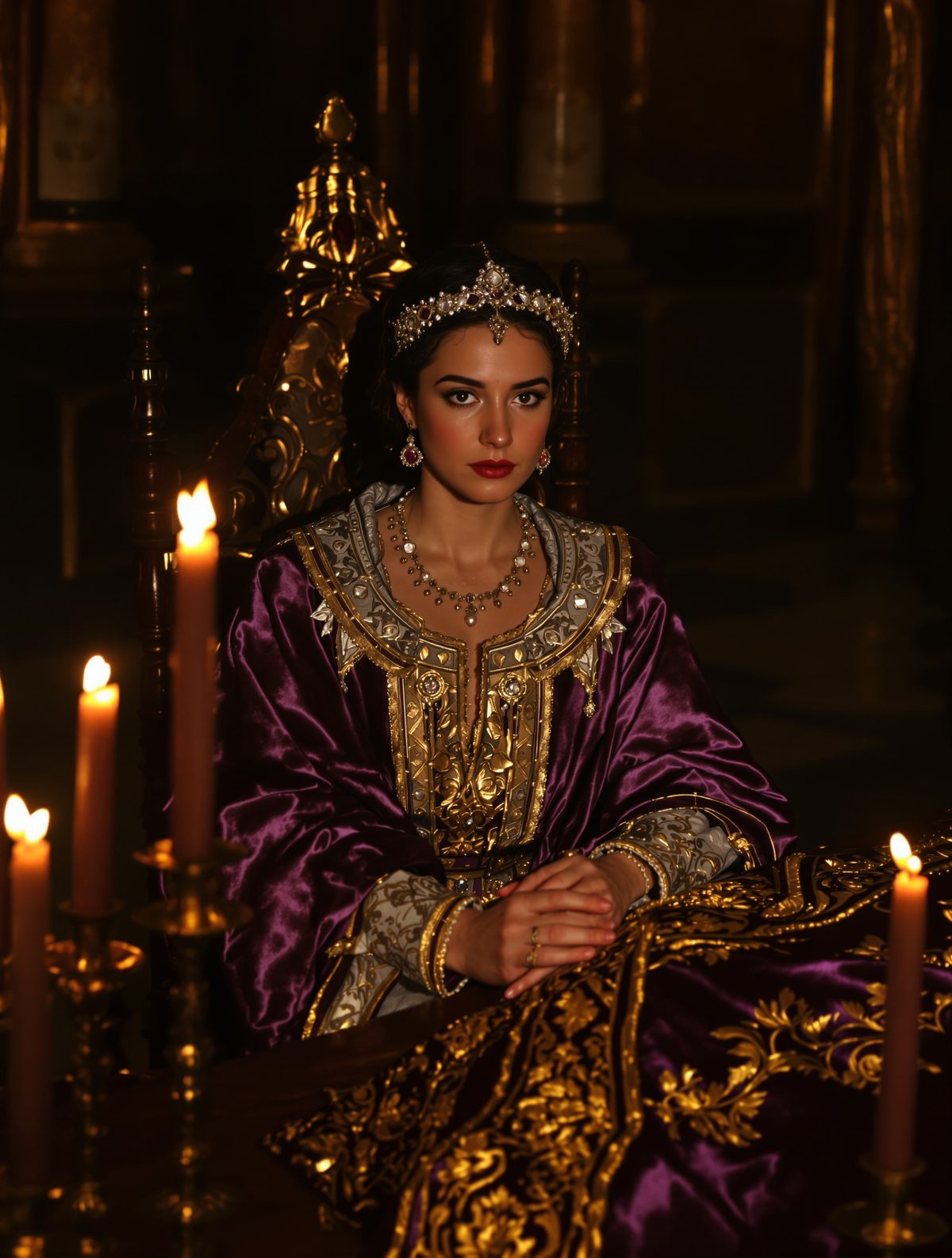
In the flickering candlelight of the Great Palace of Constantinople, a woman's needle moved through silk with the precision of someone who knew her time was running out. Night after night, Empress Theophano bent over her work, adding golden threads to what would become her own funeral shroud. The year was 988 AD, and the most powerful woman in the Byzantine Empire was quite literally sewing the fabric of her own death.
What drove an empress—a woman who commanded armies and influenced the fate of nations—to spend her final years preparing for her own burial? The answer lies in a haunting tale of prophetic dreams, imperial politics, and a mysterious death that would shake the foundations of two empires.
The Empress Who Dreamed of Death
Theophano was no ordinary Byzantine empress. Born around 956 AD into the powerful Skleros family, she had already lived through more political intrigue by age twenty than most people experience in a lifetime. When she married the young Holy Roman Emperor Otto II in 972, she became the bridge between two of medieval Europe's greatest powers—a living symbol of the alliance between Constantinople and the German territories.
But it was in the summer of 985 that everything changed. According to the court chronicler John Skylitzes, the empress began experiencing vivid nightmares that left her gasping and trembling in the pre-dawn darkness. These weren't ordinary anxiety dreams about imperial duties or political conspiracies. Theophano claimed she could see her own death with startling clarity—the pale face in the coffin, the mourners dressed in purple, and most unnervingly, the intricate golden patterns on her burial shroud.
"She would wake with the designs burned into her memory," wrote Skylitzes, "as if God himself had given her the pattern for her own departure from this world."
What makes this account particularly chilling is that Theophano wasn't known for superstition or mystical beliefs. Court records describe her as pragmatic, intellectually sharp, and politically astute. Yet something about these dreams convinced her that death was not just approaching—it was dictating terms.
Silk, Gold, and Sacred Geometry
The ritual began simply enough. Each evening after the final court duties were completed, Theophano would retreat to her private chambers with a bundle of the finest Constantinopolitan silk. The fabric itself was worth a small fortune—produced in the imperial workshops using closely guarded techniques that made Byzantine silk the most coveted luxury item in medieval Europe.
But the silk was just the beginning. The empress commissioned gold thread so fine it could barely be seen with the naked eye, spun in the palace workshops by craftsmen sworn to secrecy. The designs she embroidered were unlike anything seen in traditional Byzantine funeral garments. Instead of conventional Christian motifs, she wove intricate geometric patterns that seemed to blend Eastern and Western traditions—perhaps reflecting her unique position as a bridge between two worlds.
Palace servants reported seeing strange symbols worked into the fabric: intertwining circles that resembled both Celtic knots and Islamic geometric art, alongside traditional Byzantine eagles and Christian crosses. One particularly detailed account describes a golden tree with thirteen branches, each bearing a different symbol representing the major cities of the Byzantine Empire.
The work was painstakingly slow. Historians estimate that Theophano spent roughly three to four hours each night on the shroud, working by candlelight long after the rest of the palace had fallen asleep. The mathematics are startling: over the course of three years, she likely invested more than 3,000 hours into this single piece of fabric—enough time to learn a new language or master a complex trade.
The Imperial Palace After Dark
To understand the full strangeness of Theophano's nightly ritual, you have to picture the Great Palace of Constantinople after midnight. This wasn't just a royal residence—it was a city within a city, housing thousands of courtiers, servants, guards, and functionaries across dozens of interconnected buildings and courtyards.
While the empress worked alone in her chambers, the palace hummed with activity. Night guards patrolled marble corridors lined with mosaics depicting Christ and the saints. In the kitchens, bakers prepared bread for the morning meals. Scribes worked by lamplight copying important documents, and imperial spies came and went through hidden passages, gathering intelligence from across the known world.
Yet according to multiple sources, an unusual quiet would fall over the palace during Theophano's embroidery hours. Servants later claimed they could sense when she was working on the shroud—"the very air seemed heavier," one account notes. Palace cats, normally active hunters during the night hours, would avoid the corridor outside her chambers entirely.
Perhaps most unsettling was the empress's appearance during this period. Court physician Michael Psellos noted that Theophano began losing weight despite eating normally, and her famously lustrous hair started showing premature streaks of silver. By early 991, courtiers whispered that she looked like a woman possessed—not by demons, but by knowledge too terrible to bear.
The Final Night
On December 14, 991, something changed in the rhythm of palace life. Instead of working until the early morning hours, Theophano completed her embroidery shortly after midnight. Palace guards reported seeing unusual activity in her chambers—not frantic rushing, but a deliberate, almost ceremonial movement.
The empress spent the remaining hours before dawn carefully folding the completed shroud and placing it in a cedar chest that had been specially prepared with aromatic herbs and preserved rose petals. She then wrote letters to her three young children and her mother-in-law, Empress Adelaide. The contents of these letters have never been made public, but Byzantine chroniclers noted they were sealed with black wax instead of the traditional imperial purple.
At sunrise on December 15, Theophano attended morning prayers as usual. She participated in a routine imperial council meeting, reviewed petitions from various provinces, and shared a normal midday meal with her household. Contemporary accounts describe her as unusually serene—"like a traveler who has finally glimpsed her destination," wrote one observer.
Then, at approximately 4 PM, while reviewing correspondence in her private study, Empress Theophano collapsed without warning. Palace physicians rushed to her aid, but she was dead within minutes. The cause remains a mystery to this day—no signs of poisoning, no previous illness, no obvious trauma. She simply stopped living, as if her body had been waiting for permission to let go.
The Shroud's Dark Prophecy
When servants retrieved the finished shroud from Theophano's chambers, they made a discovery that sent shockwaves through the imperial court. The embroidered designs weren't just decorative—they formed a kind of visual calendar. Modern analysis of surviving fragments suggests the patterns corresponded to astronomical events and religious feast days spanning exactly three years and four months—precisely the amount of time between when the nightmares began and when the empress died.
Even more chilling was the central motif: a golden figure surrounded by thirteen smaller symbols, representing the manner of death. The figure appeared to be lying in peaceful repose, hands folded, eyes closed—exactly matching how Theophano's body was discovered in her study.
The shroud was used for her burial, as she had intended, but Byzantine Emperor Basil II ordered detailed drawings made before the burial took place. These drawings, preserved in the imperial archives, show a level of artistic sophistication that impressed even the master craftsmen of Constantinople's famous silk workshops.
Legacy of a Prophetic Thread
Theophano's story forces us to confront an uncomfortable question: what do we do when intuition conflicts with rational explanation? Here was a brilliant, educated woman who somehow knew she was going to die and spent three years preparing for that inevitability with methodical precision.
Modern psychologists might diagnose anxiety disorder or depression, but that explanation feels inadequate when faced with the shroud's uncanny accuracy. Medieval chroniclers attributed her knowledge to divine revelation or demonic influence, but Theophano herself never claimed supernatural communication—just dreams she couldn't ignore.
Perhaps the most remarkable aspect of this story isn't the prophetic dreams or mysterious death, but the empress's response to her situation. Rather than falling into despair or frantically trying to change her fate, she chose to meet death as an artist meets a canvas—with patience, skill, and attention to beauty even in the face of the ultimate unknown.
In our age of constant medical monitoring and life extension technologies, Theophano's acceptance seems almost alien. Yet there's something profoundly human about her desire to craft meaning from mortality, to transform the inevitability of death into something beautiful and purposeful. She couldn't control when she would die, but she could control how she would be remembered—one golden thread at a time.