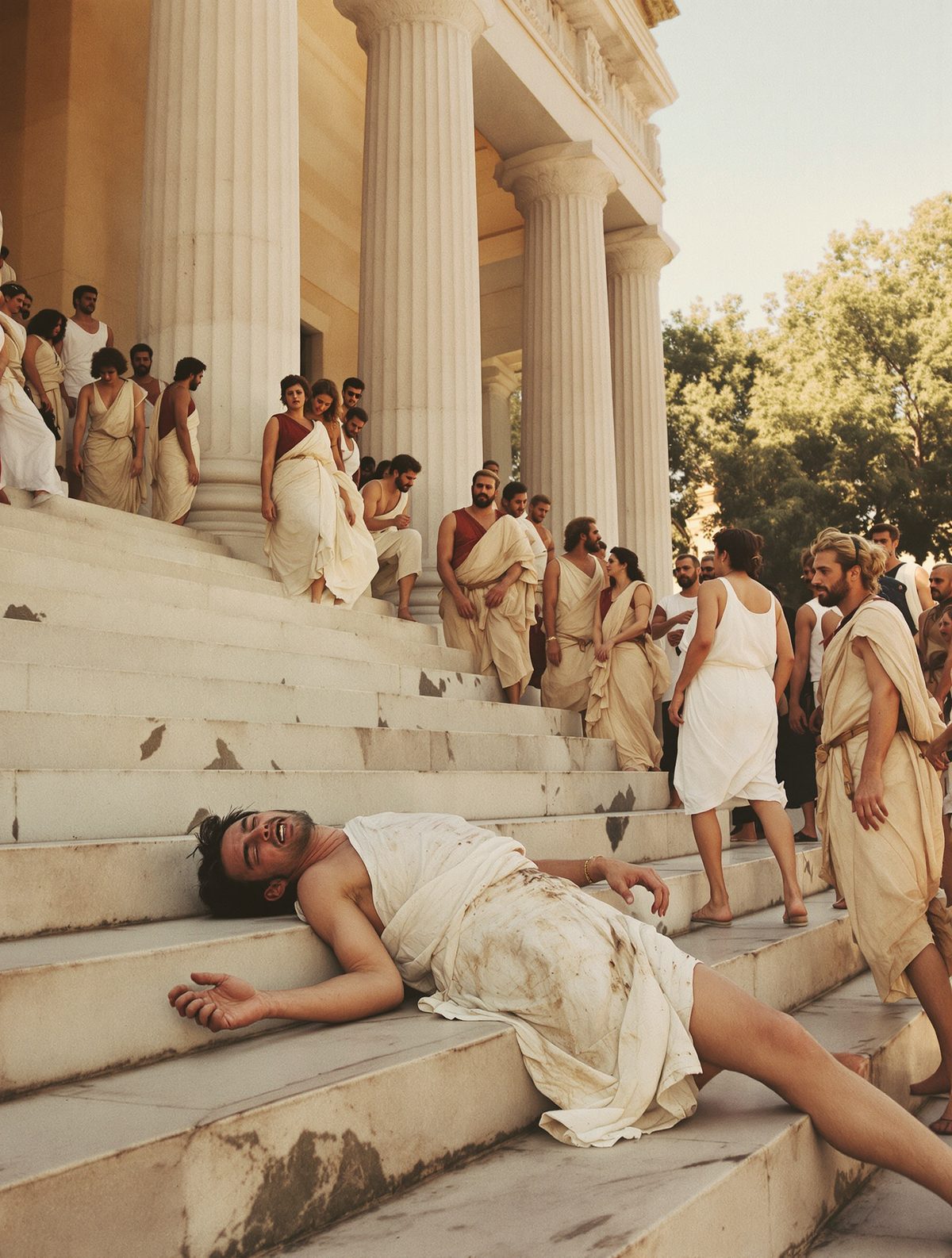
The scorching September sun beat down mercilessly as Eucles took his final, agonizing steps into the Athenian agora. His feet, bloodied and blistered beyond recognition, left crimson prints on the marble stones. The gathered crowd fell silent as this skeletal figure—more ghost than man—stumbled toward them. His lips, cracked and swollen, managed to whisper the single word that would echo through history: "Nenikékamen"—We have won.
Then Eucles collapsed. Dead.
In those final moments of September 12, 490 BC, one of history's most extraordinary feats of human endurance came to its tragic conclusion. But this wasn't just any messenger's run. Over the previous 48 hours, Eucles had covered an impossible 150 miles across the brutal Greek terrain, carrying news that would determine the fate of Western civilization itself.
The Stakes That Shook the Ancient World
To understand the magnitude of Eucles' sacrifice, you must first grasp what hung in the balance at Marathon. The mighty Persian Empire, under King Darius I, had set its sights on conquering Greece. This wasn't just another territorial expansion—this was a clash between two fundamentally different ways of life. On one side stood the Persian system of absolute monarchy and divine kingship. On the other, the revolutionary Greek experiment called democracy.
The Persian force that landed at Marathon was staggering: approximately 25,000 seasoned warriors, including the feared immortals—elite troops so named because their ranks were immediately filled whenever one fell. Against them stood roughly 11,000 Athenians and their Plataean allies. The Greeks were outnumbered more than two to one, fighting for their very existence.
What made this battle even more desperate was Athens' isolation. Sparta, Greece's military powerhouse, had declined to help due to religious obligations during the Carneia festival. Other city-states watched from the sidelines, unsure whether to risk Persian wrath. If Athens fell, democracy itself might die in its cradle.
The Impossible Victory at Marathon
At dawn on September 12, 490 BC, the Athenian general Miltiades made a decision that military historians still marvel at today. Rather than wait defensively, he ordered a full-scale assault across the Marathon plain. But here's the detail they don't teach in school: the Greeks ran the entire mile to reach the Persian lines.
This wasn't a measured advance—it was a sprint in full armor. Each Greek hoplite carried roughly 60 pounds of bronze armor, spear, and shield. Running a mile in this gear would be challenging enough in a modern gym, let alone across rough terrain toward a massive enemy army with arrows darkening the sky above.
The psychological impact was devastating. The Persians had never seen anything like it. Their archers, expecting to decimate slowly advancing infantry, suddenly faced a wall of bronze and fury crashing into their lines at full speed. The Greek center buckled under the Persian elite troops, exactly as Miltiades had planned. Meanwhile, the strengthened Greek flanks enveloped the enemy in what would become known as one of history's first recorded pincer movements.
By noon, the impossible had happened. Persian bodies littered the beach, and the survivors were frantically pushing their ships back into the Aegean Sea. Athens had won, but barely anyone knew it.
The Run That Defied Human Limits
This is where Eucles enters history, though his name appears in different forms across ancient sources—some call him Philippides, others Pheidippides. What's consistent is the superhuman feat he was about to attempt. Military commanders faced a crucial problem: how to coordinate the defense of Greece when communication traveled only as fast as human feet could carry it.
Eucles wasn't chosen randomly. He belonged to the hemerodromoi—professional long-distance runners who served as the ancient world's communication network. These men could cover vast distances that would challenge modern ultramarathoners, carrying messages between city-states across Greece's punishing terrain.
But even for a hemerodromos, what Eucles attempted was unprecedented. First, he ran the 26 miles from Marathon to Athens—the distance that gives our modern marathon its name. However, this was just the beginning of his ordeal. After delivering news of the victory to Athenian officials, he immediately set out for Sparta, covering another 140 miles of mountainous terrain.
Picture this route: from Athens, the path to Sparta winds through the Peloponnese mountains, including sections that rise over 3,000 feet above sea level. Modern hikers with lightweight gear and proper nutrition consider this a challenging multi-day trek. Eucles covered it in roughly 20 hours, sustained by little more than water and perhaps some honey or dried figs.
Racing Against Persian Ships
Why the desperate urgency? The surviving Persian fleet hadn't retreated—they were sailing around Cape Sounion toward Athens' harbor at Phalerum. If the Persians could land their remaining troops and take Athens before the Marathon victors returned, the battle victory would become meaningless. The entire Greek resistance could collapse within hours.
Eucles' mission to Sparta wasn't just about sharing good news. The Athenians needed to know: would Sparta finally commit troops to defend Athens, or would the city-state face the Persian landing alone? Every hour mattered. Every mile was a race against Persian ships cutting through the Aegean.
Here's a detail that makes this even more remarkable: ancient Greek roads weren't roads as we understand them. They were often little more than rocky paths winding between mountains, with river crossings that could be treacherous and terrain that would challenge modern off-road vehicles. Eucles navigated this in leather sandals, guided only by stars and landmarks, while his body gradually shut down from exhaustion.
The Spartan response was swift: they would march immediately. But Eucles couldn't rest—he had to carry this commitment back to Athens before the Persian ships arrived. So he turned around and ran back, retracing those 140 mountainous miles he'd just conquered.
The Final Miles to Immortality
By the time Eucles approached Athens for the second time in 48 hours, he was running on pure willpower. Modern sports science tells us that what he accomplished should have been physiologically impossible. The human body simply isn't designed to maintain the pace necessary to cover 150 miles in two days without proper rest, nutrition, or medical support.
Yet somehow, as Persian ships appeared on the horizon, Eucles' battered legs carried him through the city gates. Witnesses described a man more dead than alive—skin burned black by the sun, eyes sunken deep in their sockets, his famous runner's physique reduced to sinew and bone.
The crowd that gathered around him represented the first democracy in human history, waiting to learn whether their radical experiment in self-governance would survive another day. When Eucles delivered news of both the Marathon victory and Spartan reinforcements, he had literally run democracy back from the brink of extinction.
His final word—"Nenikékamen"—wasn't just about a military victory. It was a declaration that free people could triumph against impossible odds, that citizen-soldiers could defeat professional armies, that democracy deserved to survive.
Why Eucles Still Matters Today
Every time you vote, speak freely, or participate in democratic society, you're benefiting from what Eucles died to preserve. His 150-mile run didn't just save Athens—it saved the entire concept of democracy for future civilizations to rediscover and build upon.
But perhaps more importantly, Eucles represents something timeless about human potential. In an age when we debate the limits of what's possible, his story reminds us that ordinary people can achieve extraordinary things when the stakes truly matter. He wasn't a superhuman hero from mythology—he was a professional messenger who, when civilization needed him most, found reserves of strength that medical science still can't fully explain.
Today's marathon runners cover 26.2 miles and rightfully celebrate their achievement. Eucles covered nearly six times that distance in two days, carrying the weight of democracy itself on his shoulders. He died so that the idea of human freedom could live. In our modern world of instant communication, it's worth remembering that our most precious freedoms were once preserved by the bleeding feet of one man who refused to stop running.