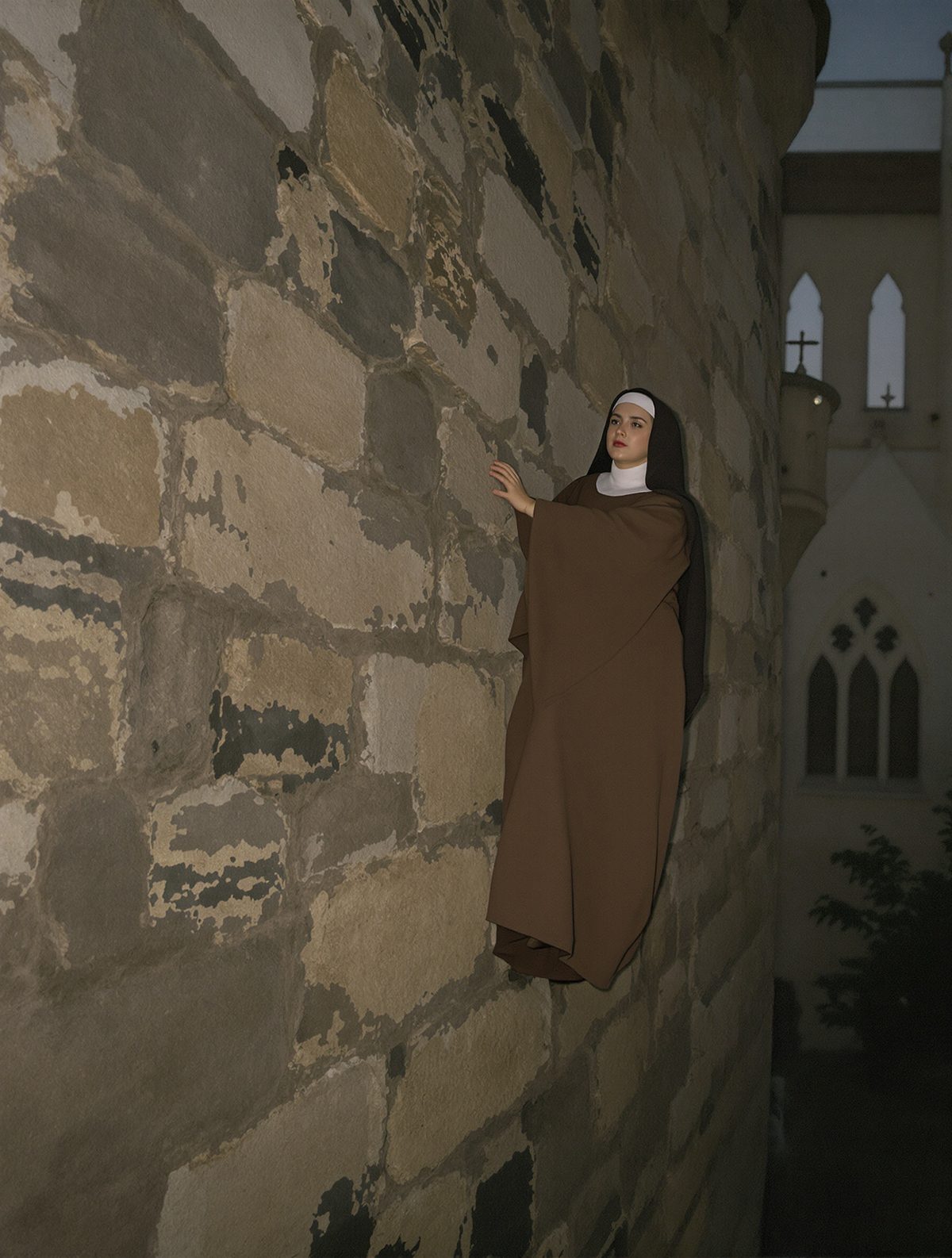
Picture this: It's dawn on a crisp morning around 1010 AD. High above the English countryside, a robed figure stands on the stone tower of Malmesbury Abbey, crude wings strapped to his outstretched arms. The wind catches his makeshift feathers as Brother Eilmer takes one final breath, whispers a prayer, and launches himself into history. For a few heart-stopping moments, the impossible happens—he actually flies.
Nine centuries before Orville and Wilbur Wright would claim fame at Kitty Hawk, a Benedictine monk named Eilmer of Malmesbury had already solved the riddle of human flight. Well, sort of. His crash landing broke both legs and nearly killed him, but for those precious seconds sailing through the morning air, Brother Eilmer proved that humans could indeed slip the bonds of earth—if only briefly.
The Scholar Who Dared to Dream
Eilmer wasn't your typical medieval monk. Born around 980 AD in Wiltshire, England, he was a polymath in an age when most people couldn't even read. By his twenties, he had mastered mathematics, astronomy, and what passed for natural philosophy in the early 11th century. The abbey's chronicles describe him as "learned in many subjects" and possessed of an insatiable curiosity about the natural world.
What set Eilmer apart was his refusal to accept that certain things were simply impossible. While his fellow monks focused on copying manuscripts and tending gardens, Eilmer spent his hours studying the flight of birds from the abbey's highest windows. He measured wingspans, observed takeoff angles, and documented how different species maneuvered through the air. In an era when most scholars were content to quote ancient authorities, Eilmer was conducting what we'd now recognize as systematic scientific observation.
The monk's fascination with flight may have been sparked by a remarkable celestial event. In 989 AD, when Eilmer was still a young man, Halley's Comet blazed across the sky—a phenomenon that terrified most Europeans but apparently inspired our would-be aviator. Later in life, when the same comet returned in 1066, an elderly Eilmer reportedly declared it a harbinger of disaster, proving his astronomical calculations were remarkably accurate.
Engineering Wings in the Dark Ages
Medieval Europe wasn't exactly a hotbed of technological innovation, but Eilmer managed to construct what may have been history's first documented hang glider. Working in secret (church authorities weren't exactly enthusiastic about monks risking their lives for science), he spent months crafting his flying apparatus.
The exact design remains a mystery, but contemporary accounts suggest Eilmer's wings were made from a wooden frame covered with feathers and fabric. He studied bird anatomy obsessively, noting how wing bones connected to flight muscles and how feather arrangements created lift. His wings likely spanned 15-20 feet and weighed between 30-40 pounds—a massive contraption that required considerable upper body strength just to carry.
What's truly remarkable is that Eilmer somehow grasped principles of aerodynamics that wouldn't be formally understood for another 800 years. He recognized that successful flight required more than just flapping—it needed the right combination of wing surface area, air currents, and launch velocity. His choice of Malmesbury Abbey as a launch point was brilliant: the tower provided sufficient height (roughly 100 feet) and faced prevailing winds that could provide crucial lift.
The monk even conducted preliminary tests, according to some accounts. Abbey records hint at experiments with model wings and careful observations of how different materials caught the wind. This wasn't a reckless leap of faith—it was a calculated scientific experiment centuries ahead of its time.
The Flight That Changed Everything
On the fateful morning of his flight attempt, Eilmer climbed to the abbey's highest accessible point. The tower offered a commanding view of the Wiltshire countryside, with open fields stretching for miles—perfect for an emergency landing, assuming he survived the initial launch.
Contemporary chronicler William of Malmesbury, writing about a century later, provides our most detailed account: "He had by some means, I scarcely know what, fastened wings to his hands and feet; then, trusting himself to the favour of the wind and the courage of his heart, he flew more than a furlong." A furlong equals roughly 200 meters—an absolutely staggering distance for humanity's first documented powered flight attempt.
For those brief, exhilarating moments, Eilmer experienced something no human being had ever felt before. He was actually flying, gliding on currents of air with the earth spreading out below him. Witnesses described seeing the monk-turned-bird soaring over the abbey grounds, his robes billowing behind him like additional wing surfaces.
But gravity, as always, had the final word. After covering that remarkable 200 meters, Eilmer's primitive glider began to lose altitude rapidly. He crashed hard in a field beyond the abbey walls, shattering both legs in the impact. The injuries were severe enough to leave him permanently lame—a small price, he later claimed, for becoming the first human being to achieve sustained flight.
The Monk's Revolutionary Insight
What happened next reveals Eilmer's true genius. Rather than abandoning his aviation dreams or attributing his crash to divine displeasure (as most medieval minds would), he immediately began analyzing what went wrong. His conclusion was startlingly modern: he needed a tail.
"The cause of his failure was his forgetting to put a tail on the back part," William of Malmesbury recorded. This insight—that aircraft require both lift-generating wings and stabilizing tail surfaces—wouldn't be formally recognized by aeronautical engineers until the 19th century. Somehow, through a combination of observation and intuition, Eilmer had grasped one of the fundamental principles of flight stability.
The injured monk reportedly spent years planning a second flight attempt, this time with proper tail control surfaces. Unfortunately, his superiors at the abbey had other ideas. Terrified that their brilliant scholar might kill himself in another flying experiment, they forbade any further aviation attempts. Eilmer lived for several more decades, continuing his scholarly work but never again attempting to slip the bonds of earth.
His story might have been forgotten entirely if not for William of Malmesbury's chronicles. Even then, most historians dismissed the account as medieval fantasy until the 20th century, when aeronautical engineers began recognizing the sophistication of Eilmer's insights.
Legacy of a Medieval Maverick
Eilmer's flight attempt stands as one of history's most remarkable examples of scientific thinking triumphing over medieval superstition. In an age when most scholars were content to debate how many angels could dance on a pinhead, this Benedictine monk was conducting practical experiments in aerodynamics.
His story challenges our assumptions about medieval intellectual life. Far from being uniformly backward and superstitious, the period produced genuine innovators like Eilmer who combined careful observation with bold experimentation. His 200-meter flight remains one of the longest documented gliding attempts before the modern era.
Modern engineers have attempted to recreate Eilmer's flight using period materials and techniques. Most conclude that his achievement was even more remarkable than it initially appears—the primitive materials available to him should have made sustained gliding nearly impossible. Yet somehow, through genius or luck (probably both), he managed to stay airborne long enough to prove that human flight was achievable.
Brother Eilmer of Malmesbury died around 1066, the same year Halley's Comet returned and William the Conqueror invaded England. But his legacy lived on in the chronicles of his abbey and in the dreams of future aviators. When the Wright brothers finally achieved powered flight at Kitty Hawk in 1903, they stood on the shoulders of pioneers like Eilmer—the monk who dared to believe that humans could fly, and for 200 glorious meters, proved himself absolutely right.
Today, as we launch rockets to Mars and plan hypersonic passenger flights, it's worth remembering the Benedictine monk who started it all with nothing but wooden wings, borrowed feathers, and the unshakeable conviction that the impossible was simply something nobody had figured out yet.