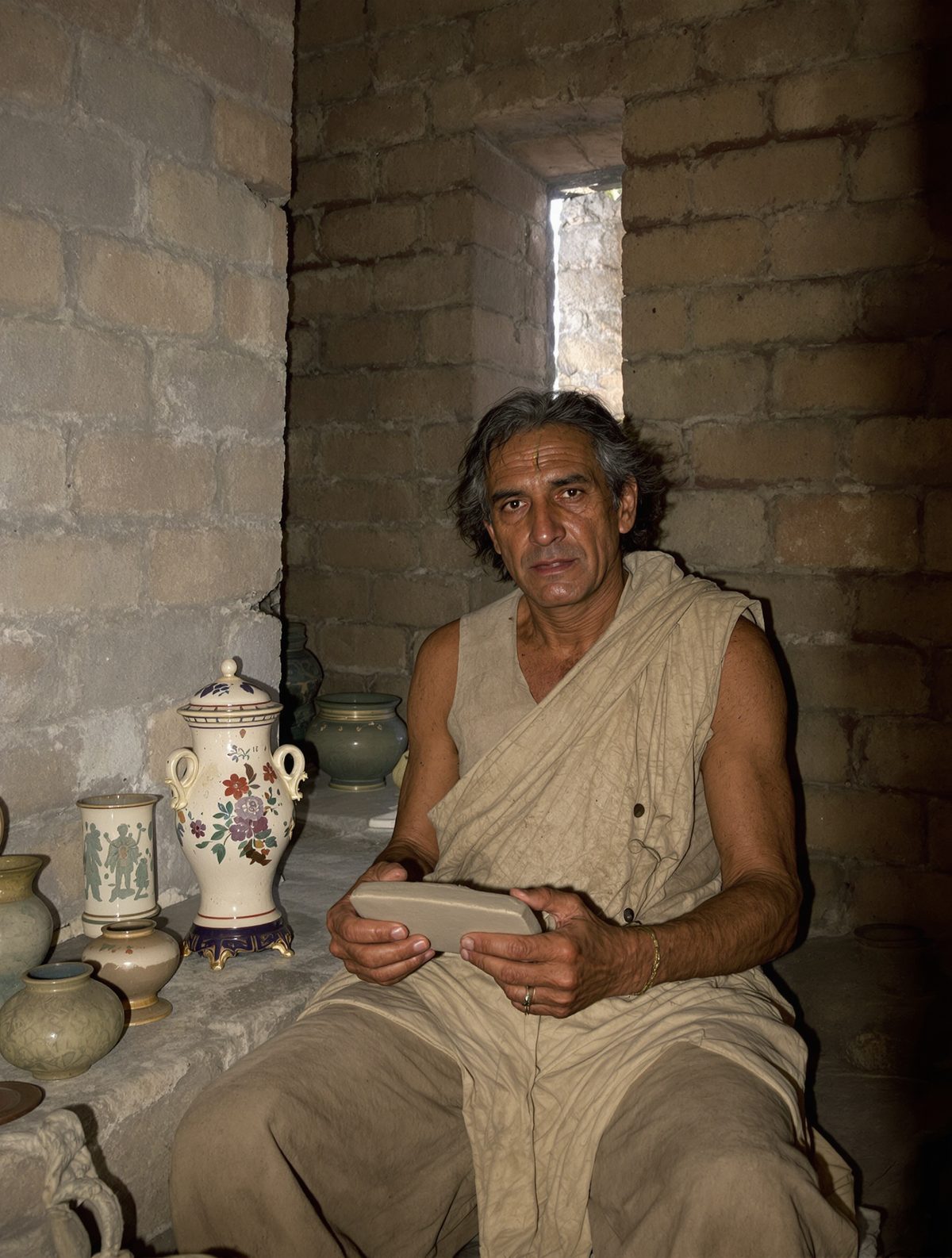
In the suffocating darkness of a sealed chamber beneath the ancient city of Harappa, a man sat clutching a clay tablet covered in the mysterious symbols of a civilization the world had forgotten. For over 4,000 years, he waited in his self-made tomb, surrounded by gleaming copper ingots, precious carnelian beads, and ivory combs that once commanded fortunes across the ancient world. When archaeologists finally broke through the carefully sealed stone door in 1926, they found him exactly as he had positioned himself in those final, desperate moments of 2300 BC—a wealthy merchant who had chosen to die with his treasure rather than live without it.
This is the story of Harish-Ka, whose name we know only from the cuneiform tablet found pressed against his chest—a ledger recording debts owed to him from as far away as Mesopotamia and the Persian Gulf. His dramatic final act offers us a rare glimpse into the sophisticated world of Bronze Age capitalism that flourished along the Indus River, in a civilization so advanced it had standardized weights, planned cities, and the world's first known sewage systems.
The Merchant Prince of the Indus
Harish-Ka lived during the height of the Indus Valley Civilization, when Harappa was one of the world's largest cities, home to perhaps 40,000 people. This was no primitive settlement—the city boasted multi-story houses with private wells, public baths fed by sophisticated aqueducts, and streets laid out in perfect grids that put modern urban planning to shame. The Great Bath of Harappa, with its waterproof bitumen lining and elaborate drainage system, suggests a level of engineering that wouldn't be seen again for centuries.
Archaeological evidence from Harish-Ka's compound reveals he was no ordinary trader. His warehouse, built from precisely cut sandstone blocks, covered nearly 2,000 square feet and contained goods from across the known world. Lapis lazuli from Afghanistan, silver from Iran, gold from Karnataka, and shells from the Arabian Sea filled his storerooms. Most tellingly, archaeologists found over 200 perfectly uniform stone weights, suggesting he conducted business on a massive scale.
The Harappan civilization had developed something remarkable: standardized measurements used across hundreds of settlements spanning an area larger than Egypt and Mesopotamia combined. A weight of 13.7 grams found in Harish-Ka's treasure room matched identical weights discovered in Harappan sites nearly 1,000 miles away—evidence of a commercial network more sophisticated than anything Europe would see until Roman times.
The Night the World Changed
The attack came without warning on what archaeologists believe was a moonless night in late summer, 2300 BC. Charcoal samples from the site suggest fires burned throughout the merchant quarter, while scattered weapons and hastily abandoned valuables paint a picture of sudden chaos. This wasn't random violence—it was organized warfare, possibly connected to the mysterious decline that would soon swallow the entire Indus Valley Civilization.
Harish-Ka's ledger, painstakingly translated by teams of linguists, records his final hours with chilling precision. The Harappan script remains largely undeciphered, but the tablet contains enough Akkadian cuneiform—the lingua franca of ancient commerce—to reconstruct the night's events. He writes of "raiders from the burning lands" and describes how his guards fled as attackers scaled his compound's walls.
Most haunting is a passage that roughly translates to: "My ships sail distant seas, but I sail now to the land from which no trader returns." Archaeological evidence supports his account—bronze arrowheads found embedded in the warehouse doors match designs used by pastoral tribes from the Balochistan highlands, groups that were increasingly pressuring settled Harappan communities as climate change dried up their traditional grazing lands.
The Last Gambit
As the raiders broke through his compound's outer defenses, Harish-Ka made a calculated decision that reveals much about both his character and his civilization's values. Rather than flee with whatever portable wealth he could carry, he retreated to a secret chamber built beneath his warehouse—a room whose existence was unknown even to his servants.
The chamber, measuring just 8 feet by 12 feet, had been designed as the ultimate safe room. Its entrance was concealed behind a false wall that could only be sealed from the inside using an ingenious counterweight system. Bronze tubes provided air circulation, while clay jars held enough water and grain to last several weeks. Harish-Ka clearly believed he could wait out the raiders and emerge to rebuild his empire.
But he had underestimated the thoroughness of the attack. The fires that consumed his warehouse collapsed portions of the building, blocking the chamber's air vents. His ledger's final entries, scratched in increasingly unsteady handwriting, record his growing desperation as oxygen dwindled. Yet even facing death, he continued updating his accounts, recording debts and calculating profits with the methodical precision that had made him wealthy.
Treasures of a Lost World
When British archaeologist Sir Mortimer Wheeler's team finally broke into the chamber, they found Harish-Ka's body surrounded by wealth that would have made him the envy of pharaohs. Over 400 pounds of copper ingots, stamped with the distinctive Harappan symbols of purity and origin, lay stacked against one wall. Nearby, thousands of perfectly drilled carnelian and faience beads filled ceramic jars—luxury items that had made Harappan merchants wealthy from the Mediterranean to Southeast Asia.
Most remarkably, the chamber contained what may be the world's oldest known safe-deposit system: individual sealed containers, each marked with unique symbols, apparently belonging to other wealthy Harappans who had entrusted their valuables to Harish-Ka's keeping. This suggests the Indus Valley had developed not just trade networks, but banking systems that wouldn't reappear until classical antiquity.
Among the most intriguing finds were dozens of small bronze figurines depicting traders, farmers, and craftsmen—possibly accounting tokens used to track different types of business transactions. These figurines display the same standardized proportions found in Harappan art across the civilization, suggesting centralized control over commercial practices that extended even to record-keeping methods.
The Civilization That Vanished
Harish-Ka died at a pivotal moment in world history. Around 2300 BC, the great Indus Valley Civilization was beginning its mysterious decline. Climate data suggests that changing monsoon patterns were drying up the rivers that fed Harappan agriculture, while archaeological evidence points to increasing raids by pastoral peoples displaced by the same environmental changes.
Unlike the Egyptian and Mesopotamian civilizations that left behind vast royal monuments, the Harappans built practical, egalitarian cities focused on trade and craftsmanship. Their undeciphered script appears mostly on small seals used for commercial purposes rather than royal proclamations. This merchant-centered culture created unprecedented prosperity—Harappan cities show little evidence of the extreme wealth disparities that characterized other ancient civilizations.
Yet this very practicality may have contributed to their civilization's disappearance from historical memory. With no pharaohs to build pyramids or kings to carve monuments, the Harappans left behind only the ruins of bathhouses, granaries, and merchant quarters. Their greatest achievements—standardized weights, urban planning, and long-distance trade networks—were invisible to later civilizations that associated greatness with monumental architecture and military conquest.
The Merchant's Legacy
Harish-Ka's story forces us to reconsider our assumptions about ancient history and human progress. His sophisticated accounting methods, international business network, and standardized commercial practices reveal a level of economic development that the world wouldn't see again for over a millennium. The Harappan civilization's emphasis on trade over warfare, practical infrastructure over monuments, and standardization over individual glory created a model of human organization that was, in many ways, more modern than anything that followed.
Today, as we grapple with global supply chains, international banking, and the environmental challenges of industrial civilization, Harish-Ka's final hours offer a sobering reminder that even the most sophisticated societies can vanish when environmental change outpaces human adaptation. His decision to die with his treasure rather than abandon his life's work speaks to something timeless about human nature—the merchant's eternal gamble that tomorrow's opportunities will justify today's risks.
In that sealed chamber beneath Harappa, clutching his ledger as the air ran out, Harish-Ka became both the first and last witness to a civilization that achieved greatness not through conquest, but through commerce—a achievement so complete that for 4,000 years, no one even knew it had existed.