
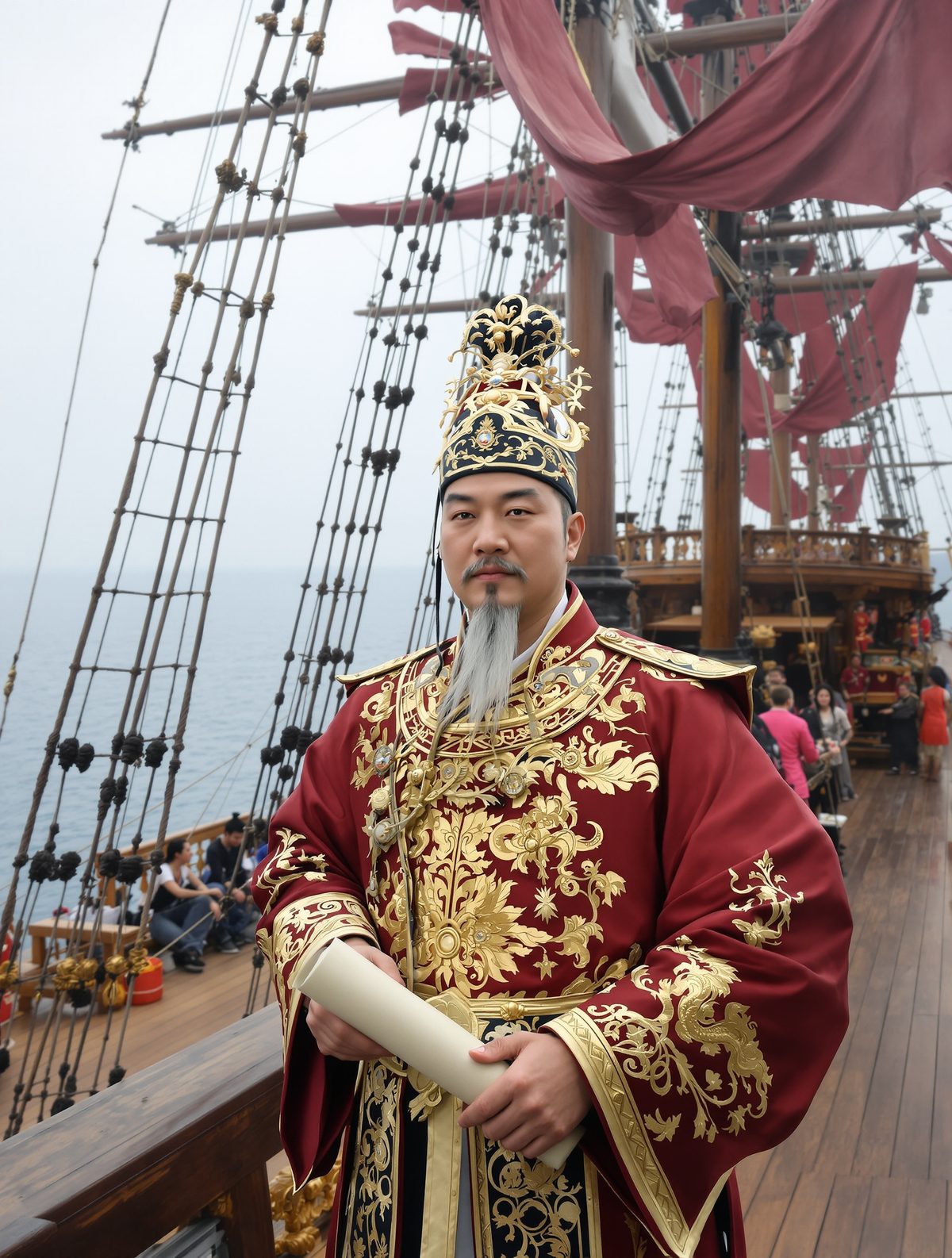
Picture this: It's 1405, and the largest fleet the world has ever seen is preparing to leave China's shores. Not one or two ships, but nearly 300 vessels carrying 28,000 men. The flagship alone stretches over 400 feet long—longer than Columbus's entire fleet combined. At the helm stands a towering figure, six feet tall in an age when most men barely reached five and a half feet. His name is Zheng He, and he's about to embark on the greatest maritime adventure in human history. Oh, and there's one more thing they never mentioned in your history textbook: he's a castrated Muslim leading a Chinese armada to the edges of the known world.
The Eunuch Who Conquered Oceans
Zheng He's story begins not with glory, but with tragedy. Born Ma He around 1371 in China's Yunnan province, he was a Muslim boy from the Hui ethnic minority. When the Ming Dynasty's armies swept through his homeland in 1381, ten-year-old Ma He was captured, castrated, and forced into imperial service—a common fate for conquered peoples' children. But this wasn't just cruelty; it was imperial strategy. Eunuchs couldn't father dynasties or threaten the emperor's bloodline, making them paradoxically powerful and completely dependent on royal favor.
The young eunuch caught the attention of Prince Zhu Di during the brutal civil war that followed the founding emperor's death. Ma He proved himself a brilliant military tactician, helping Zhu Di seize the throne in 1402. The grateful new emperor, now called Yonglo, renamed his loyal servant Zheng He—literally "Zheng's Harmony"—and promoted him to admiral. It was the ultimate rags-to-riches story, medieval Chinese style.
But why did Emperor Yonglo suddenly decide China needed the world's largest navy? The answer reveals a side of medieval China that would shock most Western readers: this wasn't an isolated, inward-looking civilization. This was a confident superpower ready to announce its dominance to every corner of the known world.
Treasure Ships Larger Than Cathedrals
When Zheng He's first treasure fleet departed Nanjing in 1405, European observers would have struggled to comprehend what they were seeing. The flagship—called a "treasure ship"—measured an estimated 400 feet in length and 160 feet in width. To put that in perspective, Columbus's flagship, the Santa María, was roughly 85 feet long. These weren't just ships; they were floating cities with nine masts reaching toward the sky like a forest of giants.
The fleet itself was organized with military precision that wouldn't look out of place in a modern naval operation. Beyond the massive treasure ships came 240 support vessels: warships bristling with early cannons, supply ships loaded with provisions, troop transports carrying 27,800 soldiers, sailors, merchants, doctors, interpreters, and officials. Some ships served as floating gardens, growing fresh vegetables during months-long voyages. Others functioned as mobile hospitals or workshops for repairs.
The scale of preparation was staggering. Chinese shipyards worked for years crafting these maritime marvels, developing advanced techniques like watertight bulkheads—compartments that could be sealed if the hull was breached. While European ships of the era were essentially large rowboats with sails, Chinese vessels incorporated sophisticated rudder systems, multiple masts for better navigation, and compass technology that gave them unprecedented accuracy on the open ocean.
Each voyage cost the imperial treasury roughly 3.3 million ounces of silver—equivalent to about 10% of the entire government's annual revenue. For comparison, Columbus's entire expedition cost less than what it took to feed Zheng He's crew for a month.
Seven Voyages to the Edge of the World
Between 1405 and 1433, Zheng He launched seven massive expeditions, each more ambitious than the last. The first three voyages focused on Southeast Asia, establishing Chinese authority in what Europeans would later call the "Spice Islands." But it was the fourth voyage in 1413 that truly made history: Zheng He's fleet rounded the Indian subcontinent and entered the Arabian Sea, becoming the first Chinese expedition to reach the Persian Gulf and the eastern coast of Africa.
The Chinese weren't coming as conquerors, but as the world's ultimate diplomatic mission. Everywhere they landed, Zheng He's interpreters—speaking Arabic, Persian, Tamil, and local dialects—announced that the Son of Heaven desired peaceful relations with all nations. Local rulers were invited aboard the treasure ships, where they gasped at displays of Chinese silk, porcelain, tea, and craftsmanship that seemed almost magical to medieval eyes.
The return voyages turned into floating zoos. From Ceylon (modern Sri Lanka), they brought back cinnamon trees and Buddhist relics. From India came precious stones and exotic birds. But the crown jewel of Chinese diplomacy came from the eastern African coast: giraffes.
When Zheng He's ships returned to Nanjing with these impossibly tall creatures, the imperial court went wild. Chinese scholars declared them qilin—mythical creatures whose appearance was supposed to herald a golden age of peace and prosperity. The Yonglo Emperor was so delighted that he commissioned paintings of himself receiving the "qilin" as tribute, propaganda masterpieces that declared China's cosmic authority over the natural world.
The Admiral Who Reached Africa First
Here's where the story gets mind-bending for anyone raised on European-centered history: Zheng He was regularly sailing to Africa's eastern coast decades before Portuguese explorers had even figured out how to navigate around West Africa's treacherous Cape Bojador. While Europeans were still hugging coastlines in terror of falling off the edge of the world, Chinese admirals were confidently crossing open oceans using sophisticated star charts and magnetic compasses.
The Chinese established permanent bases in what's now Malaysia and Sri Lanka. They intervened in local conflicts, sometimes decisively. During his first voyage, Zheng He encountered a pirate confederation led by a notorious commander named Chen Zuyi, who controlled the crucial Strait of Malacca. The resulting naval battle was a massacre—5,000 pirates killed, their leaders captured and brought back to China for public execution. The message was clear: the South China Sea and Indian Ocean were now Chinese lakes.
Archaeological evidence of this Chinese presence keeps surfacing across the Indian Ocean. Fifteenth-century Chinese coins have been found in Kenya. DNA studies suggest some East African populations carry Chinese genetic markers dating to this period. Most intriguingly, local African oral traditions in Somalia and Kenya still preserve stories of light-skinned visitors who arrived in enormous ships, bringing gifts and trading for exotic animals.
What makes this even more remarkable is the technology gap. When Vasco da Gama finally reached India in 1498, he found a sophisticated trading network that Chinese admirals had been dominating for nearly a century. European "discoveries" weren't discoveries at all—they were attempts to muscle into existing Chinese spheres of influence.
The Most Expensive Maritime Funeral in History
Then, almost overnight, it all ended. Emperor Yonglo died in 1424, and his son took a dramatically different approach to foreign policy. The new emperor, Hongxi, ruled for less than a year, but his brief reign began a fundamental shift in Chinese priorities. The treasure voyages were enormously expensive, and China was facing pressure on its northern borders from Mongol tribes. Why waste silver on exotic giraffes when barbarians were threatening the homeland?
Zheng He managed to launch one final voyage in 1433 under Emperor Xuande, but it was clearly a farewell tour. When the great admiral died sometime between 1433 and 1435—possibly during this last expedition—an entire era of Chinese maritime exploration died with him.
What happened next was the most systematic destruction of historical records in maritime history. New emperors ordered the treasure ships broken up for timber. Maritime charts were confiscated and destroyed. Officials who had participated in the voyages were transferred to inland posts. Within two generations, it became almost treasonous to even mention Zheng He's expeditions.
The Confucian bureaucrats who had always opposed the expeditions finally got their way. China turned inward, focusing on land-based threats and internal development. The world's greatest navy was scrapped, and China's dominance of the Indian Ocean was abandoned just as European explorers were beginning to venture beyond their coastal waters.
The Alternative History That Never Happened
Imagine if China had continued Zheng He's maritime expansion. Chinese colonies might have been established across Southeast Asia, India, and East Africa decades before Europeans arrived. The age of European colonialism might never have happened, or at least would have faced organized Chinese resistance backed by established bases and allied local rulers.
Instead, when Portuguese explorers finally reached the Indian Ocean, they found a power vacuum. The sophisticated trading networks were still there, but no unified naval force protected them. European cannons and aggressive tactics gradually displaced the peaceful tribute-based system that Zheng He had established.
This decision to abandon the seas may rank as one of history's most consequential policy reversals. China possessed the technology, resources, and organizational skills to dominate global trade for centuries. Instead, the Middle Kingdom chose isolation, leaving maritime exploration to smaller, poorer European nations whose descendants would eventually show up at China's borders with gunboats and opium.
Today, as China once again projects naval power across the South China Sea and Indian Ocean, officials sometimes invoke Zheng He's memory. The eunuch admiral has become a symbol of China's "peaceful rise"—a historical precedent for Chinese expansion that emphasizes trade and diplomacy rather than conquest and colonization. Whether that's historically accurate is debatable, but there's no question that Zheng He's story offers a fascinating glimpse of how different our world might have looked if China had chosen the sea over the land, exploration over isolation, and the future over the past.