The autumn mist clung to the stone walls of Dún Ailinne like a burial shroud on the night of October 31st, 722 AD. Inside the fortress, High King Fergal mac Máele Dúin feasted with his warriors, their laughter echoing through torch-lit halls. But as the wine flowed and the fire crackled, a sound pierced the revelry—a keening wail that seemed to rise from the very earth itself. The warriors fell silent. Goblets clattered to stone floors. The king's face went ashen, for he knew that cry. Every Irishman of noble blood knew it. The Bean Sídhe had come for him.
Within days, Fergal would lie dead on a battlefield, struck down in his prime. The ghostly herald had kept her ancient promise, as she had for countless generations of Irish royalty. Welcome to the terrifying world of the Banshee—Ireland's most feared supernatural messenger.
The Phantom Genealogist: Death's Personal Herald
The Bean Sídhe (pronounced "ban-SHEE," literally meaning "woman of the fairy mound") wasn't just any random specter haunting Ireland's countryside. She was far more selective—and far more sinister. This otherworldly entity attached herself exclusively to the bloodlines of ancient Gaelic nobility, serving as a supernatural genealogist who tracked royal lineages with deadly precision.
What makes the Banshee truly remarkable among the world's mythological creatures is her specificity. Unlike generic death omens found in other cultures, she maintained what Irish folklore describes as detailed family trees spanning centuries. The O'Neills, O'Briens, O'Connors, MacCarthys, and Kavanaghs—each great house had their own Bean Sídhe, bound to their bloodline by ancient supernatural contracts that predated Christianity's arrival in Ireland.
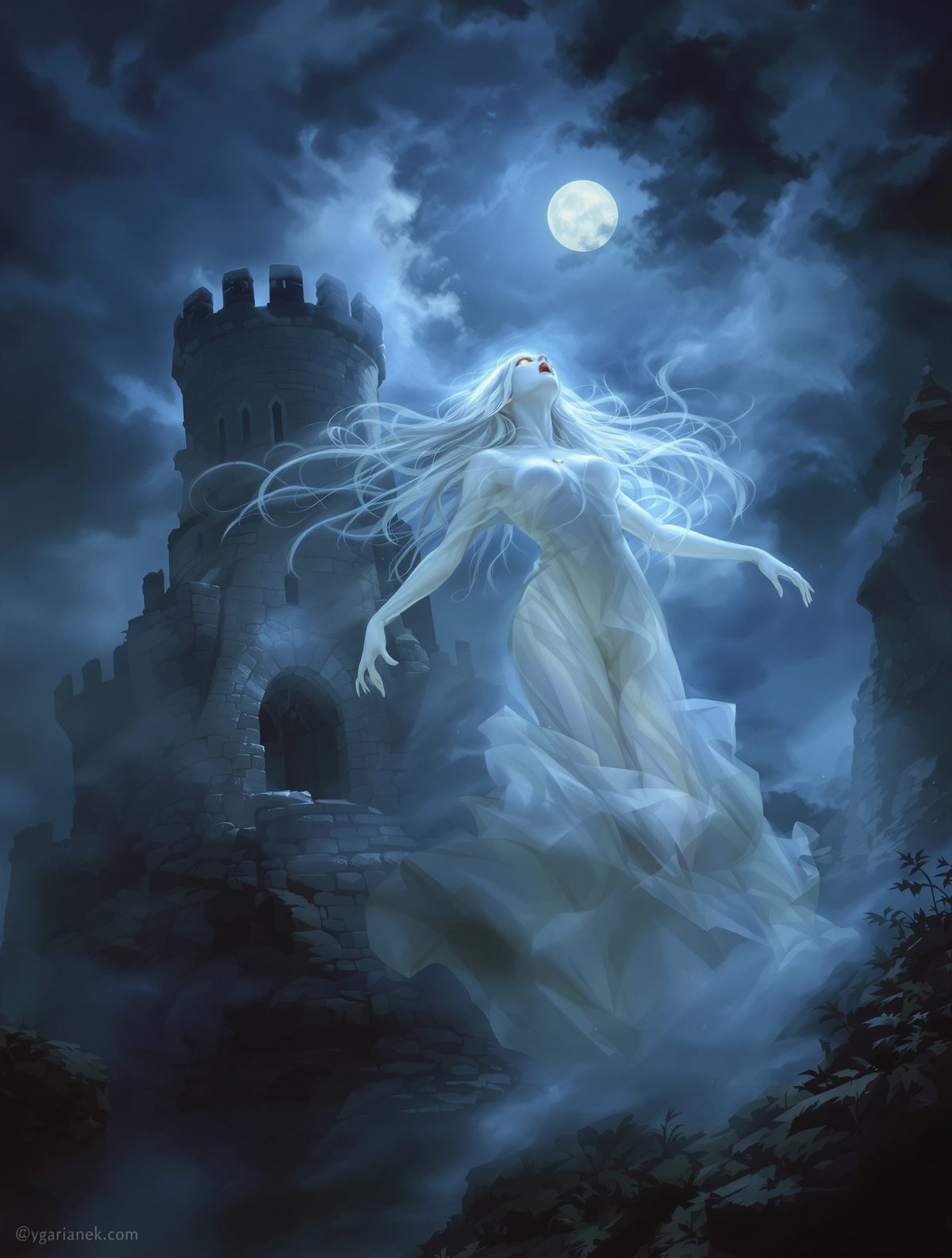
Medieval Irish manuscripts describe her as appearing in three distinct forms, each more terrifying than the last. Sometimes she manifested as a beautiful young woman in a flowing gray cloak, her ethereal beauty masking her grim purpose. Other times, she appeared as a washerwoman by a river, scrubbing bloodstained clothes in the pre-dawn darkness—the garments of those about to die. Most fearsome of all was her third form: an ancient crone with streaming white hair, her eyes red from centuries of weeping for the noble dead.
The Royal Death Watch: Historical Encounters
Irish chronicles are filled with spine-chilling accounts of the Banshee's appearances before significant historical deaths. The Annals of the Four Masters, compiled between 1632-1636, records dozens of instances where her keen preceded the demise of kings and chieftains.
One of the most documented cases occurred in 1014, before the Battle of Clontarf. Brian Boru, the High King who had united Ireland against Viking invaders, allegedly heard the Banshee's wail three nights running before the battle. His servants reported finding her washing his royal cloak in the River Tolka, the water running red around her ghostly hands. Despite his victory over the Vikings, Brian Boru died in his tent, struck down by a fleeing Norse warrior—exactly as the Banshee had foretold.
But perhaps the most chilling account comes from the 16th century, during the reign of Queen Elizabeth I. Irish nobleman Sir Richard O'Donel reported to English authorities that a "woman in white" appeared at his castle walls for seven consecutive nights, her wailing growing louder each evening. O'Donel dismissed it as peasant superstition—a fatal mistake. Within a fortnight, he was dead from a sudden fever that physicians couldn't explain, leaving English colonial records to puzzle over the "prophetic woman" who had seemingly predicted his demise.
More Than Just Screaming: The Banshee's Supernatural Repertoire
While her terrifying keen remains the Banshee's most famous calling card, Irish folklore credits her with a far more diverse set of supernatural abilities. The 17th-century manuscript Leabhar na hUidhre (Book of the Dun Cow) describes Bean Sídhe as master shapeshifters who could appear as ravens, hares, or even inanimate objects like combs or mirrors left in strategic locations.
Her mourning ritual was elaborate and specific. Witnesses described how she would begin her lament three days before a death, starting as a barely audible whisper and building to a crescendo that could allegedly be heard for miles. The keen itself wasn't random noise—it followed traditional Irish caoine (lament) patterns, complete with genealogical recitations tracing the victim's noble ancestry back generations.
What's particularly fascinating is how the Banshee's behavior adapted to reflect Irish social structures. For minor nobility, she might appear alone. But for high kings and great chieftains, folklore describes entire supernatural entourages—multiple Bean Sídhe keening in harmony, creating a otherworldly chorus that reportedly shattered glass and withered plants within earshot.
Some accounts even suggest she possessed a twisted form of mercy. Rare stories tell of Bean Sídhe appearing to warn their chosen families, giving them time to prepare for death or, in exceptional cases, to change fate through acts of great courage or sacrifice.
The Protestant Paradox: Banshees in Colonial Ireland
Here's where the Banshee's story takes an unexpected turn. When English and Scottish Protestant settlers arrived during the Plantation period (1556-1620), something remarkable happened: the Bean Sídhe began appearing to their descendants too. But only after these families had lived in Ireland for several generations and, crucially, intermarried with Gaelic nobility.
The most famous case involved the Rossmore family, Anglo-Irish peers who acquired lands in County Monaghan in the 1600s. By the 18th century, local Irish tenants reported seeing the family Banshee—a woman in brown robes who appeared whenever a Rossmore was about to die. The family initially dismissed these reports as Catholic superstition, until 1801, when multiple witnesses, including Protestant clergymen, reported seeing and hearing her before the death of the 2nd Baron Rossmore.
This adaptation reveals something profound about how Irish supernatural beliefs evolved. The Bean Sídhe wasn't simply attached to Celtic genetics—she was bound to the land itself and the feudal obligations that came with ruling Irish territories. English Protestant families who genuinely integrated into Irish society, rather than remaining colonial outsiders, found themselves inheriting not just estates and titles, but the otherworldly watchers who came with them.
The Science of Supernatural Keening
Modern researchers have uncovered fascinating connections between Banshee lore and real medieval Irish traditions that make her legend even more intriguing. Professional keening women, called bean chaointe, were actually employed by noble families to perform elaborate funeral laments. These women memorized complex genealogies and could recite the heroic deeds of the deceased's ancestors while performing ritualized mourning displays.
Archaeological evidence suggests that some keening women lived in isolated settlements near ancient ring forts and fairy mounds—the same locations where Banshees were said to dwell. Dr. Patricia Lysaght, Ireland's leading Banshee researcher, theorizes that the supernatural Bean Sídhe evolved from folk memories of these real professional mourners, who would have known the intimate details of noble families and might have been able to predict deaths through their close connections to household politics and health.
Even more intriguingly, recent studies of Irish traditional keening have found that the vocal techniques produce frequencies that can carry for extraordinary distances under the right atmospheric conditions—especially in the misty, humid climate of medieval Ireland. What witnesses interpreted as supernatural volume might have been sophisticated acoustic knowledge passed down through generations of professional mourners.
When Ancient Omens Meet Modern Times
The Bean Sídhe's influence on Irish culture extends far beyond dusty folklore collections. Her presence shaped how entire generations approached death, power, and the responsibilities that come with leadership. Unlike many mythological creatures who simply terrorized for entertainment, the Banshee served as a supernatural check on noble privilege—a reminder that death comes for kings and commoners alike.
In our modern world, obsessed with celebrity culture and political dynasties, there's something both terrifying and oddly comforting about the Banshee's absolute impartiality. She didn't care about wealth, armies, or political connections. Royal blood was royal blood, and death was death. Her keen cut through pretension and power games with supernatural clarity.
Perhaps that's why Banshee stories continue to evolve in contemporary Ireland. As recently as the 1950s, rural Irish communities reported Banshee sightings before the deaths of local politicians and business leaders whose families could trace their lineage back to Gaelic nobility. The ancient supernatural contracts, it seems, remain in effect—binding the living to their otherworldly herald across centuries of change.
The Bean Sídhe reminds us that some forces transcend human ambition and political power. In a world where we often forget that leadership carries spiritual as well as worldly responsibilities, her eternal vigil offers a haunting lesson: those who rule the land must answer to powers far older and more enduring than any crown.