
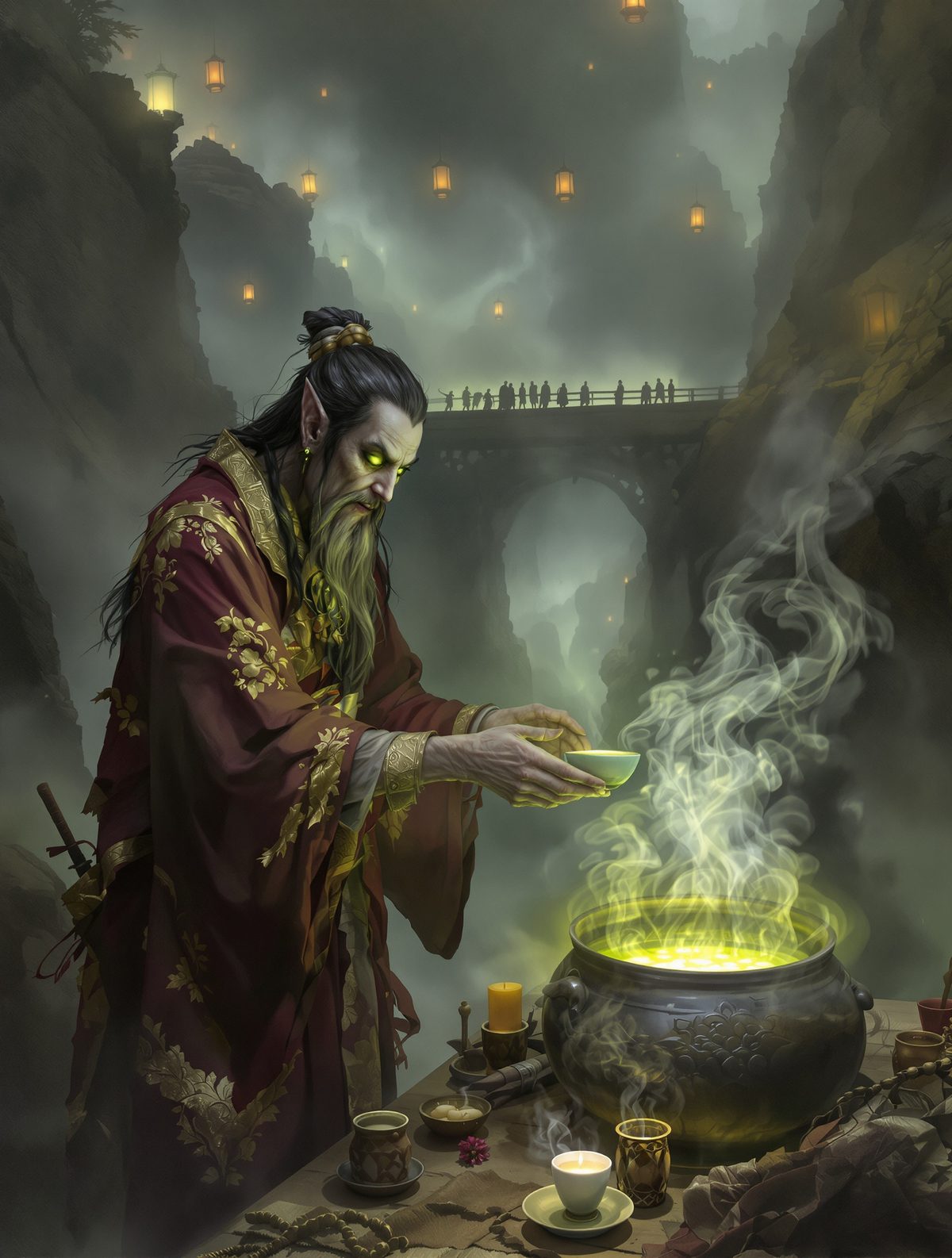
Picture this: you've just died, and after what feels like an eternity wandering through the shadowy corridors of the Chinese underworld, you finally see light ahead. But as you approach what you hope is your escape back to the world of the living, an ancient woman appears before you, her weathered hands wrapped around a steaming cup of tea. She smiles with the patience of someone who has performed this ritual billions of times before. "Drink," she whispers, and you realize with growing horror that this one sip will erase everything you ever were—every kiss, every sunset, every moment of joy or sorrow that made you human.
This is your encounter with Meng Po, the goddess of forgetfulness, and the tea she offers is no ordinary brew. For over two millennia, Chinese culture has whispered tales of this mysterious figure who stands guard at the boundary between death and rebirth, ensuring that no soul carries the burden of their previous life into the next.
The Lonely Sentinel of Naihe Bridge
Deep within the Chinese underworld, spanning the treacherous River of Helplessness, stands the Naihe Bridge—literally translated as the "Bridge of Helplessness" or "Bridge of No Alternative." This isn't just any bridge; it's the final checkpoint every soul must cross before returning to the world of the living. And there, like a cosmic customs officer with the ultimate immigration policy, sits Meng Po with her humble tea stall.
The bridge itself is described in ancient texts as impossibly narrow, forcing souls to walk single file toward their fate. Some accounts from the Journey to the West traditions describe it as being made of bones from the virtuous dead, while other sources suggest it shifts between silver for the righteous and rusty iron for the wicked. But regardless of the bridge's appearance, every soul faces the same destiny: Meng Po's tea.
What makes this legend particularly fascinating is its specificity. Unlike vague mythological concepts, Chinese folklore provides detailed bureaucratic instructions about the afterlife process. Souls must present themselves to Meng Po after being judged by the Ten Courts of Hell—a complex judicial system that would make modern legal proceedings look simple. Only after receiving proper documentation of their judgment could they approach the tea station.
The Recipe for Oblivion
But what exactly goes into this memory-erasing brew? According to texts dating back to the Han Dynasty (206 BCE - 220 CE), Meng Po's tea isn't made from ordinary leaves. The goddess collects five specific ingredients, each more haunting than the last: tears shed in life, bitter herbs from the underworld, sweet water from the River of Forgetfulness, fragments of forgotten dreams, and drops of morning dew from the mortal world that carries the essence of new beginnings.
The brewing process itself is described as taking exactly forty-nine days—seven cycles of seven, a number considered magically significant in Chinese cosmology. Meng Po tends to her massive cauldron with supernatural patience, stirring counterclockwise to reverse the flow of memory, while chanting incantations that have never been written down, only passed through the ether of the underworld.
Perhaps most chillingly, some versions of the legend claim that the tea tastes different to each soul—sometimes unbearably bitter, sometimes impossibly sweet, sometimes like nothing at all. The flavor allegedly corresponds to the dominant emotion of their past life. Those who lived lives filled with love taste honey and flowers, while those consumed by hatred experience a brew so bitter it burns their ghostly throats. Yet regardless of the taste, the effect remains the same: complete and total amnesia.
The Goddess Who Cannot Forget
The cruel irony of Meng Po's existence becomes clear when you learn her own tragic backstory. Unlike the souls she serves, she retains perfect memory of everything—not just her own past, but fragments of every life she's helped erase. Born during the reign of Emperor Wu of Han (156-87 BCE) as a mortal woman, she achieved such spiritual enlightenment that the Jade Emperor himself appointed her to this crucial position in the afterlife bureaucracy.
But here's where the legend becomes truly heartbreaking: Meng Po's punishment for her wisdom is eternal remembrance. She alone carries the weight of countless human experiences, making her simultaneously the most knowledgeable and most isolated being in Chinese mythology. Some accounts describe her weeping as she serves the tea, knowing that she's destroying beautiful memories alongside traumatic ones, but understanding that this erasure is necessary for the cycle of reincarnation to continue.
Ancient texts describe her appearance as deliberately unremarkable—an elderly woman in simple robes, with kind eyes that seem to hold the depth of all human experience. This ordinariness is intentional; souls in their final moments before rebirth shouldn't be distracted by divine splendor, but comforted by something that feels familiar and safe.
The Souls Who Refused to Drink
Not every soul submits willingly to memory erasure, and Chinese folklore is filled with tales of those who attempted to avoid Meng Po's tea. These rebellious spirits employed various strategies: some tried to hide memories in physical objects they carried, others attempted to rush past the tea station, and a few even tried to negotiate with the goddess herself.
According to legend, souls who successfully avoid the tea face a terrible fate. Without the clean slate of forgetfulness, they're reborn with full knowledge of their previous lives, creating psychological torment that drives them to madness. These individuals often become what Chinese culture calls "ghost children"—babies who cry inconsolably because they remember their adult deaths, or children who speak of places and people from decades before their birth.
One particularly famous story tells of a Tang Dynasty scholar who managed to bribe an underworld official to let him bypass Meng Po's station. Reborn with complete memories, he spent his new life searching for his previous wife and children, only to discover they had moved on and forgotten him entirely. The emotional devastation supposedly drove him to suicide, sending him right back to Meng Po's bridge, where this time he drank her tea gratefully.
The Five-Flavored Tea of Forgetfulness
The most detailed descriptions of Meng Po's operation come from the Ming Dynasty novel Journey to the West (16th century), though the goddess herself appears in much older Buddhist and Taoist texts. These sources reveal that she actually serves five different types of tea, each designed for specific categories of souls.
The first tea, made with sweet herbs, is reserved for those who lived virtuous lives—their forgetting should be gentle. The second, bitter and harsh, purges the memories of those who committed great evils. The third tea contains both sweet and bitter elements for souls who lived morally complex lives. The fourth tea, described as "neither sweet nor bitter, but profound," is given to those who achieved spiritual enlightenment. Finally, the fifth tea—tasteless as water—is reserved for souls so pure they need only the lightest touch of forgetfulness.
What's remarkable is how this system reflects sophisticated thinking about memory, trauma, and healing that wouldn't be out of place in modern psychology. The idea that different people might need different approaches to letting go of the past shows an understanding of human nature that transcends the legend's mythological framework.
Why Meng Po Still Matters in the Digital Age
In our era of digital permanence, where every embarrassing photo and thoughtless comment lives forever in the cloud, Meng Po's gift of forgetfulness feels almost enviable. We live in a world where memory has become both blessing and curse—we can preserve every precious moment, but we can never escape our mistakes or trauma.
The legend of Meng Po asks profound questions that remain relevant today: Is forgetting sometimes merciful? Can we truly move forward while carrying the full weight of our past? In a culture increasingly focused on accountability and remembrance, the Chinese goddess of forgetfulness reminds us that there might be wisdom in letting go.
Perhaps most importantly, Meng Po's eternal vigil represents the ultimate act of compassion—taking on the burden of remembering so that others can have the peace of forgetting. In our interconnected world, where collective memory often feels overwhelming, maybe we all need someone like Meng Po: a guardian who holds our stories so we don't have to carry them forever, ensuring that while experiences are never truly lost, souls can always begin again.