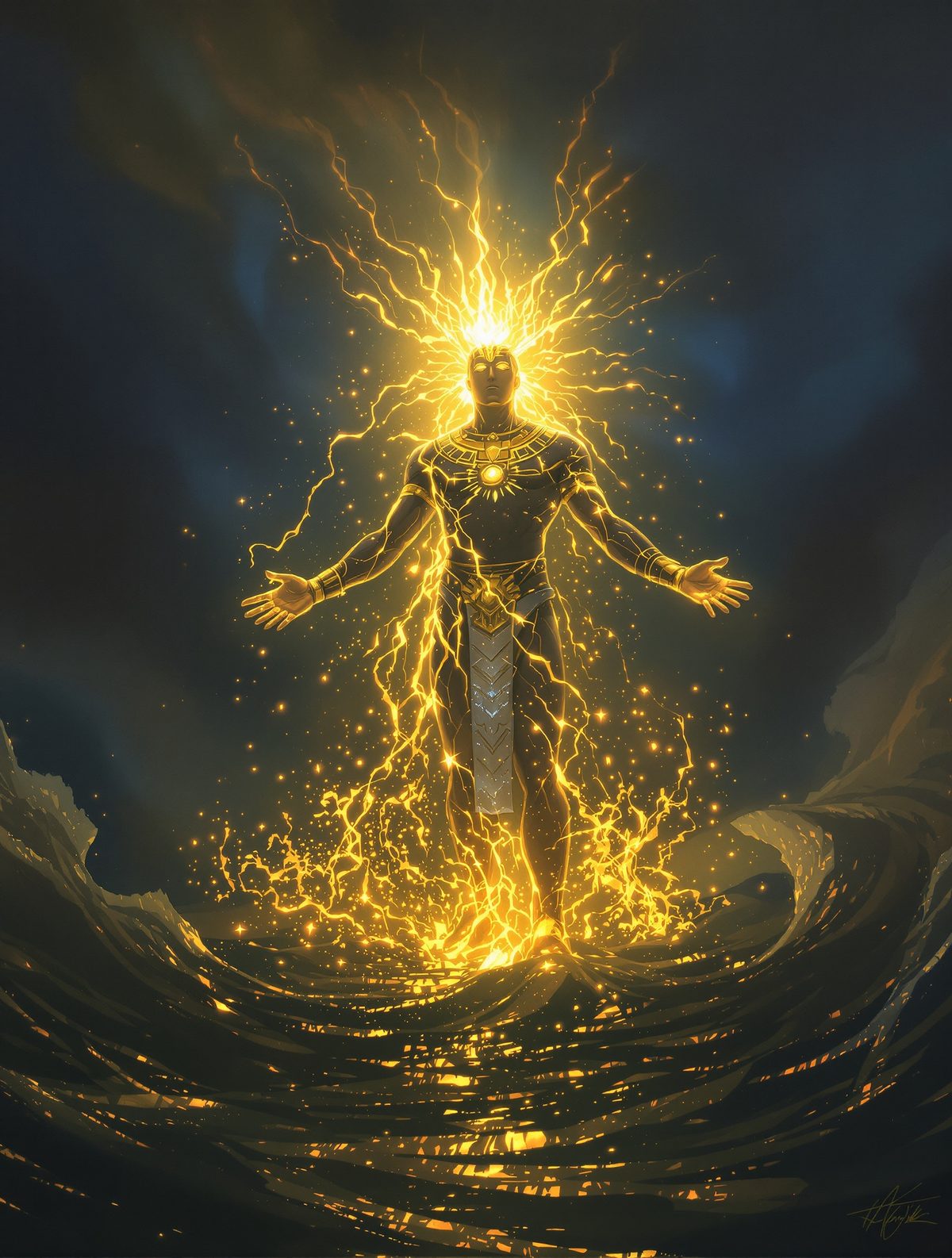
Picture this: you are the only conscious being in existence, floating in an endless ocean of darkness. There is no light, no land, no other life—just you and the infinite black waters that stretch beyond all comprehension. Now imagine you must create an entire universe. How do you begin when there's literally nothing else to work with except yourself?
This was the predicament facing Atum, the ancient Egyptian creator god, in the primordial waters of Nun around 3100 BCE, when the first pyramid texts were being carved into stone. What happened next became one of history's most audacious creation myths—a story so raw and intimate that it challenges every sanitized version of divine creation we've been taught.
The Loneliness of the First God
In the beginning, according to the priests of Heliopolis—the ancient Egyptian city known as Iunu—there was only Nun, the vast primordial ocean of chaos and nothingness. Within these dark, lifeless waters existed Atum, whose name literally means "the complete one" or "the finisher." But complete was exactly what Atum wasn't. He was utterly, devastatingly alone.
The ancient texts describe this primordial loneliness with surprising poignancy. The Coffin Texts, dating to around 2055-1650 BCE, speak of Atum's isolation in terms that would make even modern readers sympathize with this cosmic deity. "I was alone with Nun in inertness," Atum declares in one passage, "and I could not find a place where I might stand or sit."
But Atum possessed something that made him unique among creation deities: he was bisexual in nature, containing both male and female aspects within his divine essence. This wasn't unusual in Egyptian theology, where gods regularly transcended human gender limitations. What was unusual was what Atum decided to do about his cosmic loneliness.
The Act That Shocked the Divine Realm
Faced with the impossible task of creating other beings from nothing, Atum made a decision that would be recorded in some of ancient Egypt's most sacred texts. The Pyramid Texts, carved into the burial chamber of Pharaoh Unas around 2375 BCE, describe the moment with startling directness: "Atum masturbated in Heliopolis. He put his penis in his fist to make orgasm by means of it."
This wasn't a moment of weakness or divine lust—it was the ultimate act of creation. Through divine masturbation, Atum would bring forth the first gods and begin the long process of creating the world. The ancient Egyptians saw this act as so fundamental to existence that they recorded it in their most holy texts, ensuring it would be preserved for over 4,000 years.
The Bremner-Rhind Papyrus, dating to around 300 BCE, provides even more explicit detail: "I made love with my fist, I masturbated with my hand, I spat from my mouth." The Egyptian word used here, nesh, leaves no room for metaphorical interpretation—this was divine self-pleasure in its most literal sense.
From Divine Seed Springs the Universe
What emerged from Atum's climactic moment weren't ordinary children, but the fundamental forces that would shape all reality. From his divine ejaculation came Shu, the god of air and atmosphere, and Tefnut, the goddess of moisture and dew. Some versions of the myth describe Atum spitting out these first gods, while others maintain they emerged directly from his semen.
The symbolism here runs deeper than mere shock value. Shu and Tefnut represented the first separation of elements in the universe—dry air and wet moisture, the beginning of differentiation in what had been undifferentiated chaos. Their birth marked the moment when the universe began to organize itself into the complex system that would eventually support all life.
Atum's creative act also established him as "the great he-she," a being who could generate life without a partner. The Coffin Texts celebrate this unique ability: "I am the one who came into being as Khepri. When I came into being, being came into being, and all beings came into being after I came into being."
The Divine Family Tree Grows
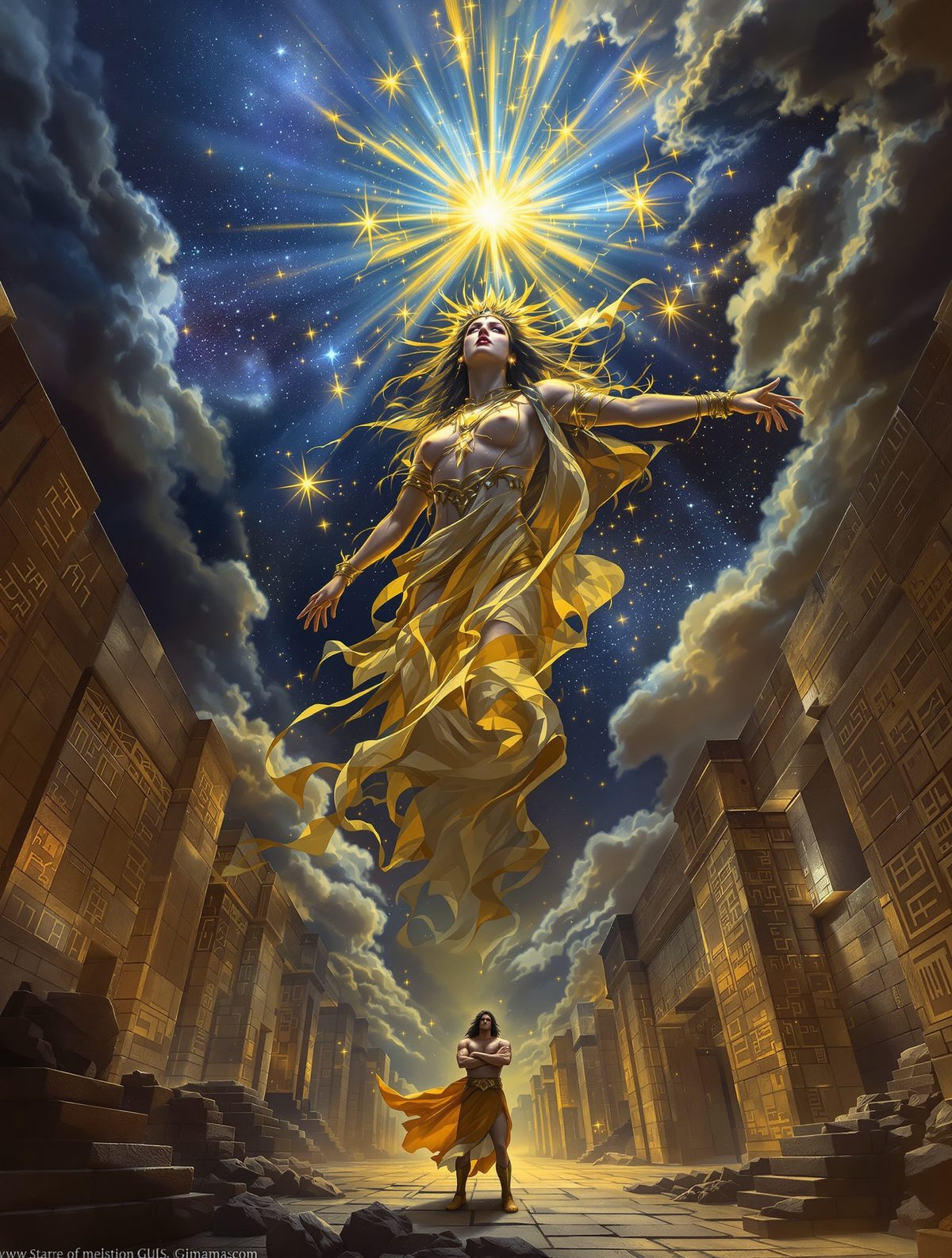
Shu and Tefnut, products of divine masturbation, would go on to have their own children through more conventional means. They produced Geb, the earth god, and Nut, the sky goddess—creating the first divine couple to engage in what we might recognize as traditional sexual reproduction. Geb and Nut's passionate union was so intense that Shu had to physically separate them, lifting Nut up to form the star-covered sky while Geb remained below as the earth.
This second generation would produce the most famous gods of the Egyptian pantheon: Osiris, Isis, Seth, and Nephthys. Each of these deities could trace their existence back to that original moment of divine self-pleasure in the primordial waters. The ancient Egyptians understood that their entire cosmic family tree had grown from a single, intimate act of self-creation.
The priests of Heliopolis maintained detailed genealogies of these divine births, creating what they called the Ennead—the nine great gods who emerged from Atum's initial creative act. These weren't just mythological figures but active forces in Egyptian religious life, worshipped in temples from Memphis to Aswan for over 3,000 years.
Sacred Masturbation in Ancient Egypt
The myth of Atum's creative masturbation had profound effects on ancient Egyptian culture and religion. Far from being seen as shameful or hidden, divine masturbation became incorporated into sacred rituals and royal ceremonies. Pharaohs, as living gods, were expected to reenact Atum's creative act during certain festivals.
The annual flooding of the Nile, which brought life to Egypt, was directly connected to this creation myth. The Hymn to the Nile from around 2100 BCE describes the river's life-giving flood as a continuation of Atum's original ejaculation: "When the Nile floods, it is Atum creating life anew." Priests would perform ritual masturbation ceremonies to ensure the flood's arrival, understanding it as participation in cosmic creation.
Archaeological evidence from sites like Karnak and Dendera shows that temples contained special chambers where these creation rituals took place. Hieroglyphic inscriptions describe priests "completing the work of Atum" through sacred masturbation, demonstrating how thoroughly this creation myth had been integrated into Egyptian religious practice.
Why This Story Still Matters
In our modern world, where creation myths are often sanitized into children's stories or dismissed as primitive superstition, Atum's story offers something radically different: a creation myth that embraces the full spectrum of biological reality. The ancient Egyptians understood something we often forget—that creation is inherently messy, intimate, and deeply physical.
This myth also challenges our assumptions about ancient attitudes toward sexuality. Rather than shame or embarrassment, the Egyptians saw divine masturbation as the ultimate creative act, worthy of celebration and ritual reenactment. They understood that life emerges from the most intimate aspects of existence, and they weren't afraid to acknowledge that truth.
Perhaps most importantly, Atum's story speaks to the fundamental human experience of loneliness and the drive to create connection. In our age of digital isolation and existential anxiety, there's something powerfully relevant about a god who faced ultimate loneliness and responded by creating community. Atum didn't wait for someone else to solve his cosmic solitude—he took action, literally into his own hands, and built the universe he wanted to inhabit.
The next time you encounter a creation story, remember Atum floating in those dark waters of Nun, facing an impossible task with nothing but his own divine essence to work with. Sometimes the most profound acts of creation come from the most intimate moments of self-discovery.