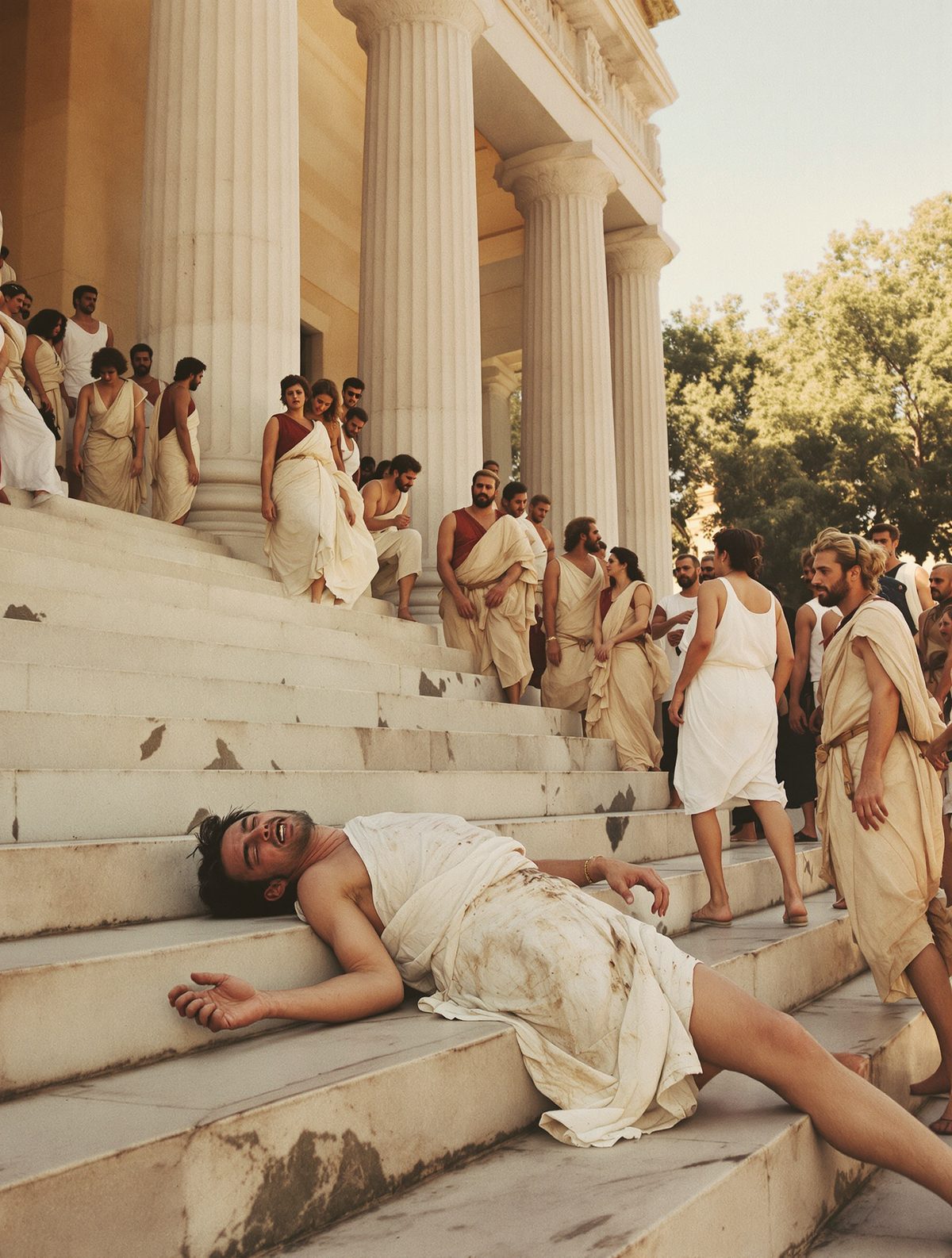
Picture this: you're standing in the Athenian agora in 322 BC, watching mourners file past an elaborate funeral bier. The entire city has turned out to pay respects to Hyperides, one of their greatest orators—a man who had thundered against tyrants and defended democracy with his silver tongue. Women wail, men bow their heads, and flowers pile high around the ceremonial coffin. There's just one problem: the corpse inside isn't actually dead.
What the grieving Athenians didn't know was that they were witnessing one of history's most audacious political escape acts. Hyperides, very much alive and listening to his own eulogies, had staged the entire elaborate charade to flee the wrath of voters who blamed him for Athens' catastrophic defeat to the Macedonians. It was a desperate gambit that would make him a living ghost—a dead man walking in the shadows of ancient Greece.
The Silver-Tongued Giant Who Defied Kings
To understand why Hyperides needed such a dramatic exit strategy, you need to know just how powerful—and dangerous—he had become. Born around 390 BC into Athens' elite class, Hyperides wasn't just another politician. He was a rhetorical weapon of mass destruction in a city that worshipped eloquence above almost everything else.
Ancient sources tell us he was second only to the legendary Demosthenes in oratorical skill, and in some ways, he was even more feared. While Demosthenes was known for his prepared speeches, Hyperides excelled at improvisation—he could devastate opponents with off-the-cuff remarks that left them speechless. The Roman writer Quintilian later described his style as having "grace and elegance" combined with a "sharpness that could cut to the bone."
But Hyperides wasn't content to just win court cases. As Macedonia's power grew under Philip II and later his son Alexander the Great, Hyperides became the most vocal advocate for Athenian resistance. He spent vast sums of his own fortune—reportedly over 3,000 talents, enough to fund several warships—equipping the Athenian navy. He proposed radical measures like freeing slaves to serve as soldiers and granting citizenship to foreign residents who would fight for Athens.
When Alexander died unexpectedly in Babylon in 323 BC, Hyperides saw his chance. He became the driving force behind what historians call the Lamian War—Athens' final, desperate bid for freedom from Macedonian rule.
When Democracy's Champion Became Its Scapegoat
The Lamian War started with such promise. Greek cities rallied to Athens' banner, and early victories made it seem like the impossible might happen—that tiny Athens could throw off the Macedonian yoke. Hyperides delivered stirring speeches that had citizens ready to die for liberty. His words, according to the historian Plutarch, could "make the dead want to rise and fight for Greece."
But by the summer of 322 BC, everything had gone catastrophically wrong. The Macedonian general Antipater crushed the Greek forces at the Battle of Crannon. Athens, facing siege and starvation, was forced to surrender on humiliating terms. The city that had invented democracy was compelled to accept an oligarchy backed by foreign troops.
Suddenly, the silver tongue that had inspired so much resistance became a liability. Angry, defeated Athenians needed someone to blame for their misery. Who better than the man who had convinced them they could win? Hyperides found himself in the crosshairs of a population looking for blood. The Macedonians wanted him dead as a rebel leader. His own people wanted him dead as the architect of their disaster.
Making matters worse, Antipater had issued a death warrant for Hyperides and other anti-Macedonian leaders. There would be no trial, no chance for one final speech. Just execution, probably by crucifixion—the Macedonians' preferred method for dealing with rebellious Greeks.
The Performance of a Lifetime
Faced with certain death from multiple directions, Hyperides hatched a plan so audacious it bordered on the insane. If he couldn't live as Hyperides the politician, he would die as Hyperides the martyr—and then quietly resurrect himself somewhere safer.
The details of his fake death plot reveal the elaborate nature of ancient Greek funeral rituals, which Hyperides exploited perfectly. Working with loyal friends and family members, he arranged for a substitute body to be prepared according to proper burial customs. Some sources suggest it was a recently deceased person of similar build, others that it was simply a body-shaped collection of grave goods wrapped in burial shrouds.
The funeral procession itself was a masterpiece of theater. Hyperides' household slaves appeared in torn clothing, wailing and beating their breasts in the traditional display of grief. Professional mourners—women hired to cry and sing laments—filled the air with such convincing anguish that even close friends were moved to tears. The bier was carried through the agora and past the major temples, giving all of Athens a chance to pay their respects.
But here's the most remarkable part: Hyperides himself was likely present at his own funeral, disguised among the mourners. Ancient sources hint that he wanted to hear what Athenians truly thought of him—and to ensure his plan worked. Imagine the surreal experience of listening to your own eulogies, hearing former enemies praise your patriotism while former friends cursed your warmongering.
Living Dead in the Temple of Zeus
With his death officially recorded and his "burial" complete, Hyperides faced a new challenge: how to exist as a dead man in a world where everyone knew his face. His solution was to exploit one of the ancient world's most sacred institutions—temple sanctuary.
Greek temples offered asylum (literally "right of seizure") to anyone who could reach their sacred precincts. Not even kings could legally drag someone from a god's protection. Hyperides made his way to a temple of Poseidon on the island of Aegina, where he began his strange afterlife as a living ghost.
For months, he survived in this liminal state—legally dead but physically alive, protected by divine law but cut off from human society. He grew a beard to disguise his famous features and adopted the rough clothing of a common petitioner. Ancient sources suggest he spent his time writing speeches he could never deliver and letters he could never send under his own name.
The psychological toll must have been enormous. Hyperides had built his entire identity around public speaking and political action. Now he was condemned to silence and inactivity, listening to reports of how Macedonia was reshaping the Greece he had fought to preserve.
The Final Act: When Even Death Couldn't Save Him
Hyperides' elaborate deception ultimately bought him only a few months of life. The problem with faking your death to escape powerful enemies is that those enemies are usually smart enough to figure out what you've done.
Antipater's agents had been suspicious of the convenient timing of Hyperides' death and began investigating. They questioned funeral attendees, examined the burial site, and eventually pieced together the truth. By early 322 BC, Macedonian soldiers were searching temples throughout Greece for the "dead" orator.
When they finally cornered him at the temple of Poseidon, Hyperides faced a choice: come quietly and face execution, or force the Macedonians to commit sacrilege by violating temple sanctuary. In a final act of defiance, he chose to make Antipater's men drag him from the altar.
The execution was swift but symbolically brutal. According to the historian Hermippus, the Macedonians cut out Hyperides' tongue before killing him—silencing forever the voice that had inspired Athens' final stand for freedom. His head was then sent to Antipater as proof of death.
The Art of Political Survival in an Age of Rage
Hyperides' fake death scheme failed to save his life, but it succeeded in revealing something profound about the nature of political survival under extreme pressure. In an age when losing elections meant exile or execution, when political opponents didn't just disagree but literally wanted your head, elaborate deceptions became tools of basic survival.
His story resonates today not because we face the same physical dangers, but because we live in our own age of political polarization where careers can be destroyed overnight and public figures face genuine threats to their safety. The internet has created new forms of mob justice that can feel just as inescapable as an ancient Athenian assembly calling for blood.
Perhaps most remarkably, Hyperides' willingness to fake his own death reveals the price of political leadership in turbulent times. He had spent his fortune, sacrificed his reputation, and ultimately his life for a cause he believed in. When that cause failed, he faced a choice familiar to leaders throughout history: accept responsibility and face the consequences, or find a way to escape and fight another day.
The man who could move audiences to tears with his words discovered that sometimes, in politics as in theater, the most important performance is your final bow—even if you're not actually taking it.