In the heart of ancient Rome, amidst a clamor of deities yielding to the might of Jupiter, there stood one god whose stubborn resolve defied even the king of gods. His name was Terminus, the god of boundaries. As the plans unfolded for what was to become Rome's greatest temple on Capitoline Hill, every deity occupying the sacred space relented to Jupiter's authority—except for Terminus. This is the tale of an immovable god and a resolute boundary stone that became a symbol in the heart of Rome.
Jupiter's Ambitious Plan
In the 6th century BCE, as Rome was swiftly expanding its influence, the city’s visionaries sought to construct a temple befitting the might of its chief deity—Jupiter Optimus Maximus. The chosen location was none other than the Capitoline Hill, a site steeped in divine significance. Under the auspices of Rome’s last king, Tarquinius Superbus, preparation for the temple began. The augurs and priests set about clearing the sacred site, tasked with the monumental duty of relocating all existing divine presences to make room for a temple that would rival the heavens themselves.
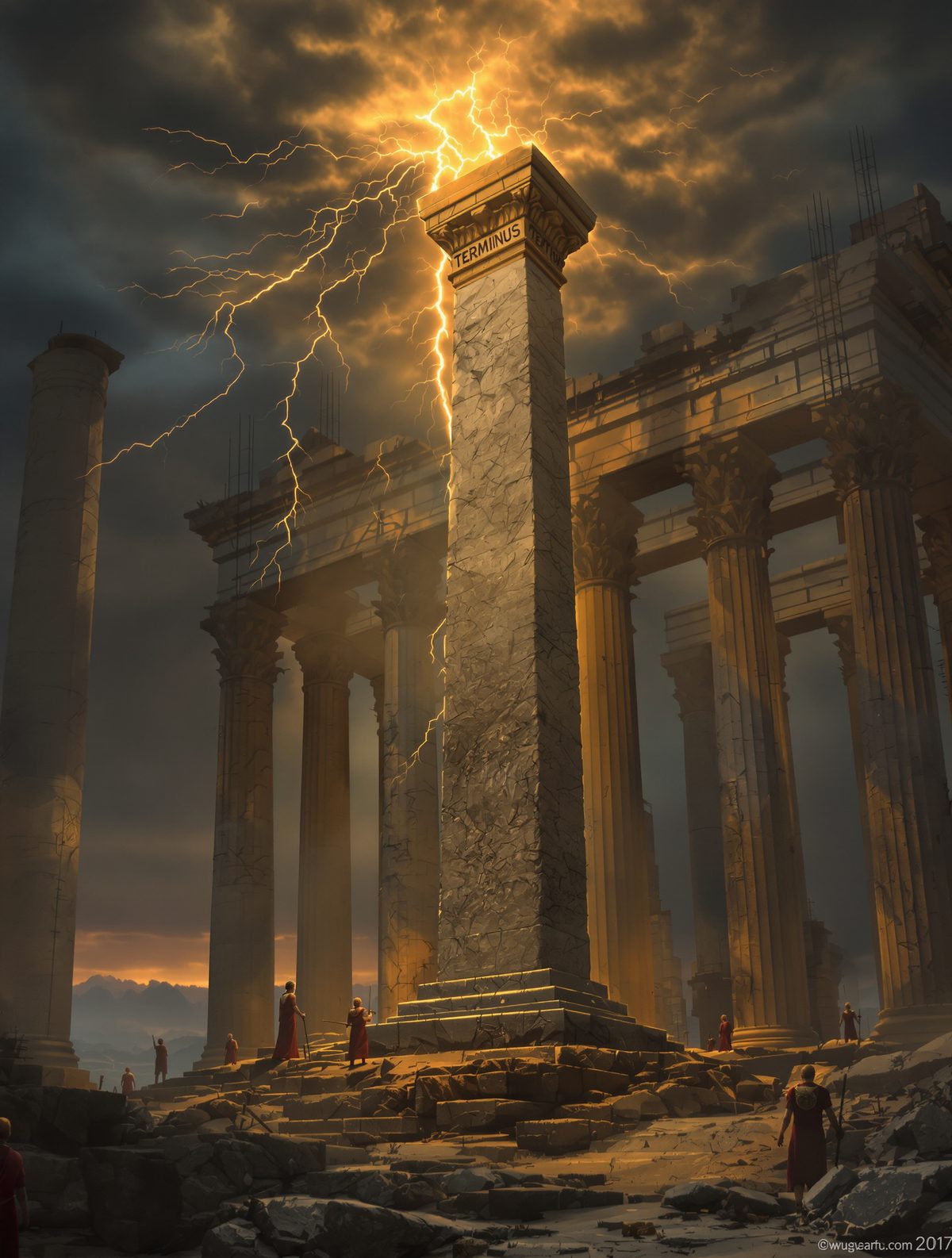
Yet, amidst the shuffling of divine residences, a curious event unfolded. The god of boundaries, Terminus, was unlike his peers. He was not a god of grand statues or dazzling rituals. Instead, he was represented by simple boundary stones, unassuming yet vital to the Romans. Under Terminus' watch, these stones marked the invisible lines that governed property, law, and order. As Jupiter claimed Capitoline Hill, one stone stood insistently, capturing the attention of augurs and astonished citizens alike.
The Defiant Boundary Stone
The moment was nothing short of extraordinary. Throughout Roman history, boundaries were sacred. Jupiter himself, for all his thunderous power, respected the ancient rites and orders of these stones. Such respect was so ingrained that when Terminus’ boundary stone refused to budge, it was interpreted as divine pact approval—a rare instance of cosmic unanimity.
According to legend, the boundary stone’s placement was meant to be as unyielding as the stars themselves. The inability of even Jupiter to relocate Terminus without violating the sacred order meant one thing: the temple must be built around the stone. It was here that an ordering principle of Rome itself was affirmed: boundaries, both physical and moral, must be respected—even by the most powerful of gods.
A Temple with a Unique Feature
Thus, the Temple of Jupiter Optimus Maximus was constructed with Terminus' stone enshrined within. This offshoot held significant implications for Roman society. In an era when gods were often perceived to shape destinies through capricious whims, this singular event reinforced the importance of justice, steadfastness, and lawfulness. Factually, it stood as the temple’s only internal altar, a silent reminder that even Rome's paramount deity had accorded respect to the boundary god.
The temple in its final glory was a colossal structure, covering nearly 55,000 square feet and becoming a beacon visible from afar. It symbolized Rome's might, but also a deep-seated respect for demarcation and order. Did you know that despite its grandeur, only this unpretentious altar to a quiet god was presented within? The story of Terminus added a narrative of humility and resilience, showcasing the blend of Roman practicality and spirituality.
Lessons from a Stone
The defiance of Terminus offers insight into Roman attitudes toward boundaries and their profound importance. For Romans, establishing clear boundaries was an act of reverence to the divine order. This deep-rooted reverence influenced Roman law and politics, perpetuating the belief that boundaries—moral, legal, and political—sustained society’s very fabric.
This narrative became more than just a myth; it endured as a historical touchstone about the significance of steadfastness. Even emperors could not escape the lessons engrained by Rome’s ancient narratives. By the time of Augustus, Rome understood its identity as resting equally on its walls, roads, and the stones of Terminus.
A Legacy Etched in Stone
The story of Terminus quietly persisted through Rome’s evolution. It’s a tale that prophesied the rise of the Roman Empire while engraining respect for the inviolable—boundaries. As strange as it sounds, the tiny, unyielding altar to Terminus in Jupiter’s grandest of temples became a compelling symbol of Rome’s strength, a strength fostered by respect for ancient principles amid rapid expansion and change.
Why does this matter today? Because it echoes the timeless lesson of boundaries—a topic as relevant now as it was in the days of Rome. In our interconnected world, the invocation of boundaries—ethical, environmental, personal—will continue to shape societies. Ancient Rome reminds us that sometimes power must abide by principles larger than itself, a poignant reminder to cherish and respect the boundaries that order our shared, complex world.