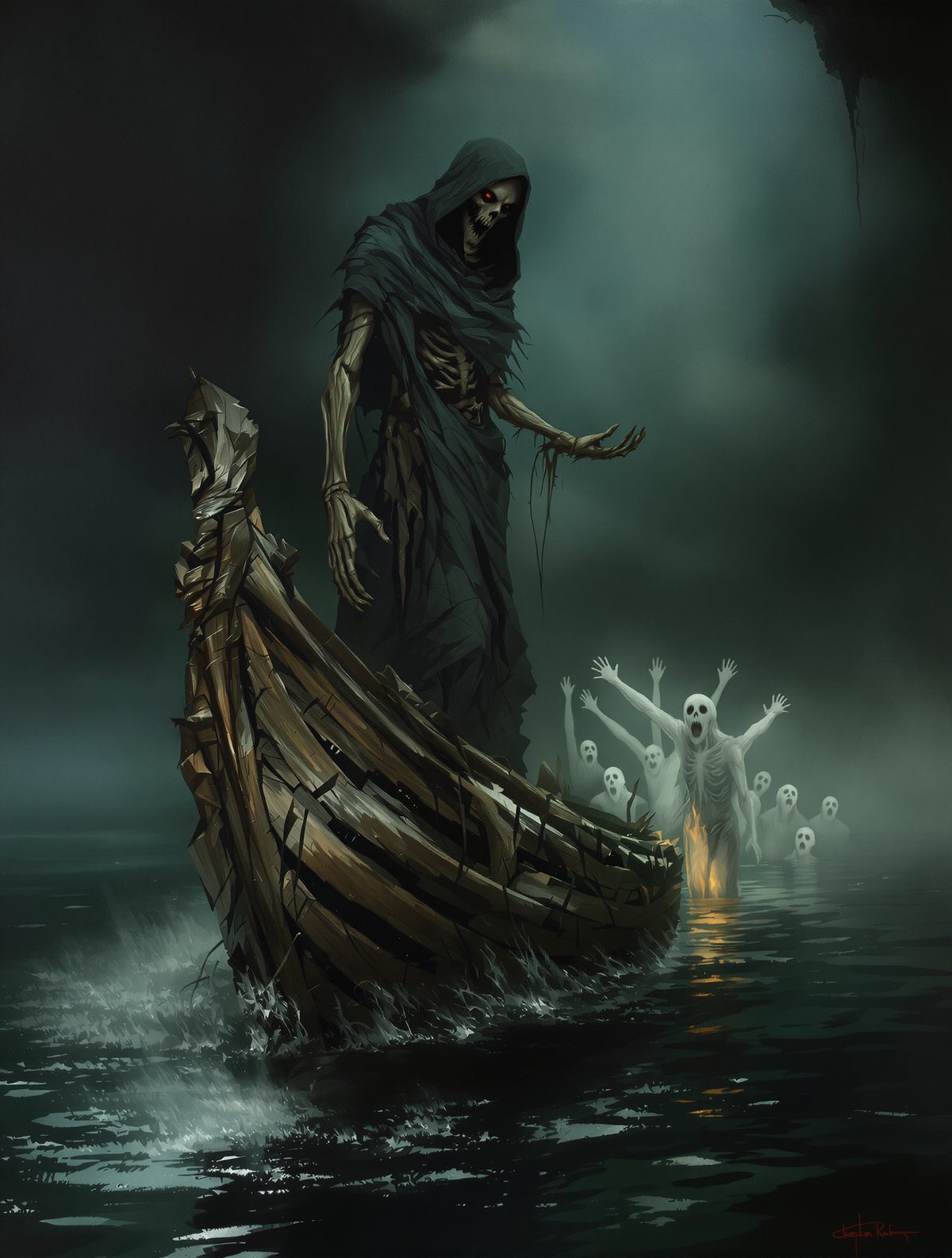
On the bleak shores at the edge of the underworld, a solitary figure rows his boat through the mist. Charon, the ancient ferryman, its silent helm. His eyes—steady and indifferent—glance beyond those souls that await his passage. Yet, among them, some wander aimlessly with tattered cloaks of despair, forever bound to this liminal purgatory. Why, you ask? The answer lies not in their deeds or defiance, but in a mere coin never placed upon their lips.
The Ferryman's Eternal Watch
In the tapestry of Greek mythology, Charon emerges as a poignant figure, one who dictated the passage of souls across the rivers that separated the world of the living from the realm of the dead. His charge was the River Acheron—though some myths cite the Styx—and only those with a proper burial and a coin—obol or drachma—could afford his crossing. Without it, a soul was doomed to linger on the desolate riverbanks for a century, a plight more fearful than the fires of Tartarus itself.
The earliest mentions of Charon trace back to the 5th century BCE, vividly portrayed in works such as Aristophanes’ plays and Virgil’s epic Aeneid. Yet, while feared by some, the ferryman was not one of doom, but rather a gatekeeper adhering strictly to his charge—no coin, no crossing, no exceptions.
A Test of Desperation: Banishment by Burial
Imagine the anguish of those ancient souls, unable to pay Charon's fare, their fate twisting into an existential torment. For a hundred years, they roamed aimlessly, caught between worlds, in a state of inertia more taxing than any mythical punishment devised on Olympus. This peculiar exclusion stemmed not from cruelty but tradition—a societal mandate for the living to prepare their dead adequately for the afterlife.
Burial customs in Ancient Greece underscored the community's duty to bestow upon every person the dignity of crossing over. Homer’s Iliad and Odyssey emphasize the gravity of such rites, encapsulated in Priam’s plea for Hector's body or the poignant scene of Elpenor beseeching Odysseus for a proper burial. Here lay a universal fear: to be forgotten not only by the living but also barred from eternal rest.
The Coin That Seals Fate
The notion of placing a coin on the tongue of the deceased traces its roots to a token meant for Charon's service—a practice known as Charon’s obol. As early as the 6th century BCE, this funerary rite sought to ensure safe passage, its neglect considered tantamount to a denial of peace. The coin varied across regions and time, from simple copper tokens to silver drachmas, each an offering to appease the unyielding ferryman.
Yet, these customs were not universal. In certain Hellenistic societies, burial without coins occurred due to poverty or simplicity, attracting neither judgment nor calamity. Interestingly, discoveries from Etruscan graves reveal no such conventions, hinting at cultural divergences in the narratives shaped by Greek mythos.
The Wanderers by the Shore: Souls Adrift
While the horror of a century upon Acheron’s banks might seem overstated in modern eyes, for the Ancients, it symbolized the ultimate in liminality. These souls were untouched by the joys of Elysium or the justice of Tartarus, existing instead in a timeless void. They straggled the shorelines—unburied soldiers, sailors lost at sea, or the nameless forgotten—each a ghostly testament to rituals unfulfilled.
Pausanias, the Greek traveler and geographer of the 2nd century CE, recounts myriad tales of unburied spirits. They were inextricably tied to the lands they haunted, offering a perspective on how entwined earth and underworld were perceived, as experiences of eternity without resolution lingered.
Lessons from Lost Crossings
In the myths where Charon stands staunch, rejecting the passage of the unburied, lies a haunting resonance with modernity. He personifies the barriers not of punishment but of neglect—a poignant metaphor for the consequences when societal rituals and traditions crucial for transitioning phases of life are overlooked.
Today, echoing Charon's somber duty, we find significance in the rituals that define human passages; be they funerals, memorials, or commemorations, the act of remembrance holds power. In understanding the grave responsibilities seen in ancient beliefs, we gain insight into our own cultural rites—elucidating not only who we are, but what we may irrevocably leave behind.
In the end, Charon, the taciturn guardian of the crossing, teaches us this: Symbolism imbues life's thresholds with significance, marking the journey from one state to another. When neglected, much like Charon’s forlorn denials, we risk stranding those memories in the eddies of forgotten time, void of closure or peace.