It is a tale that defies the grandest of legends, the epic journey of a child purportedly destined for greatness but crippled by misfortune. Born with legs that could not support him, Sundiata Keita's enemies scoffed at the idea of him becoming a king. His mother wept in humiliation as a prophecy promising his rise seemed to crumble with each passing day of inactivity. But, in one miraculous moment of determination and power, young Sundiata seized an iron bar, the ground shivered beneath his feet, and the landscape itself bore witness to the king who learned to walk.
The Birth of an Inception
In the early 13th century, within the heart of what is now Mali, the kingdom of Niani awaited its prophesied ruler. The birth of Sundiata Keita around 1217 was no ordinary event; it was shrouded in divine foretelling. Sogolon Conde, his mother, bore him as the second wife of King Naré Maghann Konaté, amidst whispers of a promise cast by a revered hunter-seer. This child, born of an "ugly" mother scorned by her co-wife, was destined to unite and reign over the splintered Mandinka tribes, yet he entered the world unable to even stand.
Sundiata’s early years were marked by unjust ridicule. At a time when African kingdoms revered physical prowess as a hallmark of leadership, Sundiata's condition was a source of ceaseless shame. His mother, once celebrated in the intimate circles of the royal court, fell into disrepute as Balla Fasséké, the griot who chronicled their lineage, recorded nothing but the laughter of their adversaries. Little did they know, the strength that Sundiata lacked in limbs he housed tenfold in spirit.
From Scorn to Strength
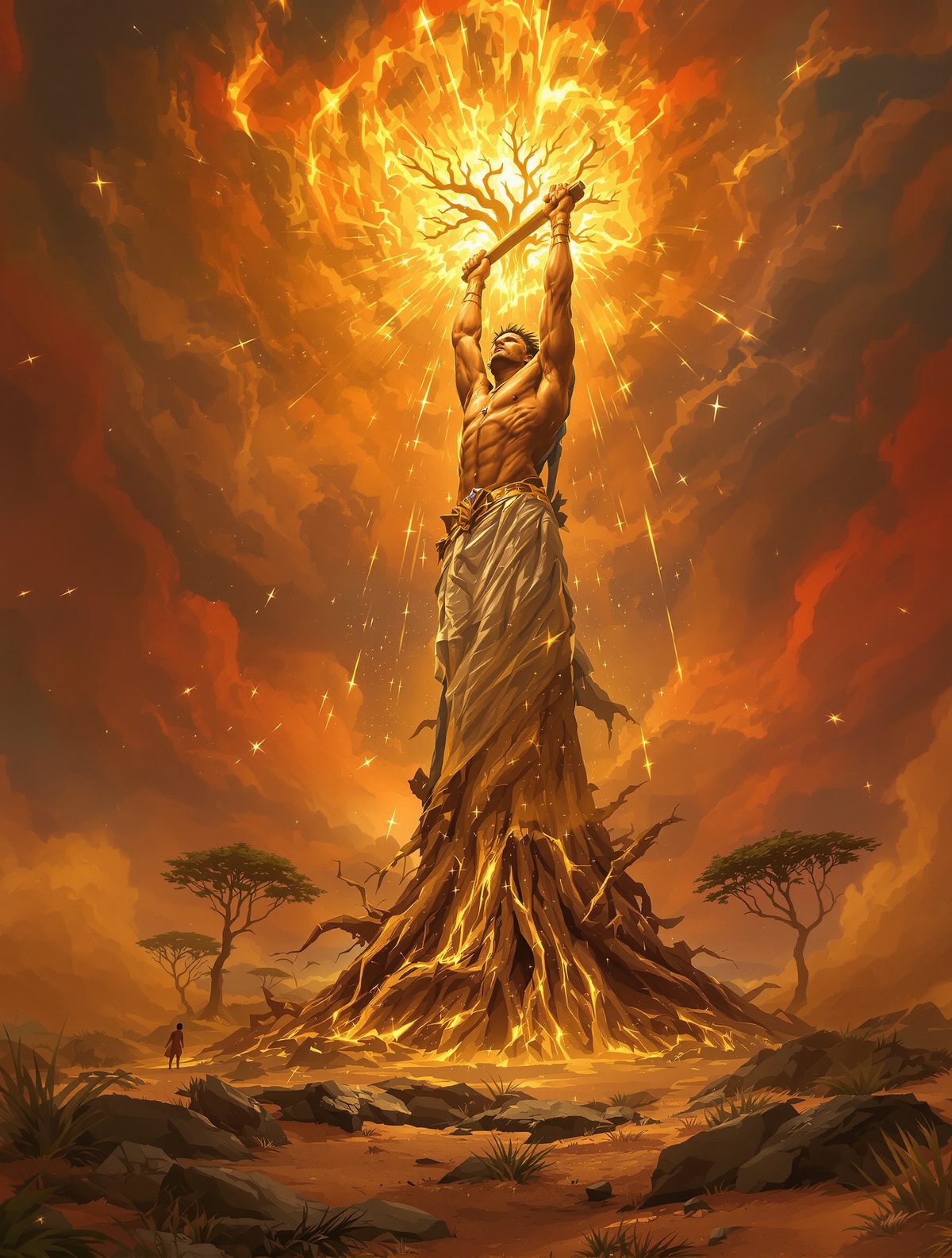
The legend takes its most dramatic turn when Sundiata, at the age of seven, overheard the mockery surrounding his family. Driven by an internal storm, his resolve ignited. He demanded an iron bar from which to pull himself up, sparking what would become a defining transformation. Accounts tell of the ground quivering and trees bowing in awe as Sundiata, once dormant, stood. His first acts of strength included uprooting a baobab tree—a demonstration of his unformed power and the fulfillment of the earlier prophecy.
This moment wasn't merely the rise of Sundiata from child to potential ruler; it was symbolic of Africa's enduring spirit, a point often overlooked. Sundiata’s fight was not just physical but also a psychological triumph over an oppressive fate. The notion that he drew strength from metal, the heart of the earth itself, emphasizes the grounded, tenacious resilience that later defined his reign.
The Exile and the Gathering Storm
Powerful forces conspired against him. Queen Sassouma Bérété, his father’s first wife, saw a threat in Sundiata’s recovery and future claim to the throne. Driven by fear and spite, she forced Sogolon and her son into exile. This flight, however, took Sundiata on a journey across West Africa, from Ghana to Mema, solidifying alliances that would later form the backbone of his empire.
His time in exile was pivotal. Sundiata encountered diverse cultures and people, learning strategies and gathering supporters. His encounters with rulers beyond the Mandinka lands taught him diplomacy and warcraft. He absorbed wisdom from the edges of the Sahara to the dense Guinea woodland, returning eventually not just as a man, but as a ruler equipped to forge destiny anew.
The Call of Destiny — Battle of Kirina
By 1235, the political landscape had reached a tipping point. Soumaoro Kanté, the sorcerer-king of Sosso, oppressed the Mandinka nation with relentless ferocity. The time for Sundiata's prophecy to fulfill itself drew near. He marched upon the fertile fields of Kirina with an army comprised of diverse allies—men he had met on his decades-long journey—and led them into battle against the tyrannical Sosso forces.
The climax transpired under the glaring West African sun at Kirina. It is said that Sundiata strategically invoked local magics and outmaneuvered Soumaoro, ultimately seizing victory with an arrow tipped in the cock’s spur—a mystical weakness of the sorcerer-king. By this battle’s end, Sundiata had not only reclaimed his heritage but initiated the golden era of the Mali Empire.
Legacy Beyond a Legend
Sundiata Keita’s narrative resonates even now. His life journey from an immobile, mocked youth to the architect of Africa's largest 13th-century empire is a profound illustration of potential reaching beyond visible limits. He laid the foundation for a Mandinka federation powerful enough to withstand the sands of time, reaffirming the strength that can arise from adversity.
In today’s world, where challenges are met at every turn, Sundiata’s story serves as a timeless archetype. It teaches us to rise beyond physical, societal, and external adversities, building a legacy from personalized triumphs. The legend of Sundiata’s iron legs reminds us that even the most unassuming can rise to reshape history. One should not merely study Sundiata as a tale from ancient Africa but as an enduring anthem to the resilience of the human spirit.