From the misty annals of ancient Chinese mythology springs the compelling tale of Nezha, a child god whose audacious spirit veered towards defiance rather than compliance. As legends tell, Nezha's story isn't just a narrative of mischief and rebellion; it is an epic saga of the little known, a journey of rebirth and self-creation, one whose echoes persist amidst the clamor of myths—and dare we say—realities, intertwined with consequence and heroism. Let us delve into a divine narrative unlike any other: Nezha's lotus rebirth.
The Divine Child: Born at the Edge of Heaven and Earth
Our tale begins in Chentang Pass, a mythical locus where the realm of man meets the extraordinary. Here, Nezha's entrance into the world was accompanied by celestial signs. Born to the military commander Li Jing and Lady Yin, Nezha emerged not as an ordinary child but wrapped in a golden hoop and a red band, vessels of potent, divine, and unpredictable powers. His birth heralded a rare astral convergence, one whispered by sagacious naysayers to portend greatness—or calamity.
Of particular significance was the celestial inspector Taiyi Zhenren, his ethereal guide and teacher, who adorned him with two enchanted jewels: the Cosmic Wheel and the Red Armillary Sash, each aiding him in channeling his innate potential. As the mists of mythology open to reveal this prodigy, Nezha's birth year can be tenuous yet is anchored within the shifting sands of time during the Shang dynasty, around 1600 to 1046 BCE, capturing the elegance and uncertainties of this epoch.
The Dragon King's Wrath: A Conflict Ignites
But all gods attract their nemeses. Legend holds that at the tender age of seven, Nezha's fate twisted violently when his exuberance summoned disaster. In the shimmering waters near Chentang Pass, the young deity found himself at odds with the son of Ao Guang, the Dragon King of the Eastern Sea. Tensions escalated, and blink-and-you-miss-it moments led to the death of the dragon prince at Nezha's hands. This wasn’t a mere youthful skirmish manifested in divine playgrounds; it was akin to an inter-heavenly offense, a transgression that called for severe reprisal.
The Dragon King, a powerful deity, demanded retribution, invoking the celestial court's intervention. Confronted with heaven's judgment, Nezha's predicament was perilous, caught between filial duty and mythical decree. Heaven's ominous call for his life was an act of rebalancing the divine order. Little did they know, Nezha had other plans.
The Self-Sacrifice: A Step into The Abyss
In a dramatic narrative twist, Nezha's response was radical and unforgettable. He decided to unmake himself, crafting a spectacle that even gods would ponder over the eons. Armed with a dagger, Nezha carved his own flesh and bones, an offering dedicated explicitly to his paternal figures—an act of ultimate contrition. He orchestrated his demise amidst a swirl of rushing waves and howling winds at the riverbank, echoing a celestial atonement, an echo so profound the earth trembled in shared grief.
What compels a divine child to such extremes? It is said that Nezha's motivations spurred from a profound contemplation on autonomy and self-sacrifice, a complex interplay pulling at the very strings that weighed destiny against the moral compass.
The Rebirth: From Straw to Lotus
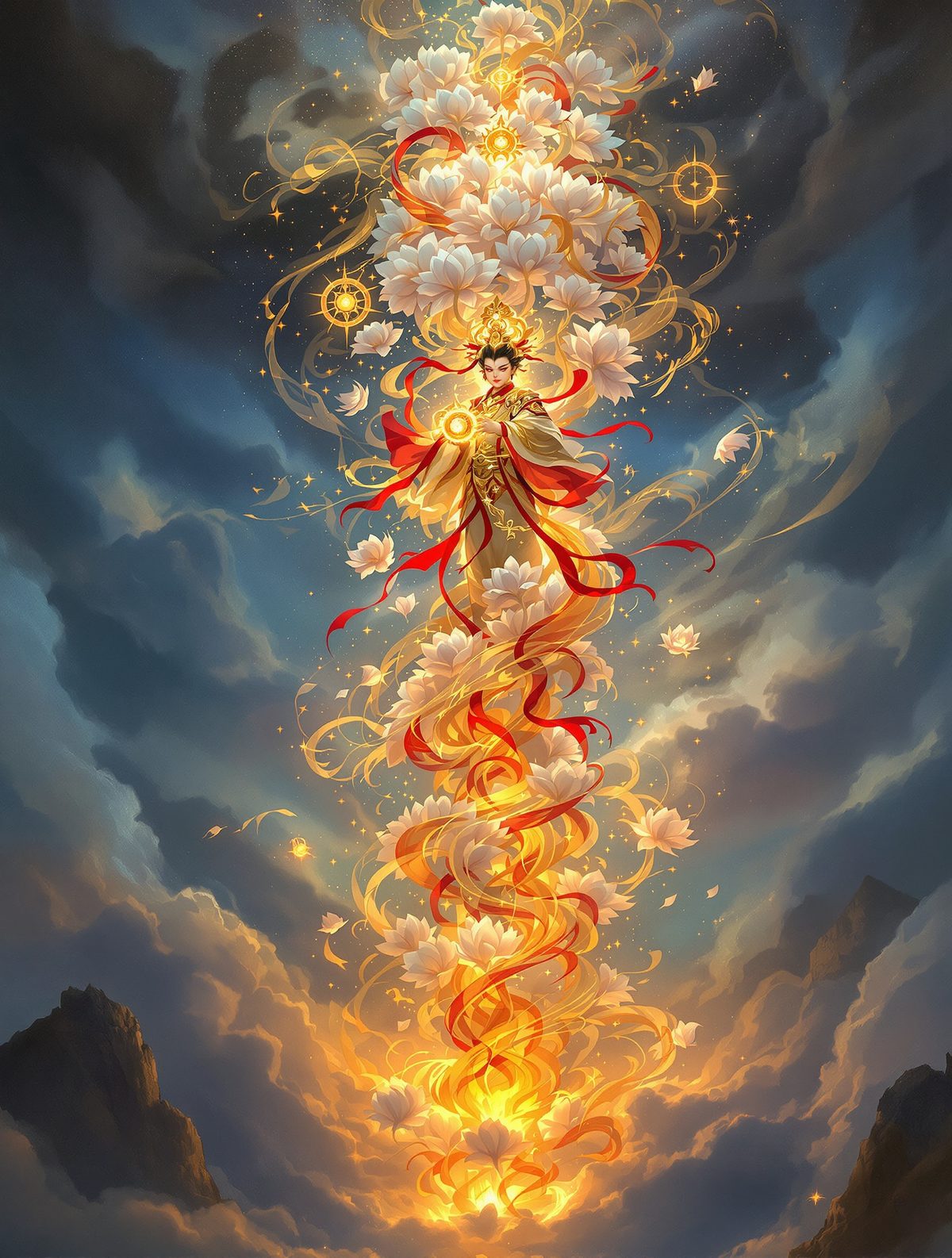
As myth tells it, three years after his agonizing end, in the in-between realms where stories become myths and myths traverse into eternity, Nezha was rebuilt. Taiyi Zhenren, his dedicated mentor, used a lotus flower for the rebirth, transforming petals into flesh and stems into bones. Nezha emerged anew, reborn amidst the iridescent gentleness of lotus blooms—a fiercer and more focused warrior god than his previous incarnation. Visible to the reverent and the bewildered, he donned his red armillary sash and cosmic wheels, symbols of rebirth and retribution now burned into eternity.
Reborn from the lotus, Nezha proved that even a deicide wouldn't lock him in the shadows forever. He returned with a mission to confront existential injustices, bestowing his name as a beacon to those searching for hope in desperation—a divine scandal retold time and again.
The Enduring Legacy of Nezha
The Nezha legend may brim with illustrative allurements of divinity and mysticism, yet at its core, it asks us to examine resilience, self-redemption, and transformation. Today, Nezha remains a poignant reminder that amid our trials and fates seemingly etched in stone, the power of rebirth and the capacity to shape our destinies lies, indeed, within our grasp.
Why does Nezha's tale persist through the ages, crossing boundaries of culture and creed? On the corridors of time, Nezha reaffirms life's core axiom: the potential for change is infinite, replete with cycles of endings and beginnings. As modernity latches onto epics of transformation, Nezha’s radiant rebirth blurs the confines between mythical pasts and present narratives as we all endeavor to reshape our trajectories—even from fragments of our unmade selves.