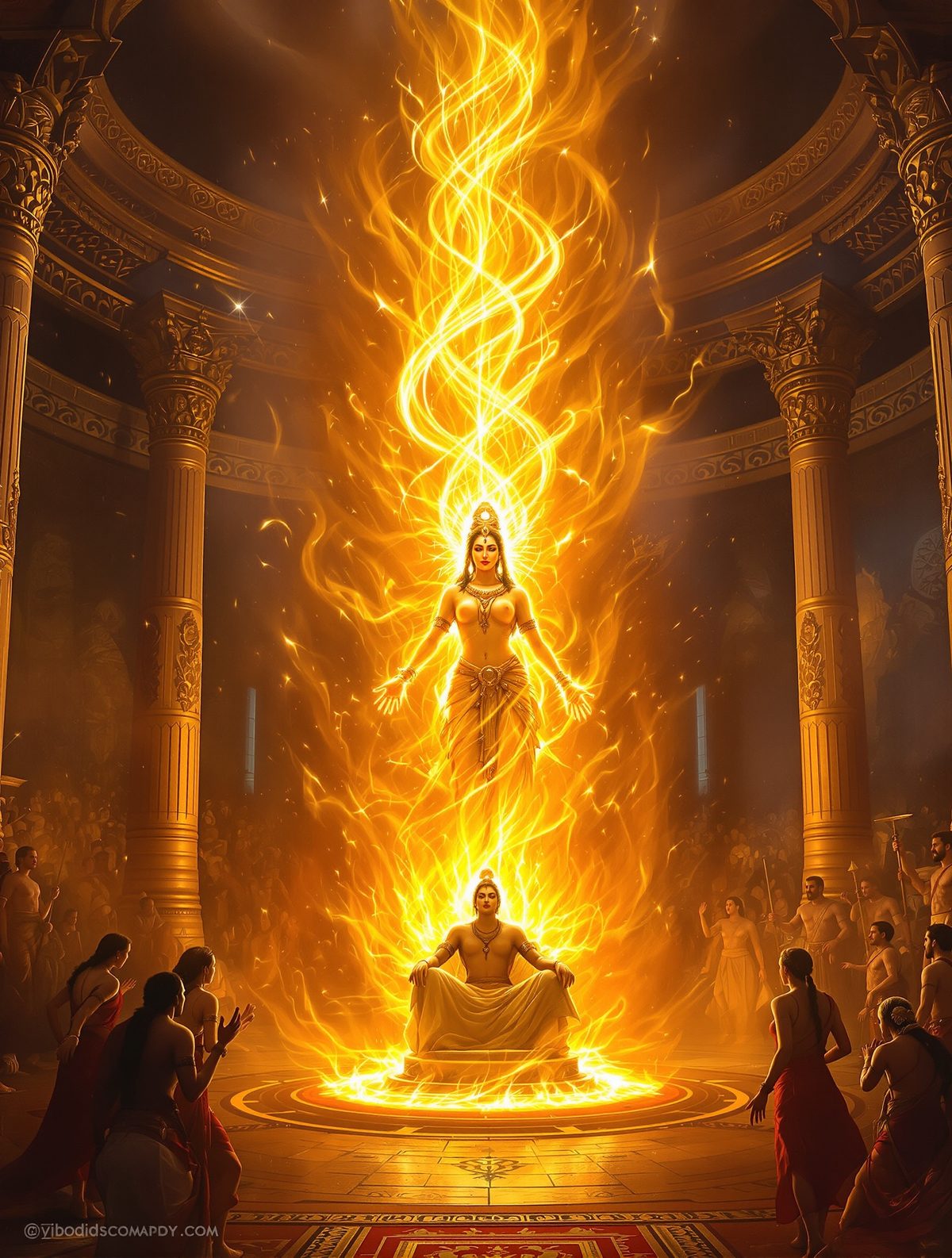
Imagine crawling on your hands and knees for seven years while your half-brother taunts you as "the crippled prince" in front of cheering crowds. Imagine your father's advisors whispering that you'll never rule because you can't even stand. Now imagine the moment when divine fury courses through your small body, and you snap iron bars like brittle twigs, rising to your feet for the first time to claim an empire that would stretch across West Africa for three centuries.
This is not a fairy tale. This is the opening chapter of one of Africa's greatest epic tales—the Sundiata Epic, the foundational story of the Mali Empire that once controlled more gold than medieval Europe had ever seen.
The Prophecy That Changed Everything
In the early 13th century, a mysterious hunter appeared at the court of Nare Maghann Konate, king of the small Mandinka kingdom of Kangaba. The hunter brought with him a woman unlike any other—Sogolon Kedjou, whose back was covered in a hump and whose appearance was so striking that she was known as "the Buffalo Woman." But the hunter's message was clear: marry this woman, and she will bear you a son who will become the greatest king in Africa.
The prophecy seemed absurd. Nare Maghann already had a beautiful first wife, Sassouma Berete, and a healthy son named Dankaran Touman who was clearly destined for the throne. Why would he need this strange, hunchbacked woman? Yet something about the hunter's words rang with supernatural authority. In 1217 CE, Sogolon gave birth to a son they named Mari Djata—later known as Sundiata, meaning "Lion Prince."
But the prophecy appeared to be a cruel joke. While other royal children took their first steps at one year old, Sundiata remained on the ground. At two, then three, then four years old, his legs remained weak and useless. Palace gossips whispered that Sassouma Berete had cursed the child through powerful sorcery, ensuring her own son would inherit the throne unchallenged.
The Mockery of a Future Emperor
By age seven, Sundiata had become the palace's greatest source of entertainment—and cruelest spectacle. His half-brother Dankaran Touman would organize elaborate games where other children would race and jump while Sundiata could only drag himself along the ground with his hands. The future lord of an empire that would span 1.2 million square kilometers spent his childhood eating dust.
Sassouma Berete's psychological warfare was even more devastating than her son's physical taunts. She would publicly praise Dankaran Touman's strength and speed, then turn to Sogolon with false sympathy: "Poor Sogolon, when will your son finally stand? Perhaps he's meant to be a palace storyteller instead of a warrior." The verbal daggers found their mark every time.
The breaking point came during a palace feast when Sassouma Berete decided to humiliate Sogolon completely. She sent her servants to Sogolon's quarters with a message: she needed fresh baobab leaves for the evening's meal, and surely Sogolon could gather them from the tree in the royal garden. It was a task that required climbing—something impossible for a woman whose son couldn't even stand to help her.
The Day Iron Bent to a Child's Will
When Sogolon returned home in tears, explaining the impossible task and the public humiliation that awaited her, something shifted in young Sundiata's eyes. The griots—West Africa's hereditary storytellers and historians—describe this moment as when the lion's spirit first awakened within the crawling child.
"Mother," Sundiata said with a voice that seemed to carry the authority of ancestors, "today I will walk."
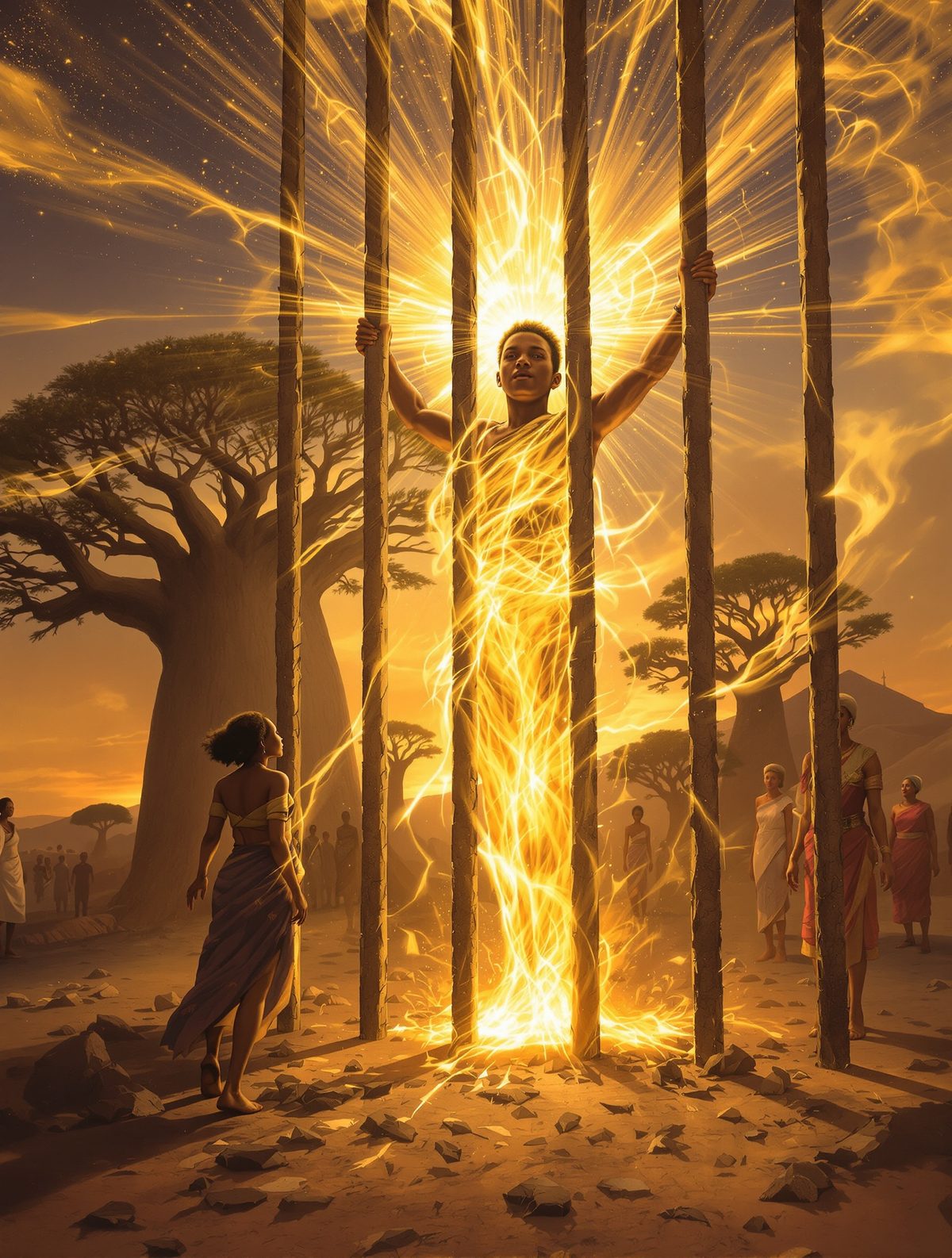
The palace blacksmith was summoned to create the strongest walking bars he could forge—thick iron rods that would normally support a grown man learning to walk after a battle injury. When the smith finished, he required two assistants to carry the massive iron framework to Sundiata's quarters. These weren't ceremonial props; they were industrial-strength supports designed to bear hundreds of pounds of pressure.
A crowd gathered as word spread through the palace. Sassouma Berete arrived with a smirk, expecting to witness another failure that would cement her son's position as heir. Dankaran Touman brought his friends, anticipating the ultimate humiliation of his rival.
Sundiata crawled to the iron bars and gripped them with his small hands. For a moment, nothing happened. Then his knuckles whitened, his shoulders tensed, and witnesses later swore they could hear the very air around him crackling with supernatural energy.
When a Prince Became Legend
The iron didn't just bend—it exploded. The thick metal bars shattered like dried wood, sending fragments across the courtyard. Sundiata rose to his feet in one fluid motion, standing taller and straighter than any seven-year-old had a right to stand. The transformation was so complete, so impossible, that several witnesses fell to their knees in terror and awe.
But Sundiata wasn't finished. He walked—no, strode—to the massive baobab tree that had represented his mother's impossible task. With his bare hands, he uprooted the entire tree, roots and all, and carried it to his mother's feet like a bouquet of flowers. The tree was so enormous that its shade had covered half the palace courtyard.
The crowd's laughter had died completely. Sassouma Berete's face had drained of color. Even Dankaran Touman stood silent, perhaps understanding for the first time that he had been mocking a lion while it learned to roar.
Sundiata looked directly at his stepmother and spoke words that would echo through West African oral tradition for eight centuries: "I have walked. Now watch me run toward my destiny."
From Walking to Empire Building
The boy who broke iron bars would grow up to shatter something far more formidable—the Sosso Empire of the sorcerer-king Sumanguru. By 1235 CE, Sundiata had united the fractured Mandinka chiefdoms and established the Mali Empire at the Battle of Kirina. His kingdom would become the largest empire in African history up to that point, controlling the trans-Saharan gold trade and making medieval Mali wealthier than most European nations.
Under Sundiata's Manden Charter—one of history's first constitutions—the Mali Empire established principles of social justice, women's rights, and environmental protection that were centuries ahead of their time. The empire he founded would endure for over 400 years, producing legendary rulers like Mansa Musa, whose 1324 pilgrimage to Mecca was so lavishly gold-laden that it crashed Cairo's economy for a decade.
The Lion's Roar Still Echoes
Today, the Sundiata Epic remains one of the world's great foundational stories, performed by griots across West Africa just as it was 800 years ago. But unlike many ancient legends, this one carries a message that resonates powerfully in our modern world: the greatest leaders often emerge from the deepest struggles.
In an age when we're quick to write off those who don't fit conventional molds of success, Sundiata's story reminds us that true strength isn't always visible on the surface. The prince who couldn't walk for seven years became the king who built bridges across ethnic and religious divisions, created lasting institutions of justice, and established an empire that connected sub-Saharan Africa to the Mediterranean world and beyond.
Perhaps most remarkably, Sundiata's moment of breaking the iron bars represents something profoundly human—that instant when we refuse to accept the limitations others place on us and discover capabilities we never knew we possessed. In boardrooms and classrooms, on playing fields and in laboratories, people still experience their own "iron bar moments" when they break through barriers that once seemed unbreakable.
The next time you face seemingly impossible odds, remember the crawling prince who became the Lion of Mali. Sometimes the greatest victories come not from those who never fall, but from those who refuse to stay down.