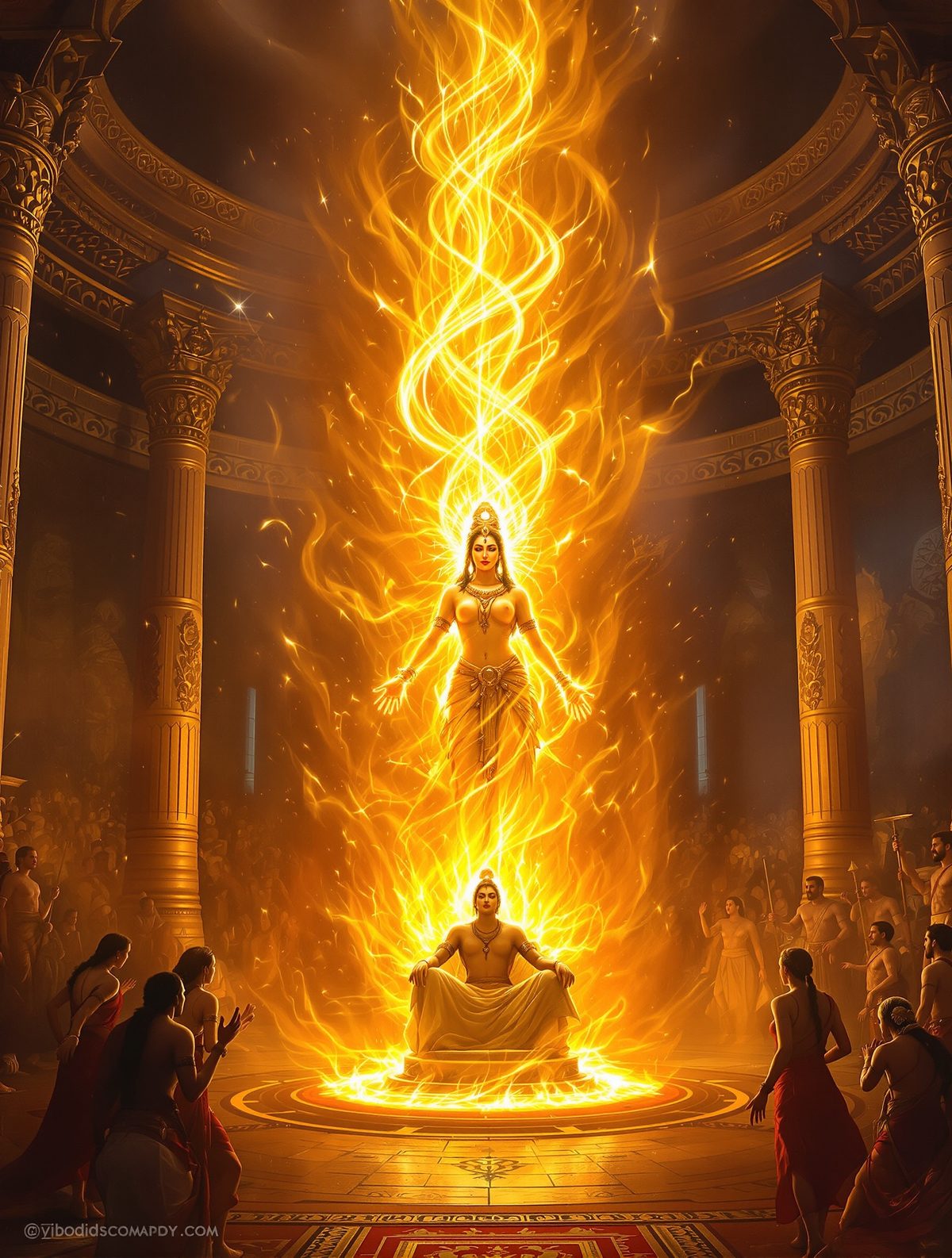

Picture this: before the first star ignited, before the first mountain rose, before even the concept of "earth" existed, there was only water. Not the familiar blue oceans we know today, but two vast, conscious entities of liquid divinity—one bitter with salt, the other sweet and pure. These weren't merely bodies of water. They were gods, ancient beyond measure, and when their currents first touched in the cosmic void, they would create something beautiful, terrible, and ultimately doomed.
This is the story your mythology textbooks glossed over—the tale of the very first divine marriage, and the family tragedy that nearly ended existence before it truly began.
When Waters Wed: The Cosmic Marriage That Started Everything
In the shadowy halls of ancient Babylon, around 1894 BCE, scribes carefully pressed cuneiform wedges into clay tablets, preserving what they called the Enuma Elish—"When on High." This wasn't just another creation story. It was their sacred history, recited annually during the eleven-day New Year festival when the Babylonian king would ritually marry the goddess Ishtar to ensure cosmic order for another year.
But the story began long before any king or kingdom existed.
Apsu, whose name meant "the watery deep beneath the earth," embodied all fresh water—every underground spring, every life-giving river, every drop of rain that would one day nourish the first gardens. Ancient Babylonians believed he was literally the sweet water aquifer that lay beneath their ziggurat foundations. Archaeologists have discovered that Babylonian temples were often built directly over natural springs, creating a physical connection between the earthly and divine waters.
Tiamat, the "bitter water" goddess, was pure primordial chaos—the salt waters of the sea that could both create and destroy. Her name shares roots with the Hebrew tehom, the "deep" mentioned in Genesis. But unlike the passive waters of later creation stories, Tiamat was vibrantly, dangerously alive. Ancient artists depicted her as a massive serpent-dragon with wings, talons, and a mouth that could swallow gods whole.
When these two primordial forces finally converged, their union wasn't just sexual—it was the first act of creation itself. Fresh mingling with salt, order dancing with chaos, the very first chemical reaction in a universe that had known only stillness.
The Noisy Children: When Divine Offspring Become a Cosmic Problem
From this aquatic marriage came the first generation of younger gods: Lahmu and Lahamu, whose names mean "the hairy ones"—likely representing the silt and sediment that forms when salt and fresh water mix. Archaeological evidence from ancient Mesopotamian irrigation systems shows that farmers were intimately familiar with this phenomenon, watching rich, life-giving mud form where river water met the salt marshes of the Persian Gulf.
But Lahmu and Lahamu were just the beginning. They gave birth to Anshar (the horizon of heaven) and Kishar (the horizon of earth), who in turn produced Anu, the sky god. Each generation grew more powerful, more complex, and crucially—more noisy.
Here's what the sanitized mythology books don't tell you: these weren't quiet, respectful children. The Babylonian tablets describe them as raucous, partying constantly, their divine revelry echoing through the cosmos. Imagine the most obnoxious college fraternity party, but with the power to shake the foundations of reality. They "disturbed Tiamat as they surged back and forth," the ancient text records, "yea, they troubled the mood of Tiamat by their hilarity in the Abode of Heaven."
For eons, Apsu endured the cosmic noise pollution. Tiamat, perhaps more patient as the chaos goddess, tolerated her rowdy descendants. But Apsu—orderly, ancient, accustomed to the deep silence of primordial waters—began to crack under the pressure.
The Father's Terrible Solution: Divine Infanticide in Paradise
What happened next reveals a disturbing truth about power, generational conflict, and the price of creation that ancient Babylonians understood all too well. Living in a harsh environment where resources were scarce and family survival often meant difficult choices, they crafted a creation myth that didn't shy away from domestic darkness.
Apsu made a decision that would echo through mythology for millennia: he would murder his own children and grandchildren. Not in a moment of rage, but as a calculated plan to restore the cosmic quiet he craved. He approached his personal advisor, Mummu (whose name means "creative force" or "technical skill"), and laid out his genocidal scheme.
The tablets record their conversation with chilling clarity: "Their ways are verily loathsome unto me. By day I find no relief, nor repose by night. I will destroy, I will wreck their ways, that quiet may be restored. Let us have rest!"
This wasn't the first time a father-god would plot against his children—the Greeks had Cronus devouring his offspring, the Norse had similar tales—but the Babylonian version carries a uniquely domestic horror. These aren't titans or monsters. They're a family torn apart by irreconcilable differences, by the eternal tension between the old ways and the new.
Tiamat's Dilemma: When Love and Loyalty Collide
Here's where the story takes a psychologically complex turn that modern readers might find surprisingly relatable. When the younger gods discovered Apsu's plot (thanks to the wise god Ea, who possessed supernatural hearing), they naturally turned to their mother for protection.
But Tiamat faced an impossible choice: side with her husband or her children.
Initially, she chose her marriage. When the younger gods first brought their complaints about Apsu's behavior, Tiamat responded with what sounds remarkably like enabling: "What? Should we destroy that which we have built? Their ways indeed are most troublesome, but let us attend kindly!" Ancient Babylonian society was deeply patriarchal—wives were expected to support their husbands' decisions, even when those decisions seemed harsh to modern sensibilities.
This moment reveals something profound about Babylonian psychology: they understood that even gods struggled with family loyalty, that love could become complicated and contradictory, that parents weren't automatically wise or just. Unlike later mythological traditions that would sanitize divine family dynamics, the Babylonians crafted gods who felt authentically, messily human.
The First Divine Murder: When Paradise Dies in Its Sleep
The younger gods, realizing they couldn't count on their mother's protection, took matters into their own hands. Ea, god of wisdom and magic, crafted a spell so powerful it could affect even primordial deities. He "poured sleep upon" Apsu, then bound the unconscious water god and killed him in his slumber.
This wasn't a glorious battle between cosmic forces—it was assassination, pure and simple. The first murder in the universe happened not in passion but in calculated self-defense, carried out while the victim slept peacefully, trusting in his own invulnerability.
Ea then established his dwelling place directly upon Apsu's corpse, founding his temple in what had once been the body of the fresh water god. Archaeological excavations at ancient Eridu, one of the oldest Sumerian cities, have revealed temple complexes built directly over natural springs—perhaps the physical inspiration for this mythological detail.
The implications rippled through the cosmos. With Apsu dead, the sweet waters of the earth now belonged to the younger generation. Ea took Apsu's name and powers, becoming the new god of fresh water, wisdom, and magic. The old order had been violently overthrown, but the consequences were far from over.
Why This Ancient Drama Still Echoes Today
This 4,000-year-old family tragedy might seem like ancient history, but its themes pulse through our modern world with uncomfortable relevance. How many families today struggle with generational divides, with older members feeling overwhelmed by the pace and noise of change, while younger generations fight for their right to exist as they are?
The Babylonians understood something we're still grappling with: that creation is inherently disruptive, that new life disturbs old peace, that progress comes at a cost. They didn't romanticize their gods or pretend that families always found happy compromises. Sometimes, they recognized, survival requires fighting those who are supposed to love and protect you.
But perhaps most remarkably, they understood that even in the cosmic realm, there are no true villains—only beings struggling with impossible choices, trying to preserve what they value most. Apsu wanted peace; his children wanted to live. Tiamat wanted to love both her husband and her offspring. These aren't the desires of monsters, but of recognizably human hearts wrestling with irreconcilable needs.
The next time you hear about generational conflict, about the tension between tradition and change, about families torn apart by different visions of the future, remember Tiamat's salt water meeting Apsu's fresh—and how the very first family in the universe faced the same struggles we do today, with consequences that literally reshaped reality itself.