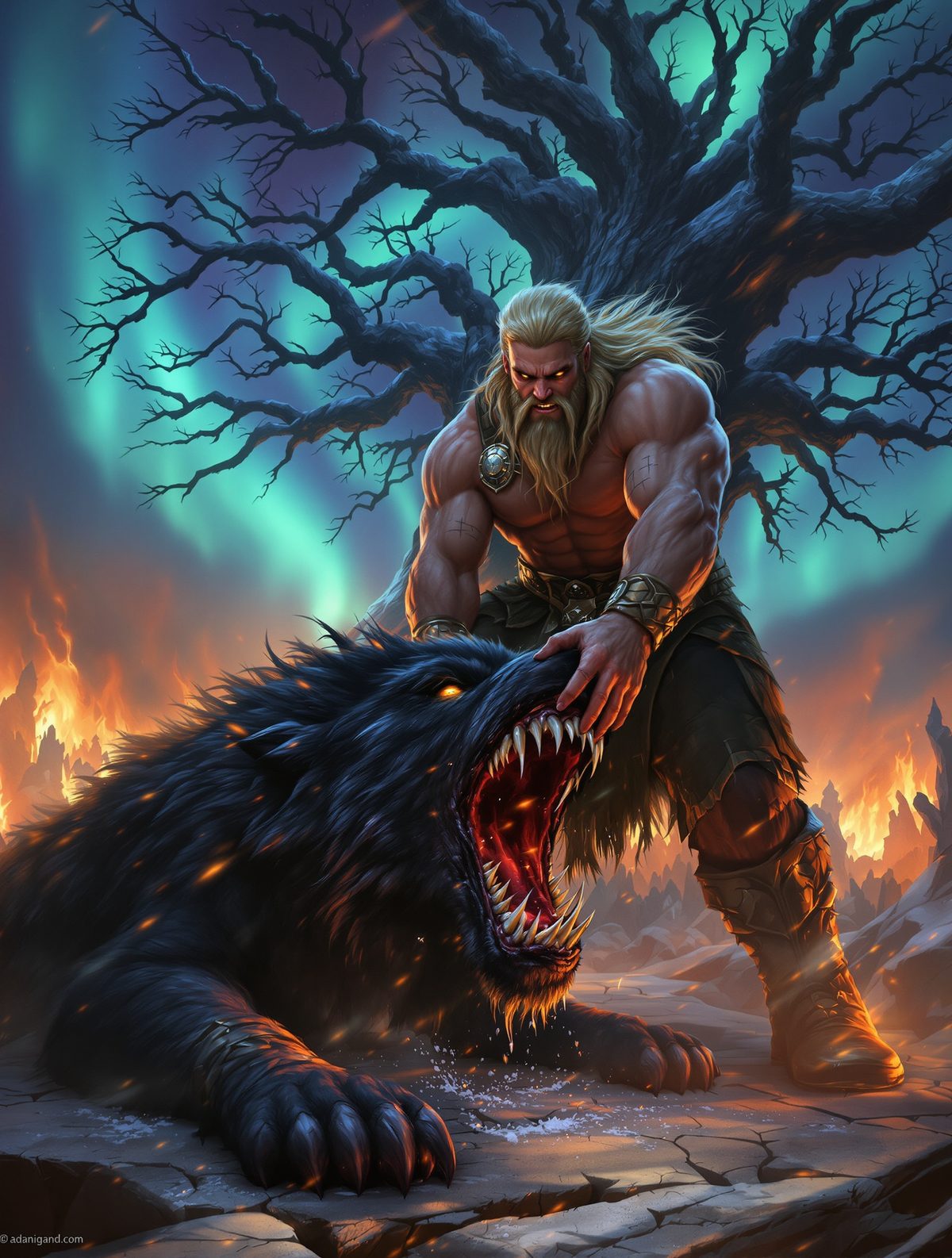

The midday sun blazed mercilessly over the rugged hills of Boeotia as young Actaeon wiped sweat from his brow, his hunting spear gleaming in his calloused grip. At his feet, fifty of Greece's finest hounds panted in the shade, their pink tongues lolling after a successful morning hunt. The grandson of Cadmus, founder of Thebes, Actaeon had everything a young nobleman could desire—royal blood, legendary skill with bow and spear, and a reputation as the greatest hunter in all of Greece. In mere moments, however, his world would transform into a nightmare that would echo through mythology for millennia.
What happened next in that sacred grove near Mount Cithaeron wasn't just a cautionary tale—it was a brutal reminder that even in ancient Greece, some boundaries were never meant to be crossed, and some sights were deadly to behold.
The Hunter at the Height of His Powers
Actaeon's reputation wasn't built on noble birth alone. Trained by the centaur Chiron—the same legendary teacher who had instructed Achilles and Jason—he possessed skills that bordered on the supernatural. Ancient sources describe him as capable of tracking a deer across solid rock and shooting arrows with such precision that he could pierce a coin thrown into the air. His pack of hounds, each bred from the finest hunting stock in Greece, obeyed his slightest whistle and could bring down a wild boar without losing a single member of their number.
On this particular day, Actaeon had led his hunting party through the dense forests that carpeted the lower slopes of Mount Cithaeron, a peak sacred to multiple gods but particularly beloved by Artemis, the virgin goddess of the hunt. The morning had yielded an impressive haul—several stags, wild boar, and enough game to feed his retinue for days. As the sun reached its zenith and the heat became oppressive, Actaeon made a fateful decision that would separate him forever from his companions.
"Let the hounds rest," he called to his hunting party. "I'll scout ahead for fresh tracks while you prepare the noon meal." His men, exhausted from the morning's exertions, readily agreed. They watched their young master disappear into the thick undergrowth, his bronze spear catching the dappled sunlight filtering through the canopy above. It was the last time they would see Actaeon in human form.
The Sacred Grove Where Gods Bathed
What Actaeon didn't know—what no mortal was supposed to know—was that deeper in the forest lay Parthenios, a hidden valley containing Artemis's most sacred bathing pool. Fed by an underground spring that never ran dry, this crystal-clear basin was surrounded by ancient olive trees whose branches formed a natural pavilion. Smooth marble stones, placed there by the nymphs themselves, created perfect seats around the water's edge.
Archaeological evidence suggests that real sacred groves matching this description existed throughout ancient Greece. At Brauron, about 25 miles from Athens, excavations have revealed a sanctuary to Artemis complete with sacred springs and bathing areas dating back to the 8th century BCE. These weren't mere religious sites—they were considered the literal dwelling places of the gods, where divine beings would manifest in physical form.
As Actaeon pushed through a curtain of hanging vines, following what he thought was a deer path, the forest suddenly opened into this hidden paradise. The temperature dropped noticeably in the grove's shade, and the air hummed with an otherworldly energy that should have warned him to retreat. Ancient writers describe a stillness that fell over sacred spaces when gods were present—even insects ceased their buzzing, and birds fell silent in the trees.
But Actaeon, focused on tracking his quarry, noticed none of these warning signs. He stepped forward into the clearing, raised his eyes toward the spring, and beheld a sight that would cost him everything.
The Goddess Revealed and Enraged
There, in the sacred pool, stood Artemis herself—not as the marble statues depicted her, clothed and crowned with a silver diadem, but as she truly was: a goddess of terrible beauty, her skin luminous as moonlight, her dark hair flowing like water over her bare shoulders. Around her, a dozen wood nymphs tended to their mistress, some holding vessels of perfumed oil, others arranging her silver bow and quiver on the marble stones.
The moment Actaeon's mortal eyes fell upon the naked goddess, time seemed to freeze. Artemis turned slowly, her divine senses detecting the intrusion instantly. Her eyes—described by Ovid as "blazing like twin stars"—locked onto the young hunter's terrified face. In that instant, Actaeon realized the magnitude of his transgression. He had violated the most sacred taboo in Greek religion: looking upon a virgin goddess in her nakedness.
The nymphs shrieked and rushed to shield their mistress, but it was far too late. Ancient Greek religious law was absolute—some acts of sacrilege carried automatic punishment from the gods themselves, regardless of intent. Artemis's rage was immediate and volcanic. "Since you have seen what should never be seen," her voice rang out like thunder, "you shall never speak of it to anyone."
But this wasn't mercy—it was the beginning of a curse more terrible than death itself. Scooping up a handful of the sacred spring water, now glowing with divine power, Artemis flung it directly at Actaeon's face. Where the enchanted droplets struck his skin, the transformation began immediately.
The Metamorphosis: From Hunter to Hunted
The change began with Actaeon's reflection in the sacred pool. Where his human face had been moments before, the features of a stag looked back at him—a magnificent red deer with a full crown of twelve-point antlers. But his human mind remained intact, trapped within the animal form, fully aware of what was happening to his body.
Ancient sources provide chilling details of the transformation. His fingers elongated and hardened into hooves, his spine curved and stretched, his skin sprouted the russet coat of a wild deer. Most horrifically, his vocal cords changed last—he tried to scream, to call out his identity, but only the bleating cry of a frightened stag emerged from his throat. Ovid's Metamorphoses captures the psychological horror: "He tried to say 'I am Actaeon, recognize your master!' but the words failed him."
The transformation complete, Artemis smiled coldly at her handiwork. "Now run," she commanded. "Run, and see if you can escape the fate of all deer in these woods." The terrible irony wasn't lost on either of them—Actaeon, the greatest hunter in Greece, was now the ultimate prey.
What makes this myth particularly devastating is that Actaeon retained his human intelligence and memories. He could think like a man but only act like a beast. He remembered his own hunting strategies, knew exactly how his hounds would track and corner their quarry, and understood with perfect clarity that he was now living his former victims' terror.
The Pack Closes In
Actaeon had perhaps a minute's head start before the inevitable happened. His own hunting hounds, resting with his companions barely half a mile away, caught an unfamiliar scent on the wind—a magnificent stag, alone and vulnerable, somewhere nearby in the forest.
The fifty hounds of Actaeon's pack weren't ordinary dogs. Ancient sources provide their names and lineages: Ichnobates the tracker, Pamphagos the voracious, swift Dorceus, and mighty Laelaps who had never failed to catch his prey. Each dog was bred for a specific skill—some for scent tracking, others for speed, still others for their ability to bring down large game. Together, they were an unstoppable hunting machine.
As their baying filled the forest, Actaeon ran as he had never run before. His new stag's body was built for speed, but it was also heavy with the magnificent antlers that marked him as a prize worth pursuing. Behind him, the sound of his own hounds grew closer with each passing moment. His human mind frantically calculated escape routes while his deer instincts screamed at him to flee toward water, where his scent trail might be lost.
But there was nowhere to run that he didn't already know, no hiding place that he hadn't discovered in years of hunting these very woods. Every deer path, every stream crossing, every possible refuge—he had mapped them all during countless hunts. The terrible irony of his situation became complete: he was being hunted by his own methods, in his own territory, by his own pack.
The Final Hunt
The end came at a small clearing beside a stream, the very place where Actaeon had cornered his first stag as a boy of twelve. Exhausted and unable to run further, he turned to face his pursuers. For a brief moment, he hoped against hope that his beloved hounds might recognize something familiar in his scent, some trace of their master's presence.
Instead, they saw only what Artemis's curse allowed them to see—a magnificent prize stag, tired and cornered, ready for the kill. Ichnobates struck first, leaping for the throat, followed immediately by Pamphagos and the others. Ancient accounts spare no detail in describing the savagery that followed, as fifty trained hunting hounds tore apart the prey that had once been their beloved master.
Throughout his death, Actaeon's human consciousness remained intact. He felt every wound, recognized each of his hounds by name even as they killed him, and died with the terrible knowledge that his own methods and training had sealed his fate. The transformation was complete—the hunter had become the hunted, destroyed by the very skills and tools that had made him legendary.
His hunting companions, following the sound of the pack's triumphant baying, arrived to find what appeared to be the finest stag any of them had ever seen, brought down by their master's hounds. They praised the absent Actaeon's training methods, wishing he were there to see his pack's greatest victory, never knowing they were looking at his remains.
A Warning That Echoes Through Time
The myth of Actaeon represents far more than divine punishment for accidental transgression. In ancient Greece, it served as a powerful reminder that certain boundaries—between mortal and divine, between the hunter and the hunted, between the seen and the forbidden—existed for profound reasons and carried absolute consequences.
But perhaps the story's most haunting element is its exploration of identity and recognition. Actaeon died not as himself, but as what others perceived him to be. His own hounds, his closest companions in life, became his executioners because they could only see the surface, not the essential person trapped within. In our modern age of social media profiles and carefully curated identities, there's something chillingly relevant about a man destroyed by the gap between his true self and how the world perceived him.
The myth also raises uncomfortable questions about the price of forbidden knowledge. Actaeon's "crime" was seeing something not meant for mortal eyes—but he had no intention of transgression, no malicious purpose. Yet intention mattered nothing to divine justice. In our age of constant surveillance and the weaponization of privacy violations, Actaeon's fate feels less like ancient mythology and more like a warning about the dangerous power of the seen and the unseen.
Today, the name Actaeon survives primarily in psychological terminology—the "Actaeon complex" describes the fear of being watched or hunted. But the deeper lesson remains: some boundaries exist not to be challenged but to be respected, and the line between hunter and hunted can be crossed in an instant, transforming predator into prey with terrifying finality.