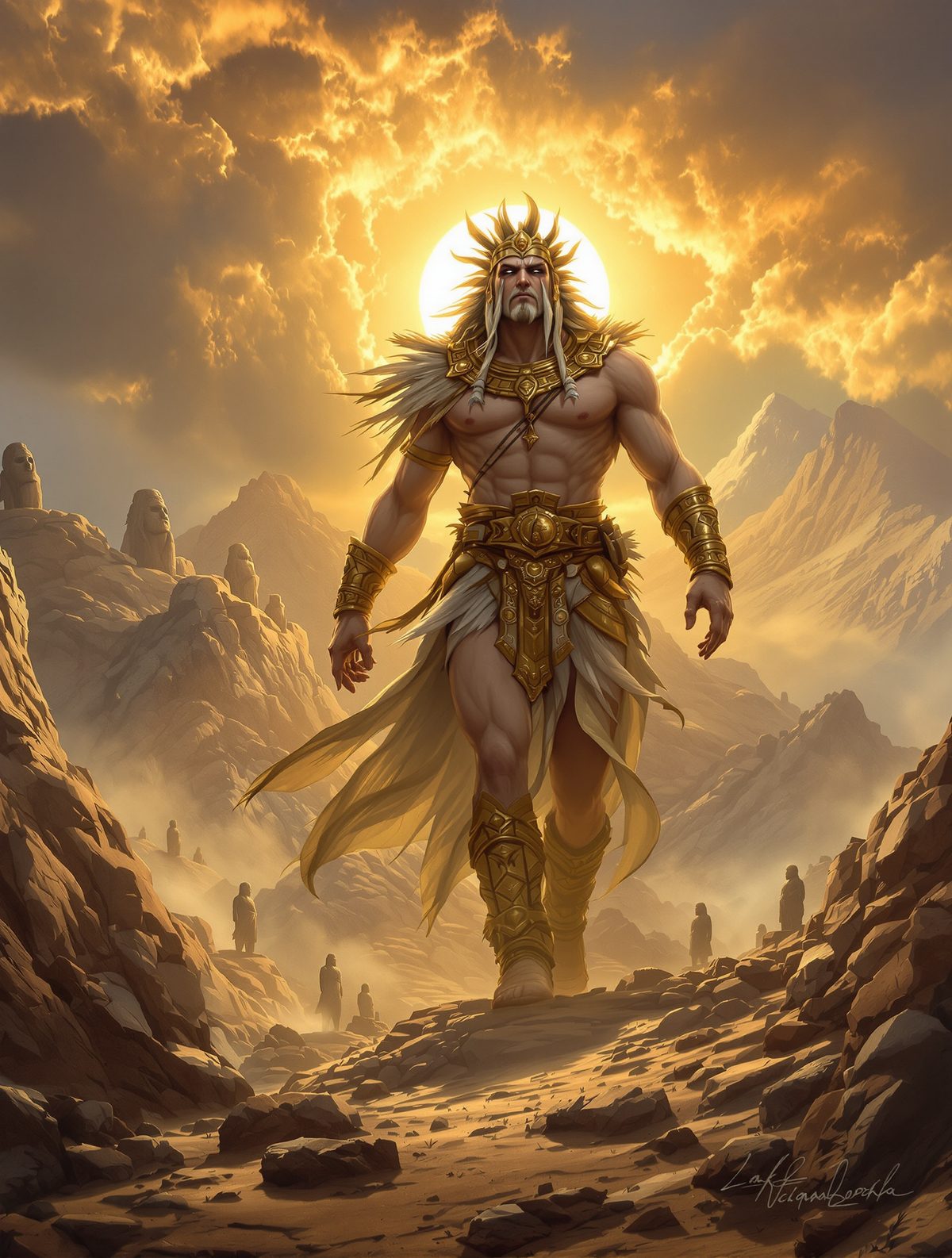
Picture this: as the last rays of sunlight fade over the ziggurats of ancient Babylon, most gods would call it a day. Not Shamash. While mortals drift into sleep and even fellow deities rest, this relentless sun god begins his most spine-chilling work. He doesn't simply vanish until dawn—he plunges straight down through solid earth, his divine flames boring through stone and clay like a cosmic drill, carrying his burning chariot into the realm where no light should ever reach. In the pitch-black underworld, surrounded by the wailing dead, Shamash becomes both torch and judge, dispensing justice in a courtroom made of shadows.
This wasn't just poetic imagery to the ancient Mesopotamians. For over 3,000 years, from roughly 3500 BCE to the fall of Babylon in 539 BCE, millions of people across the cradle of civilization believed this terrifying night shift was happening beneath their feet every single evening.
The God Who Never Sleeps
Shamash—known as Utu to the Sumerians who first worshipped him around 3500 BCE—was no ordinary solar deity. While other cultures imagined their sun gods sailing peacefully across celestial waters or resting in golden palaces, the Mesopotamians conceived something far more dramatic. Their sun god was a workaholic with a literally earth-shattering commute.
Ancient cuneiform tablets from the library of Ashurbanipal in Nineveh describe Shamash's nightly journey in vivid detail. As darkness falls, the god doesn't fade away—he transforms. His golden chariot becomes a blazing drill, and he descends through the earth itself, his divine fire so intense it melts passage ways through bedrock. The Epic of Gilgamesh, dating to around 2100 BCE, references this journey when Gilgamesh must traverse the same underground route, following "the road of the sun."
But here's what makes Shamash unique among solar deities: his night job was even more important than his day job. While bringing light to the living was certainly appreciated, his real calling lay in bringing justice to the dead. The Code of Hammurabi, carved around 1750 BCE, shows Shamash handing down laws to the Babylonian king—but those same tablets make it clear that the god's legal work continued 24/7, even in the underworld.
The Underground Courthouse of Eternity
The Mesopotamian underworld wasn't the fiery hell of later traditions—it was something arguably worse: a dim, dusty realm called Irkalla, where the dead existed in a dreary half-life, eating clay and drinking muddy water. Into this cheerless place, Shamash brought his blazing chariot every night, turning the realm of shadows into a cosmic courthouse.
According to the Descent of Inanna and other texts from around 1900 BCE, the underworld had seven gates and was ruled by Ereshkigal, Queen of the Dead. But even she had to make room for Shamash's nightly tribunal. Cylinder seals from the Neo-Assyrian period (911-609 BCE) show remarkable scenes: the sun god seated on his throne in underground chambers, his flames illuminating crowds of dead souls awaiting judgment, while demons and spirits serve as his bailiffs.
Here's the truly fascinating part: Shamash didn't just judge how people had lived—he judged how they had died. Mesopotamian legal texts suggest that deaths by murder, betrayal, or oath-breaking required special divine intervention. The god's underground court handled appeals, investigated supernatural crimes, and even overturned earthly verdicts. Imagine a legal system where death wasn't the end of litigation, but just a change of venue.
The Forensic Flames That Revealed All Truth
Shamash's fire wasn't just for show—it was the ultimate truth detector. Mesopotamian incantation texts from Mari (circa 1800 BCE) describe how the god's flames could reveal hidden crimes, expose false testimony, and literally burn away lies. In the underworld, this divine fire became a supernatural CSI unit, investigating cases that earthly courts couldn't solve.
The Ludlul Bēl Nēmeqi, a Babylonian poem from around 1000 BCE sometimes called the "Mesopotamian Job," describes how Shamash's underground flames could expose the true cause of someone's suffering or death. Did they die from natural causes, divine punishment, or human malice? The god's fire would reveal all. Archaeological evidence from Sippar, one of Shamash's most important cult centers, shows that families would leave offerings specifically requesting posthumous investigations.
But perhaps most remarkably, these flames could rewrite fate itself. Legal documents from the Old Babylonian period mention cases where Shamash's underground verdict could affect the living descendants of the dead. If the god determined someone had been wrongly executed or unjustly murdered, supernatural compensation would flow to their family line. Talk about a legal system with real teeth.
The Dawn Ascent and Divine Exhaustion
After a full night of underground legal proceedings, Shamash faced the challenge of returning to the world above. Ancient hymns describe this ascent as even more dramatic than his descent—the god's chariot erupting from eastern mountains like a volcanic explosion, his flames having grown even brighter from consuming the lies and injustices of the dead.
Sumerian temple records from Larsa show that priests would perform special dawn rituals to "assist" Shamash's return, believing the god emerged exhausted from his night's work. They would offer honey, dates, and beer—apparently even solar deities needed caffeine after an all-nighter of cosmic jurisprudence. The famous Sippar sun disk, dating to around 870 BCE, shows Shamash emerging from underground, his flames flickering with what scholars interpret as divine fatigue.
This daily cycle explained not just night and day, but the very nature of justice itself. Unlike human courts that closed at sunset, divine justice never rested. The wicked couldn't escape judgment by dying, and the innocent wouldn't remain forever unvindicated.
When Gods Worked the Night Shift
The image of Shamash burning through solid earth might seem like pure fantasy, but it reveals something profound about ancient Mesopotamian psychology. These people lived in a world where justice was often delayed, denied, or bought. Hammurabi's Code, for all its sophistication, couldn't solve every case or right every wrong. But Shamash could.
This wasn't just about imagining divine justice—it was about insisting that justice must exist somewhere, even if not in the earthly realm. The god's nightly journey represented an ancient refusal to accept that some wrongs could never be made right. In a world where the powerful often escaped consequences and the innocent suffered without explanation, Shamash's underground tribunal offered cosmic hope.
Modern sleep researchers have discovered that humans naturally experience heightened anxiety in the pre-dawn hours—what they call the "dark night of the soul." Ancient Mesopotamians intuited this phenomenon and created a mythology where even divine beings struggled through those dark hours, working tirelessly to maintain cosmic order. Perhaps Shamash's greatest lesson isn't about the afterlife, but about the work that must be done when no one else is watching—the grinding, essential labor that happens in darkness so that light can return with meaning.
In our own age of delayed justice and institutional failures, maybe we need our own version of Shamash: the promise that someone, somewhere, is working the night shift on behalf of truth.