In the celestial courts of heaven, panic reigned supreme. The Monkey King had done the impossible—he had made fools of every deity in the pantheon. Like smoke in the wind, Sun Wukong slipped through their grasp, his seventy-two transformations turning him into sparrows that mocked them from treetops, fish that vanished beneath waves, and pebbles that lay innocuously beneath their very feet. The Jade Emperor's forces were being humiliated by a single, rebellious simian who seemed to dance just beyond their reach. Then came Erlang Shen, nephew of the Jade Emperor, striding into the cosmic battlefield with something no other god possessed—a third eye that could pierce through any deception the universe could conjure.
The Master of Endless Forms
Sun Wukong's shapeshifting prowess wasn't mere party tricks—it was divine artistry perfected through centuries of disciplined study under the Patriarch Subodhi. The Monkey King had mastered the Seventy-Two Earthly Transformations, a legendary technique that allowed him to assume any form imaginable while retaining his supernatural strength and speed. Unlike simple illusions that merely fooled the eye, these transformations were complete molecular reconstructions of his being.
When the celestial armies first descended upon him, Sun Wukong demonstrated why he was perhaps the greatest escape artist in Chinese mythology. Cornered by the Four Heavenly Kings and their 100,000 celestial soldiers, he transformed into a bee and buzzed directly past their general's ear. When the Thunder God hurled lightning bolts, the Monkey King became a blade of grass, bending with the divine wind. The Twenty-Eight Lunar Mansions—powerful stellar deities—found themselves chasing butterflies, clouds, and at one mortifying moment, their own shadows.
What made Sun Wukong's transformations so devastatingly effective was his tactical brilliance. He didn't just become random objects; he studied his pursuers' psychology and became exactly what they would overlook. Facing the proud Dragon Kings, he transformed into humble driftwood. When confronted by the refined celestial scholars, he became crude stones they wouldn't deign to examine closely.
The Jade Emperor's Growing Desperation
For weeks, the rebellion of a single monkey had paralyzed the entire celestial bureaucracy. The Jade Emperor, ruler of heaven for over 18,000 years, watched his reputation crumble as reports of failure poured in. The God of War arrived with singed whiskers, claiming the Monkey King had disguised himself as incense smoke in a temple and nearly burned his divine beard. The Celestial Hounds, bred specifically to track supernatural beings, returned whimpering—they had spent three days barking at an ordinary rock that had somehow barked back.
The most humiliating incident occurred when Sun Wukong infiltrated a war council by transforming into a tea cup. For an entire hour, he sat on the strategy table listening to plans to capture himself, occasionally steaming when the discussion grew heated. Only when he burst into laughter at their increasingly ridiculous schemes did the gods realize they had been literally spilling their secrets to their enemy.
It was then that the Jade Emperor made a decision that would change the course of Chinese mythological history. He summoned his nephew, Erlang Shen—Yang Jian—the greatest warrior in the celestial realm and possessor of an ability so rare and powerful that even among gods, it was considered legendary.
The God with the Divine Eye
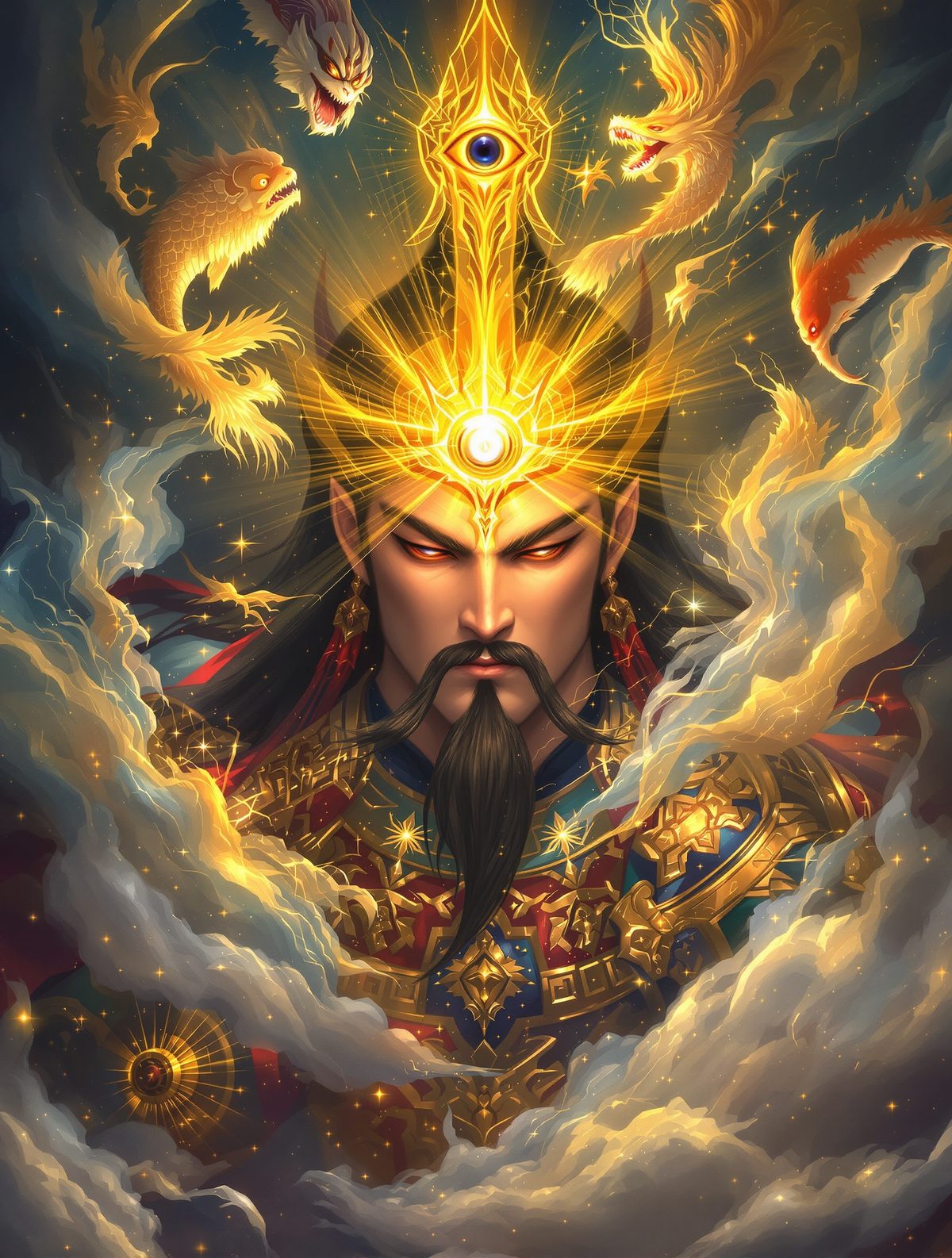
Erlang Shen was no ordinary deity. Born from a union between the Jade Emperor's sister and a mortal man, he embodied a perfect fusion of celestial power and earthly wisdom. His most distinctive feature wasn't his silver spear or his supernatural strength—it was the vertical third eye centered on his forehead, an organ of divine perception that could see through any deception, illusion, or transformation in existence.
This wasn't merely enhanced vision. Erlang Shen's third eye, known as the Tianyan or "Heavenly Eye," operated on multiple dimensional planes simultaneously. While his physical eyes saw the material world, his third eye perceived the true essence of all things—the unchanging spiritual signature that no amount of shapeshifting could alter. It was said that when fully opened, the eye could see through mountain ranges, across vast oceans of time, and into the very souls of gods and mortals alike.
The acquisition of this power came at tremendous cost. According to the Fengshen Yanyi (Investiture of the Gods), Erlang Shen had undergone a harrowing spiritual trial in which he allowed sacred flames to burn away his mortal perceptions for forty-nine days. When he emerged, his forehead bore a wound that never healed—instead, it opened into this window of absolute truth.
The Ultimate Game of Divine Hide and Seek
When Erlang Shen arrived at the battlefield, Sun Wukong initially treated him like every other celestial opponent. The Monkey King's confidence was absolute—after all, no god had yet matched his shapeshifting prowess. He immediately transformed into a towering temple, complete with incense burners and carved dragons, figuring that Erlang Shen would never think to attack such a sacred structure.
But as Erlang Shen approached, something unprecedented happened. The warrior god's forehead began to emanate a soft, golden light, and his third eye slowly opened like a blooming lotus. The moment that divine gaze fell upon the false temple, Erlang Shen smiled coldly. "Interesting architecture, Sun Wukong," he called out. "Though most temples don't have flagpoles that look quite so much like monkey tails."
What followed was the most extraordinary chase sequence in Chinese mythology. Sun Wukong, for the first time in centuries, found himself genuinely challenged. He became a sparrow—Erlang Shen became a hawk. The Monkey King transformed into a large fish—his pursuer became an even larger cormorant. Every transformation was immediately countered, every disguise instantly penetrated.
The battle raged across multiple provinces. In Sichuan, villagers reported seeing a massive eagle chasing what appeared to be a golden phoenix. In Hunan, fishermen swore they witnessed two dragons engaged in aerial combat above the Yangtze River. But most remarkably, through every transformation, Erlang Shen's third eye never lost track of his quarry's true essence.
The Moment of Truth
The decisive moment came when Sun Wukong, desperate and running out of options, attempted his most audacious disguise yet. He transformed himself into a perfect replica of Erlang Shen himself, complete with silver spear, celestial armor, and even a false third eye. It was a masterpiece of shapeshifting that should have been absolutely indistinguishable from the original.
But when the real Erlang Shen opened his third eye and gazed upon this perfect duplicate, he saw something that no amount of external mimicry could replicate—the Monkey King's unique spiritual essence, blazing like a golden flame that could never be extinguished or disguised. "Your form is flawless," Erlang Shen acknowledged, "but your soul burns with the fire of rebellion that no transformation can hide."
In that moment, Sun Wukong realized he faced an opponent who operated on an entirely different level. The third eye didn't just see through disguises—it saw through the very concept of deception itself. For the first time since his rebellion began, the Monkey King stood truly exposed, his greatest weapon rendered useless against an adversary who could perceive absolute truth.
When Illusion Meets Ultimate Reality
The story of Erlang Shen's third eye piercing Sun Wukong's transformations represents more than just a mythological battle—it's a profound meditation on the nature of truth and illusion that resonates powerfully in our modern world. In an era where deepfakes can create convincing videos of anyone saying anything, where social media profiles craft elaborate false personas, and where the line between authentic and artificial grows ever thinner, the image of the divine eye that sees through all deception has never been more relevant.
The myth suggests that beneath every disguise, every carefully constructed image, lies an unchangeable essence that cannot be hidden from true perception. It's a reminder that in our rush to present ourselves as we wish to be seen, we might be engaging in our own versions of the Monkey King's endless transformations—and perhaps wondering if anyone possesses the third eye necessary to see who we really are beneath all our digital masks and social performances.