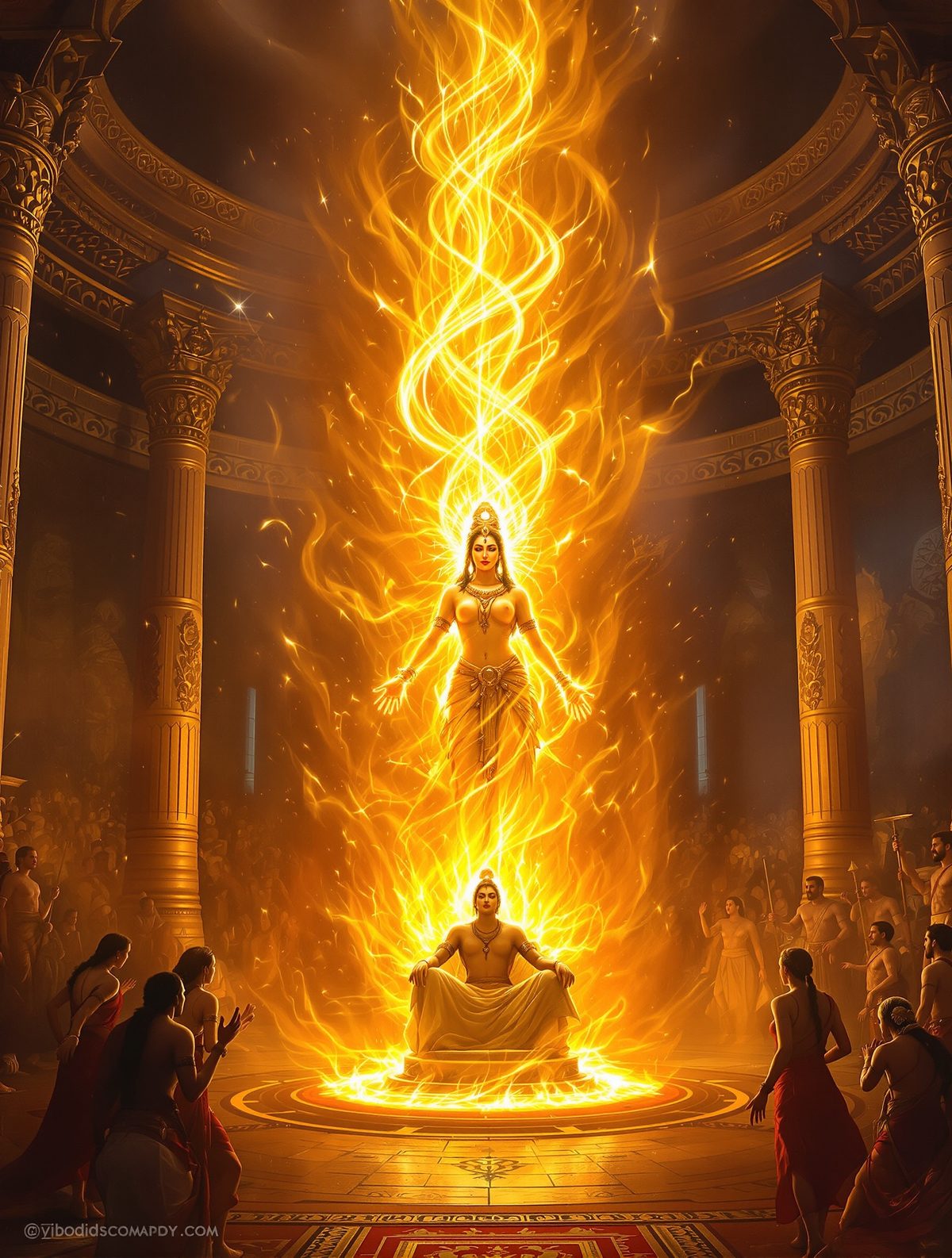
The flames that consumed Sati's divine form weren't just fire—they were fury incarnate, burning with the intensity of a thousand cosmic suns. As her body disintegrated in the sacred fire she had summoned from within, the assembled gods watched in horror. They had come to witness Daksha's grand sacrifice, the most magnificent ritual in all creation. Instead, they were about to witness the unmaking of the universe itself.
What drove the beloved daughter of one of the most powerful cosmic beings to such a devastating act? The answer lies in a tale of wounded pride, divine politics, and a love so profound that death became preferable to dishonor.
The King of All Sacrifices Sets His Trap
Daksha Prajapati was no ordinary father-in-law. As one of the primary cosmic creators, born from the mind of Brahma himself, he wielded power that could reshape reality. His ashram in the foothills of the Himalayas was a marvel of divine architecture—crystal pavilions that sang with the wind, altars carved from single gemstones, and fire pits that burned with flames from the sun itself.
When Daksha announced his Brihaspati Sava, the greatest sacrifice ever conceived, the invitation list read like a who's who of cosmic royalty. All 33 crore devas received golden tablets inscribed with the details. The Adityas, the twelve solar deities, confirmed their attendance. The eight Vasus, elemental forces of nature, cleared their schedules. Even the fierce Rudras, storm gods known for their unpredictability, agreed to participate.
But one name was conspicuously absent from the guest list: Shiva, the cosmic destroyer and Daksha's own son-in-law.
The slight wasn't accidental. Since his daughter Sati had married the ash-smeared, serpent-adorned Shiva against his wishes, Daksha had nursed a grudge that festered like an infected wound. To the refined Prajapati, Shiva represented everything uncivilized—a god who dwelled in cremation grounds, surrounded himself with goblins and ghosts, and wore tiger skins instead of silk. That this vagabond had won the heart of his most beloved daughter was an insult Daksha could never forgive.
A Daughter's Impossible Choice
High on Mount Kailash, Sati felt the cosmic tremors as thousands of divine beings journeyed toward her father's ashram. The mountain itself seemed to vibrate with excitement as celestial chariots, flying horses, and divine swans filled the skies. But in their crystal palace, an uncomfortable silence settled between husband and wife.
"The invitation must have been lost," Sati suggested hopefully, though she knew better. Divine communications didn't simply go astray.
Shiva, deep in meditation, opened his third eye just slightly—enough to perceive the truth but not enough to incinerate the mountain with his fury. "Your father has made his intentions clear, beloved. We are not welcome."
For days, Sati wrestled with an impossible choice. Hindu tradition held that daughters belonged to their father's household until death—surely she could attend uninvited? Her mother and sisters would be there. The greatest spiritual discourse in eons would unfold. How could she miss it?
But deeper still ran her awareness of the insult to Shiva. In the cosmic order, disrespecting one of the Trimurti—the three primary aspects of divinity—was tantamount to spitting at existence itself.
"I'll go and make him see reason," she finally declared, though Shiva's sad smile suggested he already foresaw how terribly wrong things would go.
The Humiliation That Shattered Heaven
Sati's arrival at her father's ashram should have been a moment of joy. Instead, it became a masterclass in public humiliation. Daksha had positioned himself on a throne carved from a single sapphire, surrounded by the cosmic elite. When his daughter approached—alone, as everyone immediately noticed—his face hardened into marble.
"How gracious of you to honor us with your presence," Daksha announced, his voice carrying to every corner of the vast assembly. "Though I notice your... husband... couldn't be bothered to attend the greatest sacrifice in creation."
The assembled gods shifted uncomfortably. This was family drama on a cosmic scale, and they all recognized the danger brewing.
Sati tried diplomacy first. "Respected father, surely there has been some misunderstanding—"
"Misunderstanding?" Daksha's laugh was like breaking glass. "The only misunderstanding was when I failed to stop my daughter from marrying a vagrant who decorates himself with corpse ash and talks to skulls. Look around you, Sati! See the refined company of real gods—beings of culture, wisdom, and cleanliness. Then ask yourself why I would invite that... that creature you've chosen to call your husband."
What happened next, witnesses would later say, was like watching a star collapse. Sati's divine radiance began to dim, then flicker, then transform into something altogether more dangerous.
The Fire That Changed Everything
When Sati began to speak, her voice carried harmonics that made the crystal pavilions resonate like temple bells. But her words carried the finality of cosmic judgment.
"You speak of Shiva as unworthy," she said, rising to her full divine height. "Let me remind you who you insult. He is Nataraja, whose cosmic dance maintains the rhythm of existence. He is Neelkanth, who drank the poison of the cosmos to save all creation. He is Ardhanarishwar, the perfect union of masculine and feminine principles. He is the destroyer, yes—but destruction that makes room for new creation."
The assembled gods began to realize they were witnessing something unprecedented. Sati's form was becoming translucent, and divine fire was beginning to kindle around her feet.
"You have dishonored not just my husband, but the cosmic principle he represents. You have placed your petty pride above divine order itself. And you have forced me to choose between the respect I owe my father and the love I bear my husband."
Daksha, perhaps finally understanding what he had unleashed, reached toward his daughter. "Sati, don't—"
"I renounce this body that came from you," she declared, and the fire that had been building within her divine essence erupted outward. "I renounce the very atoms that you contributed to my existence. Let this flesh burn so that I may be free of any connection to one who would insult Shiva himself!"
The fire that consumed Sati wasn't the ordinary flame of the sacrifice. This was yogagni—the internal fire of divine consciousness turned destructive. It burned without consuming anything else, leaving the ground beneath her feet unmarked while reducing her physical form to pure light.
When Heaven Came Crashing Down
The moment Sati's body crumbled to ash, the cosmic order itself convulsed. On Mount Kailash, Shiva's roar of grief shattered mountains. His rage, held in check for eons, finally found its target. From his own hair, he created Virabhadra—a terrifying warrior whose sole purpose was vengeance.
What followed was the destruction of Daksha's sacrifice in the most literal sense. Virabhadra and an army of Shiva's ghostly followers descended on the assembly like a cosmic hurricane. Altars were overturned, sacred fires scattered, and the gods themselves fled in terror. Daksha himself was beheaded, his sapphire throne shattered into fragments that still lie buried in the Himalayan foothills.
But the real destruction was emotional. Shiva, cradling the burnt remains of his beloved, began the Rudra Tandava—the dance of cosmic destruction. Each step cracked the foundations of reality. Each gesture sent galaxies spinning out of their orbits. The universe itself began to unravel.
Only when Vishnu intervened, literally cutting Sati's corpse into pieces with his discus to break Shiva's attachment, did the cosmic dance of destruction finally end. Where each piece of Sati's body fell became a Shakti Peetha—sacred sites where the divine feminine energy remains forever present. Fifty-one such sites exist across the Indian subcontinent, each marking a fragment of the love that literally shook heaven and earth.
The Legend They Don't Want You to Know
Why don't most people know the full details of this cosmic tragedy? Perhaps because it reveals uncomfortable truths about family dynamics, religious politics, and the price of standing up for love. Sati's story isn't just about mythological figures—it's about what happens when pride trumps compassion, when social expectations clash with personal truth, and when love becomes so pure it would rather cease to exist than compromise.
The tale takes on even more significance when we realize that Sati would reincarnate as Parvati, eventually winning Shiva's heart again through patient devotion. Their reunion suggests that true love transcends even death—but only after terrible prices have been paid by everyone involved.
In our modern world of family conflicts and social pressure, Sati's choice resonates with anyone who has ever faced an impossible decision between loyalty to family and loyalty to their own heart. Her story reminds us that sometimes, the greatest act of love is also the most devastating—and that the consequences of wounded pride can literally reshape the world.
The next time you hear about family drama, remember Sati's choice. Some arguments aren't worth having. Some pride isn't worth defending. And some love stories are so powerful they can destroy and remake the very cosmos itself.