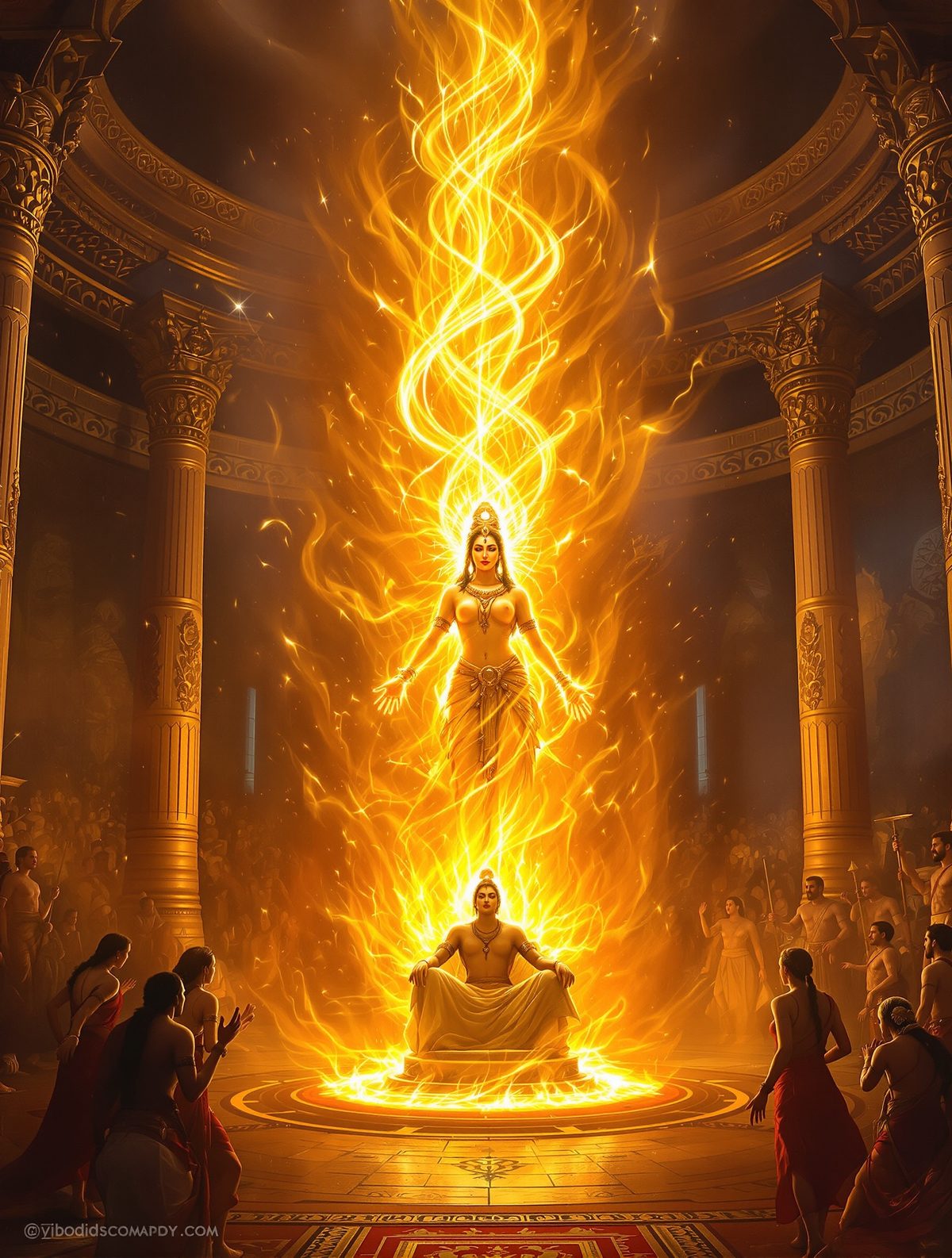

The lyre strings still hummed with wedding songs when Eurydice felt the serpent's fangs pierce her heel. One moment she was laughing, her white peplos flowing behind her as she danced away from Aristaeus the shepherd's unwanted advances. The next, she lay dying in the tall grass beside the river Hebrus, poison coursing through her veins as her new husband's music echoed mockingly across the Thracian hills.
In all the epic tales of gods and heroes, no single bite has ever carried such tragic weight. This wasn't just the death of a beautiful nymph—it was the moment that would drive the greatest musician who ever lived to attempt the impossible: to charm Death herself and return with his beloved from the realm of no return.
The Wedding That Became a Funeral
According to the earliest versions preserved by Apollodorus and later embellished by Ovid, Orpheus and Eurydice's wedding took place during the height of summer in ancient Thrace, somewhere along the fertile banks of the Hebrus River around the mythical equivalent of the 13th century BCE. The celebration should have lasted seven days, as was customary for unions blessed by the Muses themselves.
Orpheus was no ordinary bridegroom. Son of Apollo and the Muse Calliope, his voice could make stones weep and trees uproot themselves to follow his songs. Ancient sources tell us his lyre, crafted by Hermes and blessed by his divine father, possessed seven strings that corresponded to the seven heavens—though some later traditions insist it was nine, matching the number of Muses.
But even as the wedding feast reached its crescendo, darker forces were already in motion. Aristaeus, son of Apollo and the nymph Cyrene, had been consumed with desire for Eurydice since first glimpsing her dancing in the sacred groves. Ancient texts describe him as the divine protector of beekeeping and olive cultivation, but on this day, his desires were far from noble.
What many don't realize is that this wasn't a chance encounter. According to fragments preserved by the Byzantine scholar Photius, Aristaeus had been stalking Eurydice for months, waiting for the perfect moment to act. The wedding celebration, with its wine-loosened inhibitions and secluded garden paths, provided exactly the opportunity he'd been seeking.
Death Strikes at the Moment of Joy
The fatal chase began near sunset, when the golden light filtering through the olive groves cast long shadows across the rocky terrain. Eurydice had stepped away from the festivities, perhaps seeking a moment of quiet reflection on her new life, when Aristaeus cornered her beside an ancient shrine to Demeter.
His proposition was as crude as it was shocking—he offered her immortality and divine status if she would abandon Orpheus for him. When she refused, laughing at his presumption, his attempted seduction turned violent. Eurydice fled, her wedding sandals slipping on the dewy grass as she ran toward the sound of her husband's lyre.
She never saw the serpent coiled among the reeds. Ancient sources describe it as a vipera ammodytes, a sand viper whose bite delivers a cocktail of hemotoxins that cause massive internal bleeding. The Greeks called it echidna after the monster that was half-woman, half-snake—an ominous parallel that wouldn't have been lost on contemporary audiences.
The bite itself lasted mere seconds. The viper's fangs, each no longer than a rose thorn, penetrated her heel just above where her golden wedding sandal ended. But those few seconds condemned her to a death so swift that Orpheus reached her side just in time to watch the light fade from her eyes.
Here's a detail that most retellings omit: according to the Argonautica Orphica, Eurydice's final words weren't a declaration of love or a plea for rescue. Instead, she whispered the opening notes of Orpheus's own wedding song—the melody that had sealed their union just hours before.
When Music Confronts the Infinite Silence
For three days and three nights, Orpheus held vigil beside Eurydice's body, playing every song he'd ever composed and improvising new melodies of such heartbreaking beauty that the wildlife of Thrace gathered in concentric circles around the death scene. Apollonius of Rhodes records that wolves lay down beside deer, and eagles perched peacefully next to sparrows, all united in their grief for the fallen bride.
But even divine music couldn't reverse death—at least, not in the world of the living. It was Orpheus's mother, Calliope, who finally appeared to him in a vision and spoke the words that would change everything: "Your music has power over all living things, my son. But who is to say what lies beyond that boundary?"
The entrance to the Underworld that Orpheus chose was neither the famous caves at Taenarus nor the volcanic crater at Avernus that later heroes would use. Instead, according to fragments preserved by the neo-Platonic philosopher Damascius, he descended through a hidden cleft in the rocks of Mount Rhodope, following an underground river that local Thracian shamans had used for centuries to conduct rituals for the dead.
What many don't realize is just how unprecedented this journey was. In the entire corpus of Greek mythology, only three mortals had ever entered the Underworld while still alive and returned to tell the tale: Heracles (who dragged Cerberus to the surface), Theseus (who attempted to kidnap Persephone), and later, Aeneas (guided by the Cumaean Sibyl). Orpheus would become the fourth—and the only one motivated purely by love.
Charming Death: The Music That Made Hades Weep
The descent took seven days, matching the seven strings of Orpheus's lyre and the seven levels of the Underworld as described in orphic hymns. At each level, his music overcame increasingly impossible obstacles. The three-headed dog Cerberus, whose bark could shatter bronze shields, fell into a peaceful slumber. The Furies, whose very presence drove mortals insane, wept tears that turned to silver as they struck the ground.
Most remarkably, the eternal punishments ceased. Tantalus, condemned to eternal hunger and thirst, found his torment suspended as fruit and water remained within reach for the duration of Orpheus's song. Sisyphus sat down on his boulder and listened, while the stone remained motionless on the mountainside. The daughters of Danaus stopped their futile attempt to fill their broken jars and simply listened to the music of pure love.
But the greatest miracle occurred when Orpheus finally stood before the obsidian thrones of Hades and Persephone. The song he sang—preserved in fragments by the mystical poet Linus—wasn't a demand or a plea. Instead, it was a lament that captured the cosmic injustice of love interrupted, of promises unkept, of a story that ended before its final verse.
Ancient sources agree on one stunning detail: for the first and only time in all eternity, Hades wept. The lord of the dead, who had never shown mercy to any mortal soul, found himself moved by music that spoke to the one experience he truly understood—the desperate love that had driven him to kidnap Persephone from the world above.
The Condition That Doomed Love
The bargain that Hades offered seemed almost too generous to be real: Eurydice could return to the world of the living, but only if Orpheus could lead her out without once looking back to ensure she followed. The condition appears simple, even arbitrary, but it contained a cruel psychological trap that the lord of the dead understood perfectly.
What makes this condition so diabolical is that it exploited the very love that had brought Orpheus to the Underworld in the first place. Every step toward the surface would be torture—was she truly there? Was she struggling? Was she fading away while he walked obliviously ahead?
The ascent began at dawn, measured by the distant light filtering down from the world above. For six days, Orpheus climbed steadily upward, his lyre silent, listening desperately for any sound of Eurydice's footsteps behind him. But the dead make no sound when they walk, cast no shadows, disturb no dust.
Byzantine sources preserve a haunting detail: on the final day, as the entrance to the upper world came into view, Orpheus heard what he was certain was Eurydice's voice calling his name. Fearing she was in distress, he turned—only to discover that the voice had been an echo of his own desperate whisper, bouncing off the cavern walls.
In that instant, Eurydice began to fade. Her final words, preserved in Ovid's Metamorphoses, carry no anger or recrimination: "Farewell," she whispered, as she dissolved back into shadow. "I have been loved."
The Legend That Refuses to Die
The story of Orpheus and Eurydice has survived for over three millennia because it captures something fundamental about the human experience that transcends cultural boundaries. In a world where we can transplant hearts and edit genes, where technology promises to solve every problem, we still cannot bring back the dead. Love, no matter how pure or powerful, cannot overcome the ultimate separation.
But perhaps that's not the real lesson. Perhaps the true power of this myth lies not in Orpheus's failure, but in his willingness to attempt the impossible. In a universe that often seems indifferent to human suffering, the act of loving so completely that you would challenge death itself becomes its own form of victory.
Today, when we lose someone we love, we may not have Orpheus's divine music to charm our way into the underworld. But we have something equally powerful: the stories we tell, the memories we preserve, and the love that refuses to be extinguished even by death itself. Eurydice's snake bite may have ended one love story, but it began a legend that continues to offer hope to anyone who has ever loved someone they cannot save.
In the end, perhaps Eurydice didn't step on that snake by accident. Perhaps she stepped into immortality.