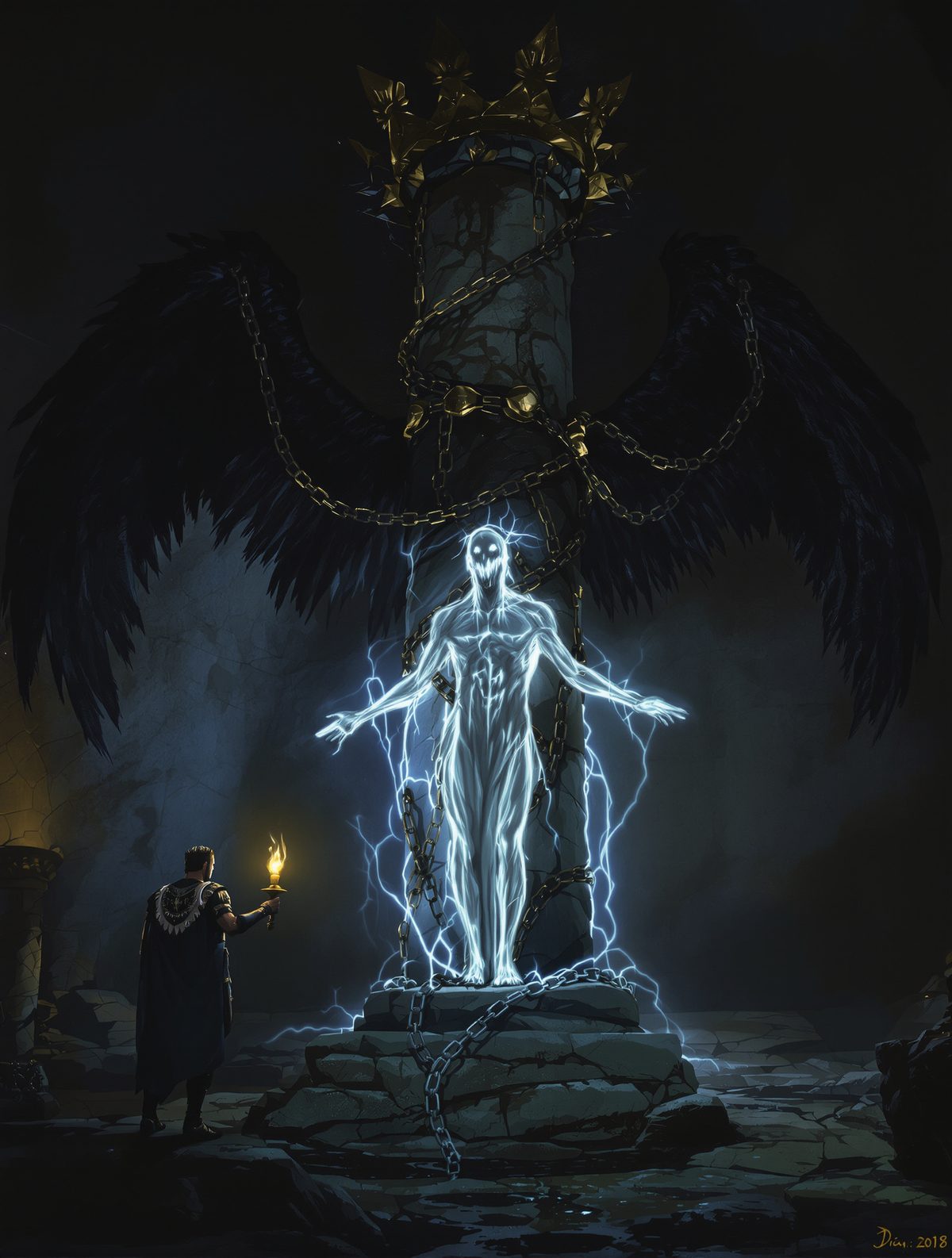

In the rolling hills of ancient Corinth, a saga unfolded that would baffle gods and mortals alike, and echo through the eons as a testament to audacity and intellect. The legend of Sisyphus endures as an emblem of cunning that defied not just earthly governance but the very cosmic order — a tale of a man who audaciously outwitted the inevitability of death not once, but twice, and in doing so, reshaped his destiny amongst the shadows of Hades.
The First Trick: Chains of Mortality
Our tale begins in the vibrant city-state of Corinth, around the shadowy mists of the mythic age. Sisyphus, the shrewd ruler and founder of Ephyra (ancient Corinth), was already notorious for his wit and deceit. However, it wasn’t his acts of earthly scheming that cemented his place in the annals of mythology. Sisyphus committed an act so profound that it stirred the depths of Olympus itself — he captured and chained Thanatos, the god of death.
With a devious grin, Sisyphus invited Thanatos to demonstrate the chains meant to bind him to the underworld. As the god bound himself to explain their function, Sisyphus acted swiftly, shackling Thanatos with his own chains. During Thanatos's imprisonment, death ceased its march across the ancient world. The battlefield was rife with wounded soldiers who could not die, causing chaos akin to an eternal twilight. It was a moratorium on mortality that disrupted the natural cycle of life and death.
In frustration, the great god Zeus dispatched Ares, the embodiment of war, to free Thanatos. Ares, notoriously simplistic in his thinking, lacked tolerance for such tricks and quickly liberated Thanatos, allowing death to resume its somber duty.
Return from the Underworld
Even though Thanatos regained his freedom, Sisyphus wasn’t out of intrigue. Eventually, his life concluded, and he found himself in the dark, somber halls of Hades, king of the underworld. Yet, Sisyphus had orchestrated yet another plan. He had instructed his wife, Merope, to leave his body unburied, a sacrilege that would permit him to invoke plausible complaints from the realm of the dead.
When he pleaded his case before Persephone, the queen of the underworld, his argument dripped with feigned indignation. Sisyphus insisted he had been improperly mourned and requested permission to ascend temporarily to rectify this oversight. Amazingly, his ruse worked, and Sisyphus was granted a temporary reprieve to the land of the living to "put things in order."
Once he rose back into the warmth of the sun, Sisyphus basked in the defiance of divine command; he had cheated death a second time, leveraging cunning over omnipotence in a move that spoke to his unyielding brilliance.
The Pitiless Punishment
Yet, for all his bravado, there was no third escape. All tales of defiance must eventually meet a conclusion, and for Sisyphus, the end came not in obliteration but in eternal frustration. Eventually recaptured and returned to Tartarus, the pit of torments, Sisyphus was condemned to an infamous punishment.
His condemnation was deceptively simple; he was tasked with rolling an immense boulder up a steep hill, only to watch it roll back down each time he neared the summit. This ceaseless, futile labor forged a poignant metaphor for the human condition — an eternal struggle against insurmountable odds.
The Making of a Myth
The tale of Sisyphus is more than a simple story of hubris punished. It espouses deeply existential themes, resonant as much in an ancient amphitheater as in modern introspection. Often seen as a mythological prototype of rebellion against divine order, his story underscores both the brevity of life and the audacious spirit inherent in humanity. The philosopher Albert Camus saw in Sisyphus a figure of the absurd hero, endlessly toiling without hope for redemption or reward.
Certainly, there are many layers within the folds of this myth. Consider the audacity of exploiting divine pity, the clever subversion of sacred obligations, and the boldness to revise the terms of one’s fate. These elements portray Sisyphus not merely as a deceiver but as a symbol of human ingenuity unbridled.
Lessons from the Underworld
What is perhaps most enduring in the tale of Sisyphus is the suggestion of agency against predestinated boundaries. The king of Corinth reminds us of an empowering truth: that even in the face of cosmic forces, there is space for sagacity, for courage, and for the inextinguishable hope that we might carve meaning from an indifferent universe.
His story resonates through centuries as a complex portrait of courage, cunning, and consequence. By challenging the very essence of the gods' decrees, Sisyphus left a legacy that speaks beyond the bounds of myth into the heart of human resilience — an eternal echo for those who refuse to surrender to inevitability without a fight.