The cunning of Sisyphus is a story that has lingered through the ages, captivating the minds of both ancient audiences and modern readers alike. Imagine a world where Death is no longer inevitable — where the finality of existence dissolves, and humans rise unscathed from the grave itself. This legend of audacity and cleverness unfolds in the underworld tapestry of Greek mythology, with Sisyphus reigniting the timeless question: What happens when humanity stares Death in the eyes... and laughs?
The Craftiest King of Ephyra
Our tale begins in the ancient city of Ephyra, known today as Corinth, where the shrewd King Sisyphus ruled with a mind sharper than the double-edged swords of his warriors. Sisyphus, son of Aeolus, was no ordinary ruler. His reputation as a trickster preceded him, not only among his subjects but across the lands of Greece and into the divine courts of Mount Olympus. He deceived neighbors and citizens alike, amassing wealth and power while consorting with mythological figures. His cunning was such that he was rumored to have defied the gods themselves — an accusation that, as our story reveals, was no mere myth.
Thanatos at the Door
In the days of yore, when gods still walked among mortals, Thanatos, the personification of death, was tasked with ensuring that the world maintained its natural order. Unlike his more famous sibling, Hades, Thanatos was not a ruler of realms, but a silent sentinel — a shadow who came peacefully at a soul's final breath. But what happens when Death itself is halted? When Thanatos approached Sisyphus to shepherd him to the underworld, the cunning king did not tremble. Instead, he welcomed Thanatos with feigned hospitality.
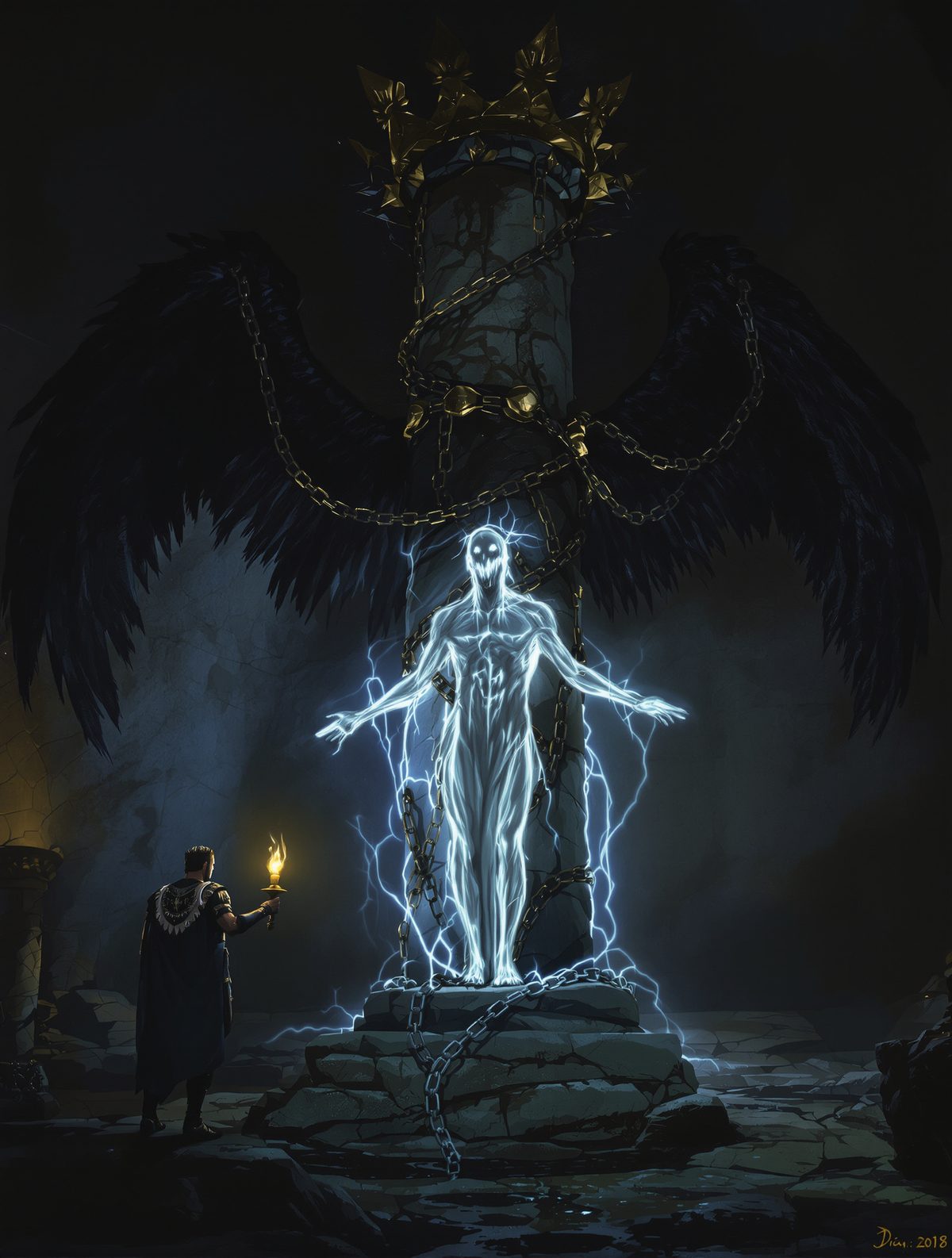
With ingenuity that would put the arch-trickster Hermes to shame, Sisyphus invited Thanatos to examine a set of iron chains, deceptively proclaiming them to be magical. As the god of death inspected the chains, Sisyphus ambushed him, clapping the very irons onto Thanatos himself! Bound and powerless, Thanatos sat impotent, and in his captivity, the world above descended into chaos.
A World Without Death
The impact of this imprisonment was immediate and profound. Soldiers fell in battle, only to rise again unscathed. Ancient records, tales hastily scrawled in script, speak of families marveling in horror and delight as loved ones sickened but could not die. From the deepest valleys to the tallest peaks of Greece, mortality ground to an astonishing halt.
But without Death to shepherd the departed, the equilibrium of the world was undone. Old wounds were left unhealed; souls lingered in a purgatory of existence. As the state of living purgatory continued, panic spread — not only among mortals but the gods themselves. Olympian eyes turned toward Earth in disbelief and fury. Who could rectify such chaos?
Ares Does What Must Be Done
The mounting disorder did not escape the notice of the gods, for whom the natural order of life and death was inviolable. Ares, the Greek god of war, watched with mounting rage, his war-chariot silent save for the distant echo of clashing steel. Ares thrived on conflict, for it was in bloodshed that his essence found purpose. A deathless war was an abomination to him, a cosmic joke of which he was the unwilling punchline.
Determined to restore the natural order, Ares descended in wrathful fury. With unbridled force, he released Thanatos from his chains, liberating Death to resume its inexorable march across the world. The balance had shifted back to its divine settings — and yet the tale of Sisyphus was far from over.
A Rock and a Hard Place
For his defiance, Sisyphus earned the ire of the gods; particularly Zeus, whose reputation brooked no insolence from mortal men. No man could be permitted to so openly mock the structures of fate and divine justice. Upon Sisyphus's actual death, he was consigned to the underworld with a punishment matching his crime: to eternally push a massive boulder up a hill, only to watch it roll back down each time the summit neared. Sisyphus's story, captured in verse and song, became an eternal symbol of futility.
And yet one can't help but wonder at the courage and craftiness that led to such a monumental triumph, brief though it was.
The Lessons of Sisyphus
Why does this tale still resonate millennia later? Sisyphus's audacity to bind Death is a powerful allegory for the human condition itself. In a world where each breath feels both precious and fleeting, the obstacles often seem impossibly large, echoing the boulder that eternally eludes him. But perhaps the lesson lies not in the futility, but in the irrepressible spirit that dares to challenge even the divine. We are reminded through Sisyphus of the indomitable nature of human spirit, sometimes more powerful than any obstacle put before us — more cunning than the gods themselves.
As we navigate our own lives, confronting the giant boulders of modern existence — disease, conflict, uncertainty — we find a spark of Sisyphus within us, the courage to defy even the chains of mortality. Let the legend endure as a tribute to audacious defiance, employing cunning where strength leaves no path. Because when Death is bound in chains, who among us can say what is truly impossible?