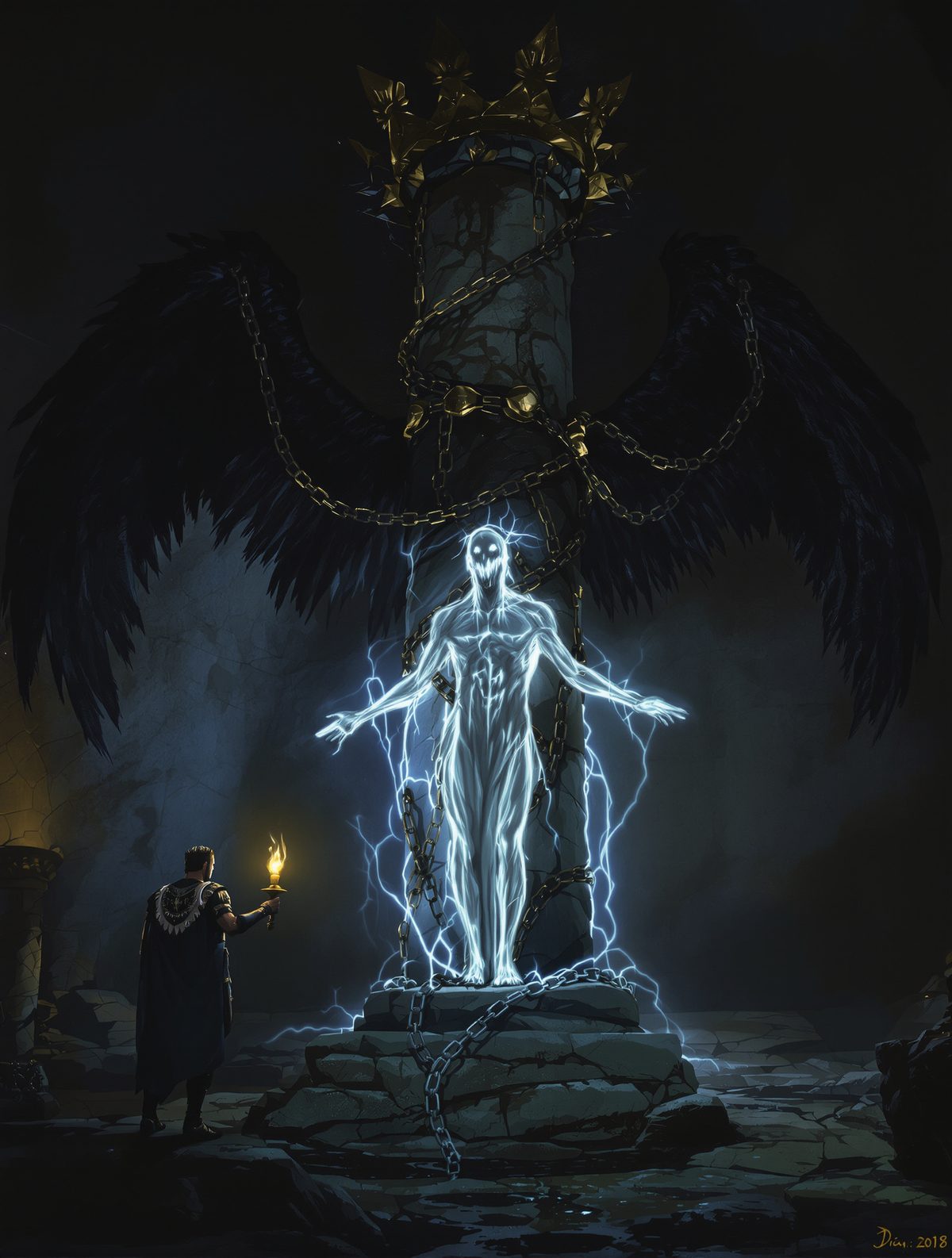
In ancient times, when the world was young and life danced effortlessly around a celestial scaffold, there existed a connection between heaven and earth as tangible as the soil beneath one's feet. A sacred rope tethered the divine to the mundane, and with this connection, the gods bestowed immortality upon humanity. But all of that changed with one woman's insatiable hunger, leading to a breach so profound that its echo can still be felt today in the certainty of mortality. This is the story of Abuk and the Forbidden Gourd—the sin that brought death to all.
The Golden Age: A World Without Death
Imagine a world without the shadow of death, where the cycle of life did not waver towards inevitable demise. This was life for the Dinka people, an ancient Nilotic tribe in what is now South Sudan. In this paradisiacal existence, humanity was free from the trials of mortality. The divine being known as Nhialic lived amongst men, his presence as constant and comforting as the stars in the night sky. Life flowed with a gentle ease, as the tasks of days were marked not by survival, but by the simple joys and rhythms of existence.
During this time, God granted one simple rule: plant only one grain each day. This rule, seemingly simple, was the thread preserving the balance between heaven and earth. It was an era where humanity's needs were met generously, but the temptation of more—an excess—resided in the hearts of men, waiting to be awakened.
The Curious Transgression of Abuk
Among these ancient ancestors lived Abuk, a woman of remarkable curiosity and ambition. She saw the bounty of life and yearned not for just enough, but for more. One can almost see her in the verdant fields, kneeling over the fertile earth, her hands brushing against the soil more lovingly than necessary.
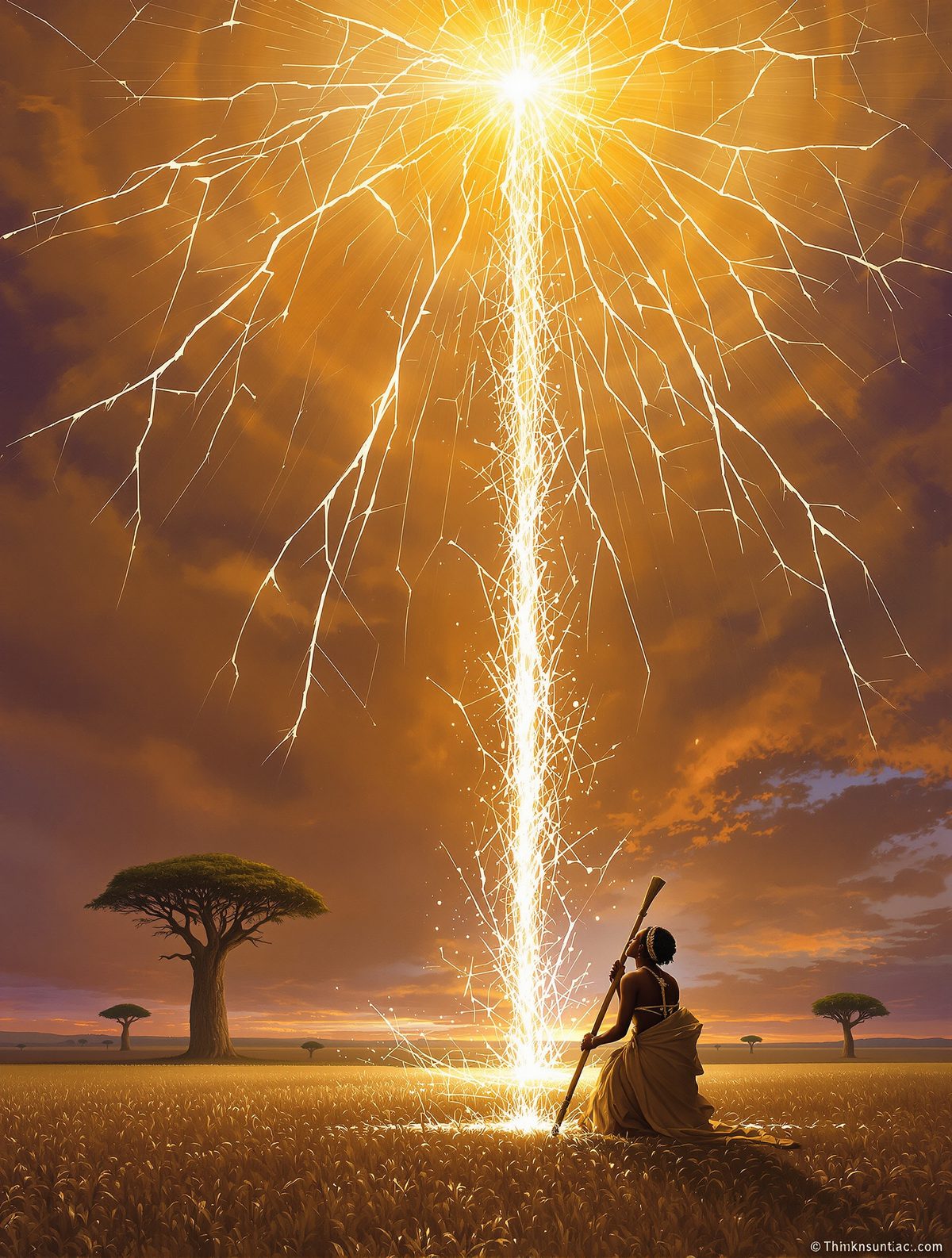
In a bold defiance of the divine rule, one day Abuk planted not just one grain, but many. She wielded her hoe with newfound vigor, its blade slicing through the earth and inadvertently reaching towards heaven itself. A resounding reverberation shuddered through the air as the blade struck the divine realm, a silent alarm echoing through the expanse.
Here marks a turning point: in her moment of impatience and longing, Abuk's act unleashed consequences no mortal eye could foresee. Her hoe, now a symbol of overreach and transgression, had pierced the very fabric tethering humanity to the divine.
God's Withdrawal: The Severing of Heaven and Earth
The heavenly rope, once a lifeline and conveyor of immortal grace, now quivered with Abuk's challenge. Nhialic, in profound disappointment, began his ascent back to the heavens, severing the rope with each patient step. His withdrawal was a tragic migration from which there would be no return, taking with him immortality and the ethereal harmony once shared. Though specific dates have been lost to history, the memory of this severance has endured for countless generations as a lesson embedded in the cultural consciousness of the Dinka people.
As Nhialic retreated, the human world underwent an irreversible transformation. The certainty of death entered the fabric of life, ushering in an era where life would be forever counterbalanced by the weight of mortality. Where once there was a seamless exchange between the mortal and the divine, now lay a chasm deeper than any sorrow known before.
The Legacy of Abuk: Mortality's Imprint
Abuk's narrative, unchanged for centuries yet starkly poignant, offers a glimpse into the eternal human struggle between desire and limitation. Her story echoes the mythical undertones found in countless other cultures, where a single act of defiance results in a profound shift in human destiny. It is this universality that speaks to something innate within the human spirit—a longing for more, pitted against the wisdom of restraint.
Intriguingly, elements of Abuk's tale appear in myths around the world, from Pandora's box in Greece to the Biblical Eve's apple. These stories, painted in the vibrant hues of their respective cultures, collectively remind us of the intricate dance between humanity's dreams and the boundaries set by divine will.
Why Abuk's Story Matters Today
In today's fast-paced world, rife with ambitions as teeming and numerous as seeds in Abuk's fateful gourd, her story bears more relevance than ever. It compels us to ponder the consequences of our desires—of taking more than what is meant for us, and the reverberations they might cause both personally and universally.
In reflecting upon Abuk's narrative, we are faced with the same eternal question: how do we balance our innate desires with the wisdom to respect natural boundaries? As we navigate the complexities of modern life, her story continues to offer an ancient reminder of humility, intention, and the fragility of the delicate web that sustains us.
Thus, the legend of Abuk and the Forbidden Gourd becomes more than just a cautionary tale; it is a mirror reflecting our own potential for both creation and destruction, inviting us to tread carefully along the pathways of our daily lives—a reminder that sometimes, less is more, and that in life's garden, one grain is nourishment enough.