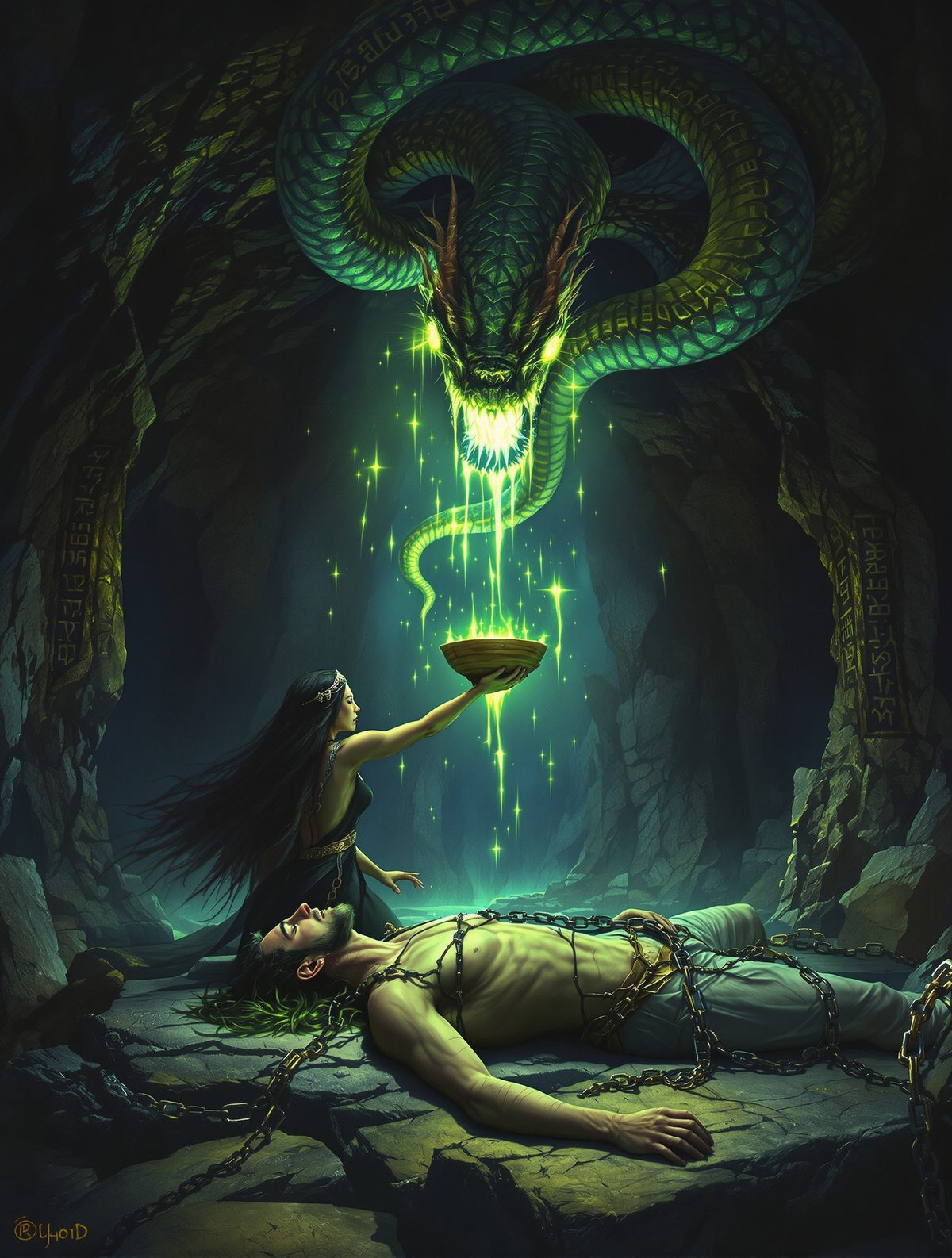
Deep beneath the earth, in a cave so remote that even the gods prefer to forget its existence, a woman sits in eternal vigil. Her name is Sigyn, and in her hands she holds a simple wooden bowl—perhaps the most heartbreaking object in all of Norse mythology. Above her, a massive serpent hangs from the cavern ceiling, its fangs perpetually dripping with venom so corrosive it could burn through stone. Between those deadly drops and the tortured face of her husband lies only Sigyn's unwavering devotion and that humble bowl.
This is the story of love's most terrible test—and how the faithfulness of one woman became responsible for every earthquake that has ever shaken the earth.
The Crime That Shattered Asgard
To understand Sigyn's eternal vigil, we must first travel back to the moment that changed everything: the death of Baldr, the most beloved of all the gods. In the grand halls of Asgard, where the Æsir gods feasted and made merry, no tragedy seemed possible. Baldr was beauty incarnate—so radiant that light emanated from his skin, so pure that nothing in the nine realms would harm him. His mother Frigg had traveled to every corner of creation, extracting oaths from fire, water, iron, and stone that they would never hurt her precious son.
But Loki, the trickster god whose silver tongue had saved the gods as often as it had endangered them, discovered the one fatal oversight. Frigg had deemed the mistletoe too young and harmless to pose any threat. In the Prose Edda, written by Snorri Sturluson around 1220 CE, we learn how Loki crafted a dart from this seemingly innocent plant and placed it in the hands of Baldr's blind brother, Höðr.
The throw was meant to be part of the gods' games—they had taken to hurling weapons at the invulnerable Baldr for sport, watching them bounce harmlessly away. Instead, the mistletoe pierced Baldr's heart, and the light of the world died forever. In that moment, Loki sealed not only his own fate but condemned his wife to an eternity of anguish.
The Binding of the Shapeshifter
The gods' vengeance was swift and merciless. They pursued Loki to his hiding place—a house with doors facing all four directions, where he would sit by the fire each day, transforming into a salmon to hide in the nearby waterfall. Using a fishing net of his own design against him, the gods finally captured their quarry and dragged him to a cave deep underground.
What happened next reveals the Norse pantheon's capacity for cruelty that would make even the most hardened medieval warrior shudder. The gods took Loki's own son, Narfi, and transformed his brother Váli into a wolf. In his lupine madness, Váli tore his brother apart. From Narfi's entrails, the gods fashioned unbreakable bonds, securing Loki to three great stone slabs—one under his shoulders, one under his loins, and one under his knees.
But this was not enough. The goddess Skaði, seeking her own revenge for Loki's role in her father's death, placed a venomous serpent directly above his face. The creature's poison was said to burn hotter than molten metal, causing agony beyond mortal comprehension. It was then that Sigyn made her choice—a decision that would define her for all eternity.
The Faithful Wife's Impossible Vigil
While most Norse tales focus on warriors and their glorious deaths, Sigyn's story reveals a different kind of heroism—one measured not in battles won but in quiet moments of selfless devotion. She could have abandoned Loki to his fate. The other gods would likely have welcomed her back to Asgard, perhaps even honored her for distancing herself from the god who had brought about Ragnarök.
Instead, Sigyn descended into that lightless cave and took up her eternal watch. Hour after hour, day after day, century after century, she sits beside her husband, catching each drop of venom in her bowl before it can reach his face. Her arms never tire in this mythic realm, but her bowl—being a simple mortal vessel—eventually fills.
And that's when the earth shakes.
The Völuspá, one of the most important poems in the Poetic Edda likely composed in the 10th century CE, hints at this cosmic connection. When Sigyn must turn away to empty her bowl, the venom splashes across Loki's face. His convulsions of agony are so violent they cause the very foundations of Midgard to tremble. Medieval Norse communities, living in geologically active Iceland and Norway, found in this myth a powerful explanation for the earthquakes that would periodically devastate their settlements.
The Woman Behind the Legend
Remarkably little is known about Sigyn herself outside of this tale—a fact that speaks to how women's stories were often marginalized even in mythological accounts. She appears to have been a goddess in her own right, with her name potentially meaning "victorious girlfriend" or "new little goddess." Some scholars suggest she may have originally been associated with agricultural fertility, making her endless vigil in the barren cave even more poignant.
What makes Sigyn's story particularly fascinating is how it subverts typical Norse gender roles. While Viking culture celebrated the warrior's path to Valhalla, Sigyn's heroism lies in her refusal to fight, to flee, or to abandon her post. She represents a form of strength that requires no sword, no shield—only an unbreakable commitment to love even when that love brings nothing but suffering.
Archaeological evidence from Viking Age burial sites shows that Norse women enjoyed considerably more rights and respect than their counterparts in other medieval European societies. They could own property, request divorces, and serve as powerful völvas (seeresses). Yet even in this relatively egalitarian culture, Sigyn's story stands out as remarkably radical in its portrayal of feminine devotion as a cosmic force.
When the Earth Moves: Ancient Explanations for Natural Disasters
The genius of the Sigyn myth lies not just in its emotional power but in its practical function as a pre-scientific explanation for geological phenomena. Medieval Scandinavians lived in one of Europe's most seismically active regions. Iceland, settled by Norwegian Vikings starting around 874 CE, sits directly on the Mid-Atlantic Ridge where tectonic plates meet. Major earthquakes were not rare occurrences but regular reminders of the earth's violent power.
Rather than viewing these disasters as random or inexplicable, the Norse created a narrative that gave them meaning. Every earthquake became a moment of shared suffering with Loki—and shared admiration for Sigyn's faithful endurance. The myth transformed natural disaster from meaningless catastrophe into evidence of the ongoing cosmic drama in which humans played a part.
This wasn't unique to Norse culture, of course. Ancient Greeks attributed earthquakes to Poseidon's anger, while various Native American tribes saw them as signs of underground spirits stirring. But the Norse version stands out for its intimate, domestic scale. This isn't about angry gods hurling thunderbolts—it's about a wife trying to spare her husband pain, failing periodically, and the whole world feeling the consequences of her momentary absence.
Love in the Time of Ragnarök
Perhaps the most haunting aspect of Sigyn's story is its cosmic timeline. She maintains her vigil not for a few years or even centuries, but until Ragnarök—the end of everything. Norse mythology is remarkably fatalistic; the gods know their doom is approaching and can do nothing to prevent it. Loki will eventually break free from his bonds and lead the forces of chaos in the final battle that will destroy gods and mortals alike.
Sigyn knows this too. She understands that her husband will ultimately betray everything she has sacrificed to protect. Yet she never wavers, never abandons her post, never lets the knowledge of future catastrophe diminish her present compassion. In a mythological tradition obsessed with honor, fate, and glorious endings, Sigyn embodies something different: love that persists without hope of reward or even gratitude.
When Ragnarök finally comes and Loki breaks free to destroy the world, what happens to Sigyn? The sources are tantalizingly silent. Some scholars speculate she dies in the conflagration that consumes the nine realms. Others suggest she might be among the few survivors who populate the new world that emerges from the ashes. Perhaps the most fitting interpretation is that she finally sets down her bowl, her impossible task complete, and walks away into whatever comes after the end of everything.
In our modern age of relationship therapists and divorce attorneys, of prenups and temporary commitments, Sigyn's story poses uncomfortable questions about the nature of love and loyalty. Her tale suggests that true devotion might require us to love not despite someone's flaws but because of our choice to remain present with them in their suffering. In a world where we're constantly told to put ourselves first, Sigyn reminds us that sometimes the most profound human experiences come from putting someone else's needs before our own—even when that choice leads nowhere but deeper into darkness.
The next time you feel the earth tremble beneath your feet, remember Sigyn in her cave, catching poison drops in a simple wooden bowl, demonstrating that even in the face of cosmic injustice, love endures.