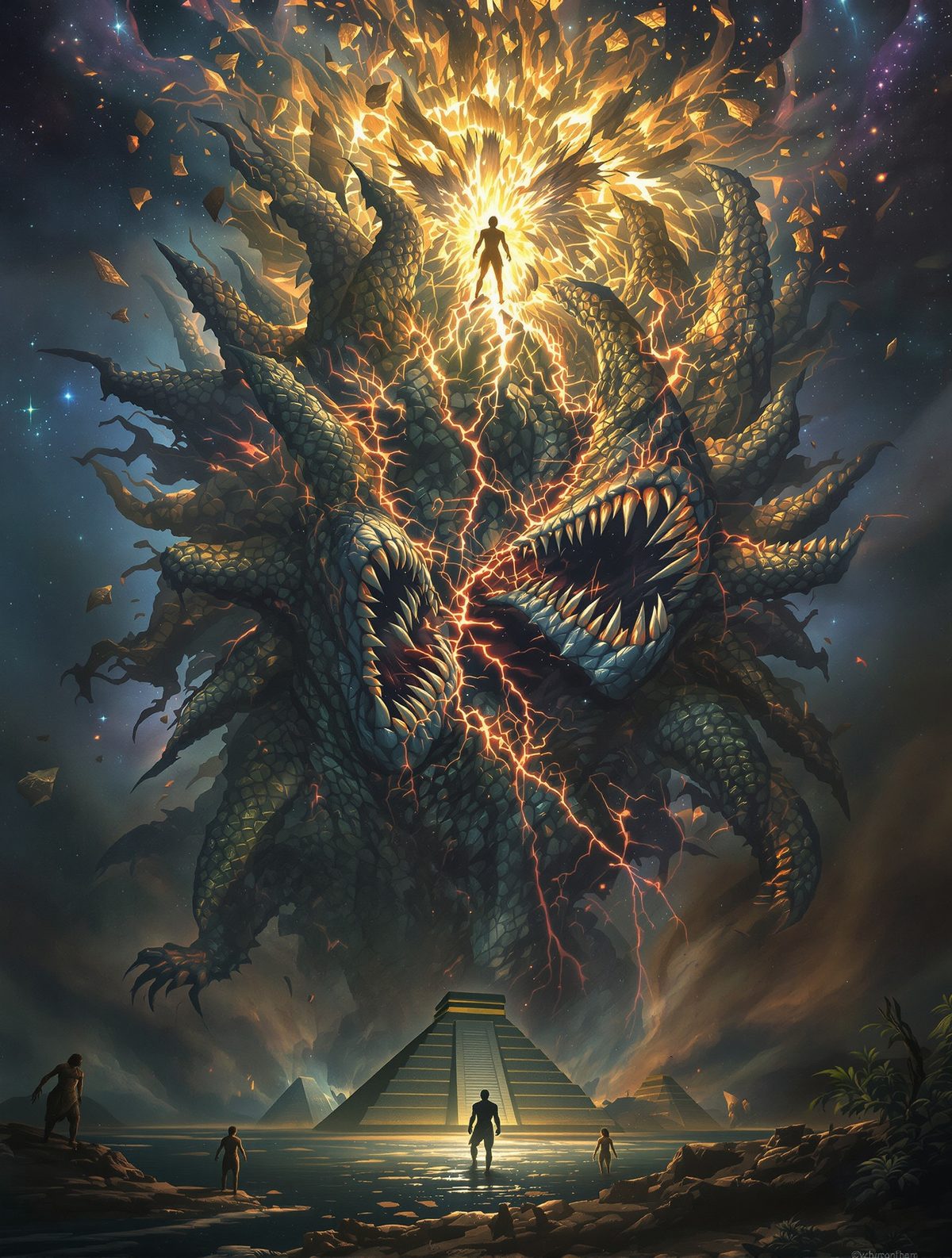
Imagine floating alone in an endless ocean of darkness, where time has no meaning and silence stretches beyond eternity. Now imagine that you are not just floating—you are the darkness, a primordial monster whose very existence defies comprehension. Every surface of your massive crocodilian body erupts with gnashing mouths, each one screaming for flesh that does not yet exist. This was Cipactli, the earth monster, swimming through the void before creation itself, unaware that her cosmic sacrifice would literally become the ground beneath our feet.
The Crocodile That Predated Reality
Long before the first Aztec temple rose from the earth, before the Spanish conquistadors ever dreamed of golden cities, the Mexica people carried within their collective memory a creation myth so visceral and terrifying that it would make Lovecraft weep with envy. At the heart of this cosmic horror story swam Cipactli—whose name means "crocodile" in Nahuatl—a creature so alien and magnificent that she existed before existence itself had rules.
Unlike the neat, orderly creation myths of other cultures, the Aztec cosmogony was born from violence, sacrifice, and cosmic cannibalism. Cipactli wasn't just a monster; she was the monster, a being whose very nature embodied the chaos that preceded order. According to the Histoyre du Méchique, a 16th-century manuscript that preserved these ancient stories, Cipactli's body was covered with mouths—not just on her head like a normal crocodile, but sprouting from every joint, every surface, every conceivable space on her impossibly vast form.
What makes this myth particularly fascinating is its psychological sophistication. The Aztecs understood something profound about creation: that it requires destruction, that order emerges from chaos, and that all life feeds on other life. Cipactli embodied this universal hunger—she was appetite incarnate, swimming through the primordial waters with countless mouths demanding sustenance that simply didn't exist yet.
When Gods Played Cosmic Wrestling
Enter two of the most complex deities in the Aztec pantheon: Quetzalcoatl, the feathered serpent god of wisdom and wind, and Tezcatlipoca, the smoking mirror god of conflict and change. These weren't benevolent creator deities in the Christian sense—they were forces of nature given consciousness, and their relationship was as complicated as creation itself.
Here's where the story takes a turn that would make modern readers do a double-take: to create solid ground for future life, these gods had to commit what can only be described as cosmic murder. But this wasn't a simple slaying—it was a calculated act of divine transformation that required them to literally become the instruments of Cipactli's dismemberment.
According to the myth preserved in the Leyenda de los Soles, Quetzalcoatl and Tezcatlipoca transformed themselves into enormous serpents and descended into the dark waters where Cipactli swam. The battle that followed wasn't quick or clean. Cipactli's countless mouths bit and tore at the gods, and in some versions of the myth, Tezcatlipoca lost a foot to her insatiable hunger—explaining why he was sometimes depicted as missing a limb.
But here's the detail that makes this myth extraordinary: the gods didn't simply kill Cipactli. They stretched her apart. Picture two cosmic forces pulling a primordial monster in opposite directions until her very flesh became the foundation of reality. Her back became the earth's surface, her belly became the sky, and her countless mouths became the caves, springs, and valleys that would nurture future life.
The Monster's Revenge: A World That Hungers
The Aztecs were too sophisticated to believe that such a violent creation would come without consequences. Cipactli's transformation into the earth wasn't a death—it was a metamorphosis that left her consciousness intact and eternally hungry. Every cave that opened into darkness was one of her mouths. Every earthquake was her movement beneath the surface. Every time the earth demanded blood sacrifice, it was Cipactli's ancient hunger asserting itself.
This explains one of the most misunderstood aspects of Aztec culture: their practice of human sacrifice. To modern sensibilities, these rituals seem barbaric, but within the context of Cipactli's myth, they represent a profound understanding of ecological balance. The earth literally hungered because it was a hungry being, and feeding it wasn't cruelty—it was cosmic maintenance.
Archaeological evidence from Tenochtitlan, the Aztec capital that once stood where Mexico City now sprawls, reveals just how seriously the Aztecs took this relationship with their living earth. The Templo Mayor, excavated in the 1970s and 1980s, contained thousands of offerings buried in the foundation—not just precious metals and jade, but carefully arranged bones, shells, and organic materials meant to nourish Cipactli's endless hunger.
What's remarkable is how this myth influenced Aztec agriculture. The chinampas, or floating gardens, that fed the empire weren't just ingenious farming techniques—they were theological statements. By creating fertile islands in the middle of Lake Texcoco, the Aztecs were literally feeding the earth monster that sustained them, offering her the rich mud and organic matter that would allow her to produce the crops that fed millions.
Hidden in Plain Sight: Cipactli's Eternal Presence
For a culture that has been systematically misunderstood and misrepresented, the Aztecs left behind surprisingly detailed records of their relationship with Cipactli. The Aztec calendar stone, that massive basalt disc housed in Mexico City's National Museum of Anthropology, isn't just a calendar—it's a map of Cipactli's transformed body. The central face represents the current sun (the Aztecs believed they lived in the fifth world), but the entire stone is carved to represent the earth monster's back, complete with claws and the characteristic earth-monster iconography.
Every day in the Aztec calendar began with Cipactli. The 20-day cycle that formed the backbone of their temporal system started with the earth monster's name, acknowledging that all time, all existence, all possibility emerged from her sacrifice. When an Aztec priest consulted the calendar to determine the fate of a newborn child, they were literally reading the signs written on Cipactli's transformed flesh.
But perhaps the most stunning evidence of Cipactli's importance lies in Aztec poetry. The Cantares Mexicanos, a collection of Nahuatl songs and poems compiled in the 16th century, contains verses that describe the earth as "the one with mouths everywhere," "she who devours blood," and "the torn one who gives life." These weren't metaphors—they were literal descriptions of the world as the Aztecs experienced it.
The Science Behind the Myth
Modern scholars have begun to recognize something extraordinary about the Cipactli myth: it demonstrates a sophisticated understanding of geological processes that wouldn't be formally recognized by European science for centuries. The idea that the earth is dynamic, alive, and constantly changing aligns remarkably well with our current understanding of plate tectonics, volcanic activity, and the carbon cycle.
The Valley of Mexico, where Aztec civilization reached its peak, sits on a geologically active zone where multiple tectonic plates meet. Earthquakes were frequent, volcanic eruptions shaped the landscape, and the very ground seemed to shift and move unpredictably. To the Aztecs, this wasn't evidence of impersonal geological forces—it was proof that Cipactli still lived beneath their feet, still moved, still hungered.
Even more remarkably, the myth contains what appears to be an intuitive understanding of what we now call the carbon cycle. The idea that death feeds life, that the earth literally consumes organic matter to produce new growth, that the boundary between living and non-living matter is more fluid than it appears—these concepts form the foundation of modern ecological science.
Why the Earth Monster Matters Today
In an era when climate change forces us to confront the consequences of treating the earth as a dead resource to be exploited, Cipactli's story offers a radically different vision of our relationship with the natural world. The Aztecs understood something we're only beginning to relearn: the earth is not a machine we can control, but a living system that responds to how we treat it.
The recent discovery of microplastics in virtually every ecosystem on Earth, the acidification of our oceans, the loss of topsoil that threatens global food security—these crises might seem disconnected from an ancient myth about a crocodile monster. But Cipactli's story reminds us that our actions have consequences, that the earth remembers everything we feed it, and that the ground beneath our feet is far more alive and aware than our modern worldview typically acknowledges.
Perhaps most importantly, Cipactli's myth suggests that creation and destruction aren't opposites—they're partners in an eternal dance. The earth monster's sacrifice created the world, but her hunger ensures that nothing remains static, nothing permanent except change itself. In a world facing unprecedented environmental challenges, this ancient wisdom offers not despair, but a kind of hope: if we can learn to work with the earth's natural cycles rather than against them, we might yet find a way to survive the consequences of treating Cipactli's body as a corpse rather than the living, breathing, eternally hungry being that sustains us all.