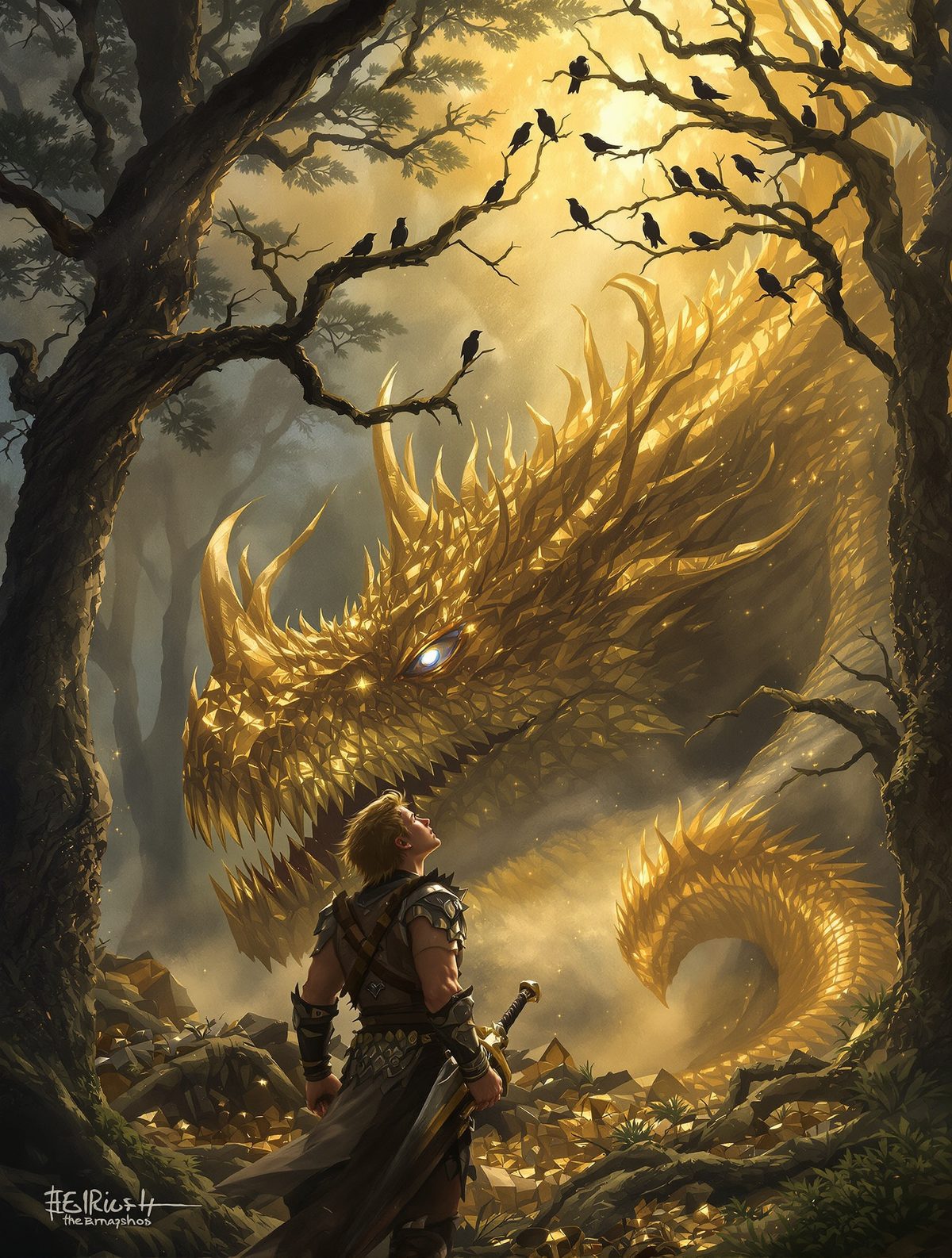
The dragon's blood was still warm when it splattered across Sigurd's finger. Without thinking, the young hero brought his thumb to his lips to soothe the burn—and in that instant, the world exploded with conversation. Every chirp, tweet, and caw in the forest suddenly transformed into urgent human speech. The ravens perched above him weren't simply making noise; they were gossiping about murder. His murder, to be precise.
This wasn't just another fairy tale moment. In the harsh realities of 9th-century Scandinavia, where betrayal was as common as the bitter northern winds, the ability to understand nature's warning system could mean the difference between a hero's saga and a forgotten grave.
The Forging of a Dragon Slayer
Sigurd Fafnisbane didn't start as a dragon-hunting hero. Born into the legendary Völsung lineage around the 9th century, he was raised by a cunning foster-father named Regin, a master smith with dwarf blood who harbored a very personal grudge against the dragon Fafnir. What the young warrior didn't know was that he was being groomed as a weapon—a living sword meant to settle an ancient family feud.
The story begins generations earlier with a simple request for hospitality. Three gods—Odin, Hoenir, and Loki—were traveling in Midgard when they killed an otter for their evening meal. Unfortunately, this wasn't just any otter. It was Ótr, one of three brothers who could shapeshift into animal forms. Their father, Hreidmar, demanded compensation: enough gold to fill the otter's skin and cover it completely.
Loki, ever the problem-solver, stole a cursed treasure from the dwarf Andvari—including a ring that would bring doom to anyone who possessed it. The gold satisfied Hreidmar, but the curse worked quickly. Fafnir, driven mad by greed, murdered his own father and transformed into a massive dragon to guard the hoard. His brother Regin fled, eventually finding young Sigurd and spinning a tale of heroism that conveniently omitted his own murderous intentions.
The Sword That Could Split Anvils
Before facing Fafnir, Sigurd needed a weapon worthy of legend. Regin first forged him two magnificent swords, each representing the pinnacle of medieval metallurgy. But Sigurd, testing their quality in the traditional Norse fashion, struck them against his father's broken blade—the remnants of Gram, once wielded by his ancestor Sigmund. Both new swords shattered like ice.
Only when Regin reforged Gram itself, using techniques that modern metallurgists still find impressive, did Sigurd have his dragon-slaying weapon. The reborn blade could slice through Regin's anvil as easily as parchment—a detail that reveals just how seriously medieval Scandinavians took their weapon crafting. In an age where iron was precious and steel was miraculous, a sword that could cut anvils wasn't just magical; it was economically revolutionary.
The Pit of Patience and Dragon's Blood
Fafnir wasn't just large—according to the Völsunga Saga, written down in 13th-century Iceland but preserving much older oral traditions, the dragon was so massive that his daily journey to drink from the river Gnita-heath wore a deep trench in the earth. Regin advised Sigurd to dig a pit in this trench and wait like a patient hunter, striking upward when the beast passed overhead.
But even this plan nearly failed. As Sigurd dug, an old wanderer appeared—Odin in disguise, though the saga doesn't immediately reveal this detail. The stranger suggested digging multiple pits to drain away the dragon's blood, warning that otherwise Sigurd would drown in the torrent. This wasn't mere folklore exaggeration; medieval Scandinavians believed dragon's blood was so potent it could dissolve human flesh on contact.
When Fafnir finally approached, the earth trembled. The dragon's breath was described as so poisonous that it could kill at a distance—likely a cultural memory of the very real dangers of volcanic gases in Iceland and Norway. Sigurd waited until the creature's heart was directly above him, then drove Gram upward with both hands. The blade pierced through scales that had turned away countless weapons, finding the one vulnerable spot in Fafnir's massive body.
The Moment Everything Changed
As Fafnir lay dying, something extraordinary happened. The dragon spoke, engaging Sigurd in a conversation that reveals the sophisticated psychology of Norse storytelling. Fafnir didn't beg for mercy or curse his killer—instead, he warned Sigurd that the treasure would bring him doom, just as it had destroyed every previous owner. This wasn't just dramatic irony; it reflected the Viking Age understanding that wealth without wisdom was a path to destruction.
After the dragon's death, Regin emerged from his hiding place and made a telling request: he asked Sigurd to roast Fafnir's heart while he napped. The foster-father's plan was simple—dragon's heart was said to grant wisdom and courage to whoever ate it, and Regin intended to claim that power for himself before murdering his young protégé.
But fate intervened through a small accident. As Sigurd tested whether the heart was fully cooked, hot dragon blood splashed onto his finger. When he instinctively sucked the burn, the blood touched his tongue—and suddenly every sound in the forest transformed into intelligible speech.
When Ravens Become Oracle
The birds wasted no time with pleasantries. According to the Fáfnismál, one of the poems preserved in the Poetic Edda, they immediately began gossiping about Regin's murderous intentions: "There lies Regin, plotting how to deceive the young man who trusts him." Another raven suggested practical advice: "Let him strike off Regin's head, then he alone shall rule all the gold."
This wasn't just convenient plot development. In Norse culture, ravens held special significance as Odin's messengers, creatures that moved between the world of the living and the realm of the gods. They were scavengers who fed on battlefields, making them symbols of both death and wisdom. For a Norse audience, the idea that ravens might warn a hero of treachery would have felt not just plausible, but expected.
The birds revealed additional secrets: they told Sigurd about Brynhild, a valkyrie sleeping behind a wall of fire, waiting for a hero brave enough to wake her. They provided directions to other treasures and warned him about future betrayals. In essence, Sigurd had gained access to a natural intelligence network that spanned all of Midgard.
Acting on their advice, Sigurd confronted Regin and, with one stroke of Gram, separated his foster-father's head from his shoulders. The man who had shaped him into a weapon had become the weapon's first victim—a irony that Norse storytellers, with their love of complex justice, would have appreciated deeply.
The Language of the Wild
Why does this thousand-year-old story still captivate us? Perhaps because it touches on humanity's ancient longing to understand the natural world around us. Before weather satellites and GPS, people relied on animal behavior to predict storms, find water, and avoid danger. Birds, with their ability to fly and their sensitivity to environmental changes, were particularly valuable sources of information.
Sigurd's gift represents the ultimate version of this ancient wisdom—perfect communication with creatures that could see the world from perspectives humans never could. In our modern age of environmental crisis, when scientists are desperately trying to understand what animals can tell us about climate change, pollution, and ecosystem health, the Norse dream of speaking with ravens seems less like fantasy and more like a lost necessity.
The story also reminds us that knowledge without action is worthless. Sigurd didn't just gain the ability to understand birds—he used their warnings to survive betrayal and their guidance to find love and adventure. In a world where we're drowning in information but often paralyzed by analysis, perhaps we could learn something from a hero who listened to the ravens and acted decisively on what they told him.