In the marble halls of ancient temples, where gods walked among mortals and music could move mountains, a single reed instrument lay abandoned on the forest floor. Its creator, the goddess Athena herself, had cast it aside in disgust after seeing her reflection while playing—cheeks puffed, face contorted, dignity shattered. But what the goddess discarded as vanity's enemy, a woodland satyr named Marsyas would claim as his pathway to divine glory... and unspeakable doom.
The year was lost to legend, but the Romans who inherited this tale from their Greek predecessors knew it spoke to something eternal: the price of challenging the gods. What began as a chance discovery in the Phrygian highlands would end with screams echoing across Mount Olympus and a river born from tears of anguish.
The Goddess's Discarded Gift
Athena, patron of wisdom and warfare, had crafted the aulos—a double-reed instrument of unprecedented beauty—from the very bones of a sacred deer. When she first played it at a gathering of the gods, the melody was so hauntingly beautiful that even Zeus himself fell silent. But Hera and Aphrodite, jealous as always, began to snicker. They pointed at Athena's face, red and distorted with the effort of playing, her usually serene features twisted into an almost comical mask.
Mortified, Athena rushed to a clear spring to see her reflection. The sight horrified her—this was not the dignified visage of the virgin goddess of wisdom. In a rage, she cursed the instrument: "Let whoever takes up this flute be doomed to suffer for their presumption!" Then she hurled it from Mount Olympus, watching it tumble through clouds and mist until it disappeared into the forests of Phrygia.
But here's what most people don't know: the aulos was no ordinary instrument. Ancient sources suggest Athena had woven actual divine breath into its construction—the very essence that gave gods their power over mortals. When she cursed it, she didn't diminish its power; she merely ensured that no mortal could wield it without consequences.
The Satyr's Discovery
Marsyas was not your typical woodland creature. Unlike his brethren who spent their days chasing nymphs and drinking wine, this particular satyr possessed an almost human obsession with music. He had taught himself to play the shepherd's pipe, the lyre, even primitive drums made from hollow logs. So when he stumbled across the gleaming aulos while hunting near the Marsyas River (which would later bear his name for reasons far more sinister), he recognized divine craftsmanship immediately.
The moment Marsyas pressed the reed to his lips, magic flowed through his being. The music that emerged was unlike anything heard on earth—melodies that made flowers bloom instantly, harmonies that drew wild animals from their hiding places to listen in peaceful wonder. Word spread quickly through the ancient world. Pilgrims traveled from as far as Egypt and the Black Sea to hear the satyr's impossible music.
Ancient Roman historian Pliny the Elder later wrote that Marsyas's playing could "heal the sick, mend broken hearts, and make even stones weep with joy." Archaeological evidence from Phrygia shows unusual concentrations of votive offerings dating to this legendary period—thousands of small musical instruments left by grateful listeners.
When Pride Meets Divinity
Success, as it often does, bred arrogance. Marsyas began to believe his own legend. At a festival in the city of Nysa, drunk on wine and praise, he made a declaration that would seal his fate: "I am the greatest musician in all creation—greater even than Apollo himself!"
The crowd gasped. Even in their revelry, they understood the magnitude of this blasphemy. Apollo was not just any god—he was the divine patron of music, poetry, and artistic perfection. To challenge him was to court death itself.
But Marsyas was beyond reason. The divine flute had filled him with power that felt limitless. "Let the golden-haired god come!" he shouted. "Let him bring his precious lyre! We shall see whose music truly deserves to rule!"
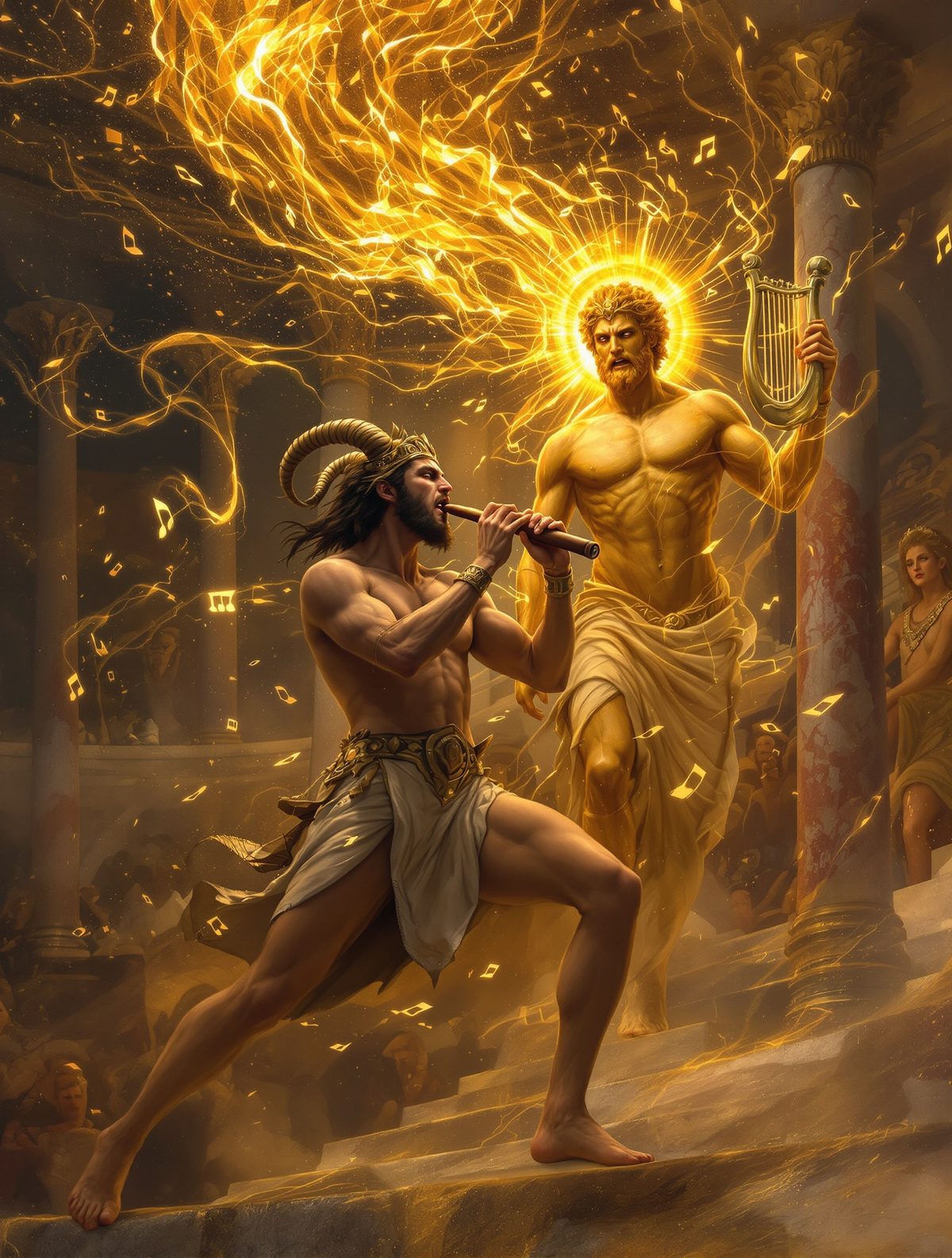
The response was immediate. The sky darkened, and a golden chariot descended from the heavens. Apollo stepped down, his face a mask of cold fury. His lyre—crafted by Hermes himself and strung with silver threads that caught starlight—gleamed in his hands like a weapon.
The Contest of Dooms
Apollo's challenge was simple and terrible: a musical contest with stakes that made mortals tremble. The winner would be declared the supreme musician of all creation. The loser would suffer the most agonizing death imaginable—flaying alive, their skin stripped away while they still breathed.
The judges assembled were no ordinary panel: the nine Muses themselves, led by Calliope, Muse of epic poetry. Even they seemed reluctant to oversee what was clearly going to end in tragedy. But divine law demanded that such challenges be honored.
The contest began at dawn on Mount Tmolus. Apollo played first, his lyre producing melodies so perfect they seemed to remake reality itself. Flowers arranged themselves in geometric patterns, clouds formed harmonious shapes, and the very air shimmered with golden light. When he finished, silence stretched for what felt like eternity.
Then Marsyas played. The cursed aulos poured forth music of such raw emotion, such primal beauty, that even Apollo's expression flickered with something that might have been worry. The satyr's melody told stories of mortal struggle, of love and loss, of the bittersweet beauty of life lived in the shadow of death. It was imperfect, chaotic—but achingly, devastatingly human.
Here's the shocking truth most versions don't tell: the first round was declared a tie. Even the Muses couldn't choose between divine perfection and mortal passion.
The Tragic Twist
Apollo, faced with the possibility of defeat, invoked his divine prerogative to change the rules. "Let us play again," he declared, "but this time, let each performer sing while playing their instrument—and play it upside down."
The challenge was cunningly cruel. Apollo could easily sing while plucking his lyre strings, whether right-side up or inverted. But Marsyas, playing a wind instrument, could not sing while blowing into the aulos—and playing it upside down made it nearly impossible to maintain the complex fingerings required.
The satyr's music, so transcendent moments before, became a broken, gasping struggle. Apollo's melodic voice soared above his perfect lyre work, and the contest was over. The Muses, bound by the rules, declared the sun god victorious.
What followed was horror beyond imagination. Apollo, his pride wounded by how close he'd come to losing, showed no mercy. He bound Marsyas to a pine tree and began the flaying while the satyr still lived. Ancient accounts describe how Marsyas's screams were so terrible that the trees themselves wept sap like tears. His blood flowed so freely it formed a river—the same river where he'd found the cursed flute.
The Legacy of a Doomed Song
The story of Marsyas became more than just another cautionary tale about divine punishment. Roman writers like Ovid saw in it a profound meditation on the relationship between art, ambition, and mortality. The satyr's fate wasn't just about hubris—it was about the eternal human struggle to transcend our limitations, even when that transcendence leads to destruction.
Archaeological discoveries in modern Turkey have uncovered a shrine to Marsyas near the ancient city of Celaenae, where locals continued to honor the defeated satyr for centuries. They saw him not as a cautionary figure, but as a hero who dared to dream of equality with the gods.
Perhaps most remarkably, the Romans eventually came to view Marsyas as a symbol of free speech and artistic courage. Statues of the satyr were erected in the Forum Romanum, representing the right to challenge authority through art and expression—even at terrible cost.
In our modern world, where artists still risk everything to speak truth to power, where creative expression can still carry life-or-death consequences in many parts of the globe, Marsyas's final song continues to resonate. His story reminds us that the most beautiful music often comes from those willing to stake everything—their safety, their lives, their very souls—on the belief that art matters more than survival. The question that haunts us across millennia remains: when the cost of creation is destruction, is the song still worth singing?