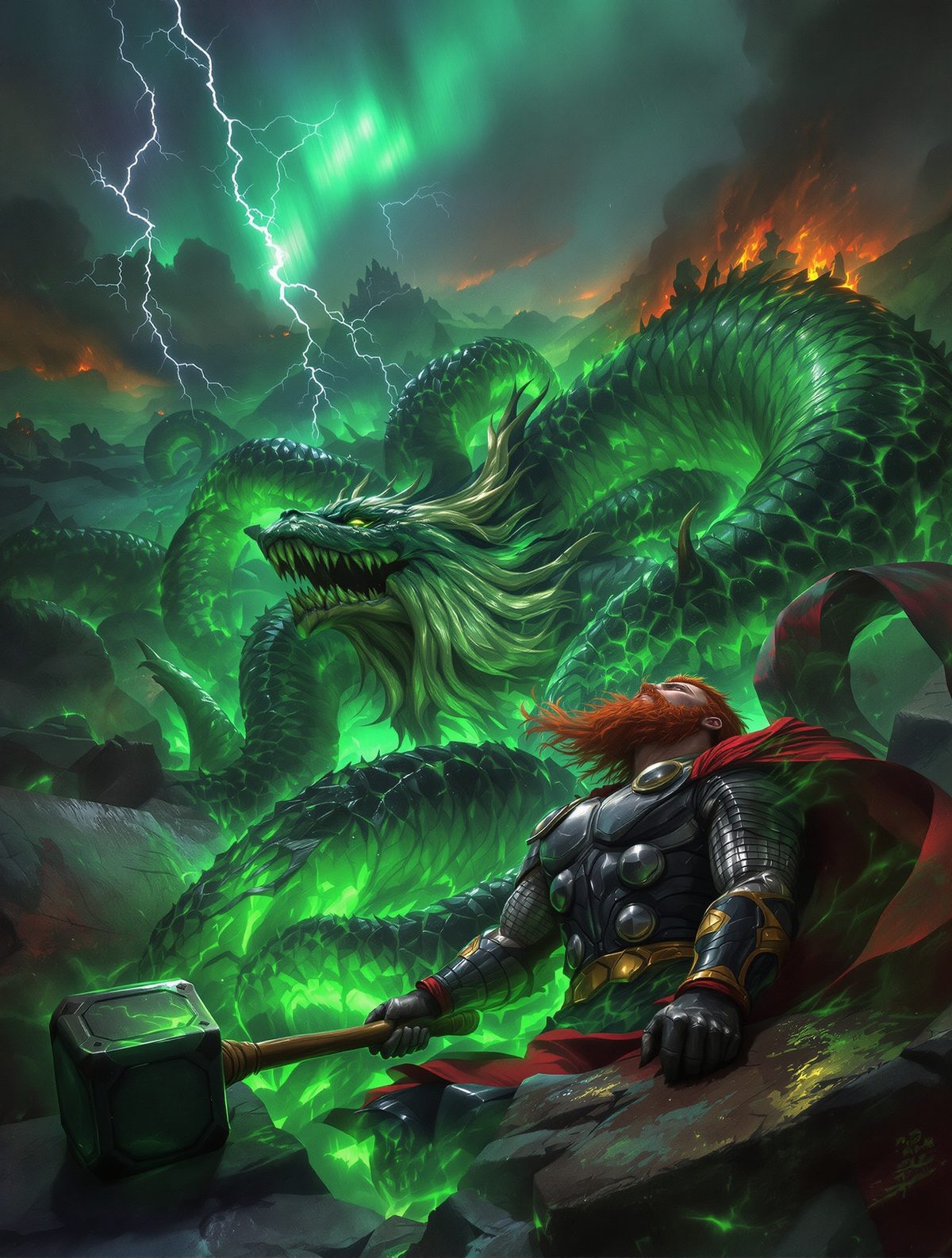
The thunder rolls across Vigrid, the vast battlefield where gods and monsters meet their end. Thor, mightiest of the Æsir, raises Mjolnir one final time. Before him writhes Jormungandr, the World Serpent whose colossal body encircles all of Midgard. The hammer falls. Bone and scale explode in a shower of gore. Victory is Thor's—for exactly nine heartbeats. Then the poison hits.
This is not the heroic ending the skalds sang about around winter fires. This is Ragnarök's cruelest irony: the moment when triumph and doom become one and the same, when even the God of Thunder learns that some victories cost everything.
The Serpent Born of Lies and Fire
To understand this apocalyptic duel, we must journey back to the roots of divine terror. Jormungandr—whose name means "huge monster" in Old Norse—wasn't some random beast that slithered out of primordial chaos. He was family. The middle child of Loki and the giantess Angrboda, brother to Fenrir the wolf and Hel, goddess of the dishonored dead. Even among this trio of nightmares, the serpent was special.
When the Æsir discovered the prophecies surrounding Loki's monstrous offspring, they panicked. Odin himself cast the infant serpent into the seas surrounding Midgard, believing the ocean's depths would contain this threat. They were catastrophically wrong. Fed by the cosmic waters and his own rage, Jormungandr grew. And grew. And grew.
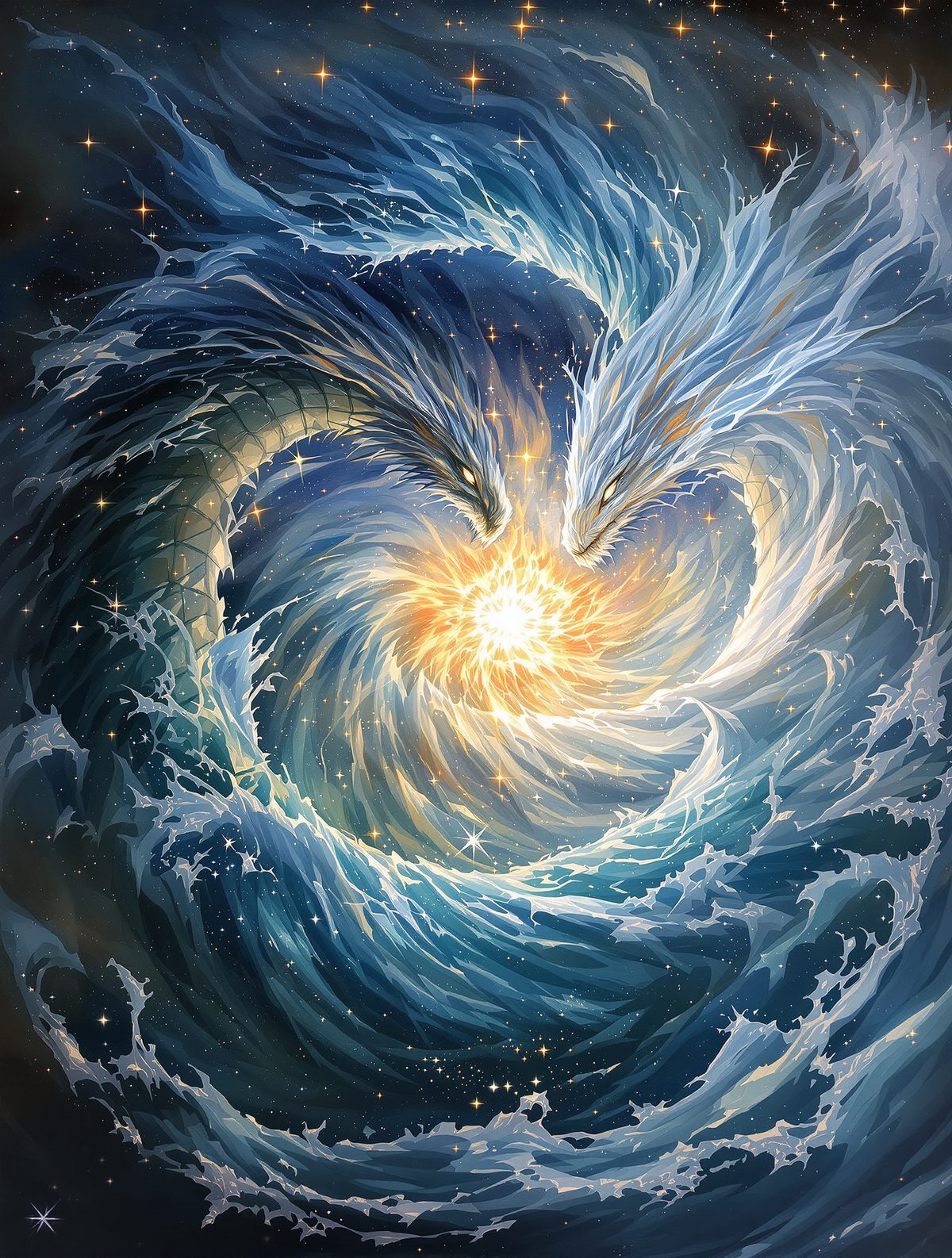
By the time human civilization began etching runes into stone, the World Serpent had become so massive that he encircled the entire world, his tail clenched firmly between his jaws. The Vikings called this position "Ouroboros," but for them it wasn't a symbol of cyclical renewal—it was a cosmic straitjacket. As long as Jormungandr held his tail, the world remained stable. The moment he let go, Ragnarök would begin.
A History Written in Thunder and Venom
Thor and Jormungandr weren't strangers when they faced each other on Vigrid's blood-soaked plain. Their relationship was a twisted saga spanning centuries, each encounter more dangerous than the last. The Prose Edda, written by Snorri Sturluson around 1220 CE, preserves three crucial meetings between god and serpent—each one a dress rehearsal for their final, mutual destruction.
The first encounter reads like dark comedy. Disguised as a young man named Eku-Thor, the thunder god accompanied Loki to the giant Útgarða-Loki's hall for a series of challenges. When Útgarða-Loki dared Thor to lift his seemingly ordinary house cat, the god strained with all his divine might—and managed only to raise one of the creature's paws. The giants mocked his weakness. Only later did Thor learn the truth: the "cat" was Jormungandr himself, magically disguised. Thor had nearly pulled the World Serpent free from his world-binding coils. Had he succeeded, Ragnarök would have begun centuries early.
Their second meeting was far more direct. Thor went fishing using an ox head as bait—a detail that reveals just how massive this fishing expedition was meant to be. When Jormungandr took the bait, the serpent's thrashing nearly capsized even Thor's divine vessel. The thunder god raised Mjolnir for a killing blow, but his giant companion, terrified by the cosmic forces at play, cut the fishing line. Jormungandr sank back into the depths, his time not yet come.
These weren't random encounters. They were destiny's rehearsals, each one bringing god and monster closer to their prophesied doom.
The Mathematics of Mutual Destruction
Norse mythology operates on precise, almost mathematical principles. The number nine appears repeatedly in their cosmology: nine worlds connected by Yggdrasil, nine days that Odin hung from the World Tree, nine mothers who bore Heimdall. When the Völuspá—the most important prophetic poem in Norse literature—describes Thor's death, it specifies exactly nine steps between victory and doom.
"Nine steps fares the son of Fjörgyn, / and, slain by the serpent, fearless he sinks."
This isn't poetic flourish. It's cosmic accounting. In Norse belief, the number nine represented completion, the end of a cycle. Thor's nine steps weren't just his death walk—they were the universe's final countdown.
But here's what the textbooks miss: Jormungandr's venom wasn't just poison. In Old Norse cosmology, the serpent's breath was eitr—a primordial substance that existed before the gods themselves. The Prose Edda tells us that in the beginning, when the fires of Muspelheim met the ice of Niflheim, their collision created venomous drops that became the first giants. Jormungandr's breath was literally the stuff of creation turned toxic, the universe's own antibodies rejecting the divine order.
The Moment Thunder Died
Picture Vigrid plain in those final moments. Bodies of gods and giants carpet the earth. The sky bleeds fire. Fenrir has already devoured Odin. Freyr lies dead at Surtr's feet. The air itself screams with the sound of ending worlds.
Then Thor arrives, Mjolnir crackling with lightning that illuminates the apocalypse. Jormungandr rears up, so massive that his head blocks out the burning sky. When he opens his jaws, rivers of venom pour forth, creating steaming lakes of death. This is the moment the Norsemen both dreaded and celebrated—the ultimate test of divine power against primordial chaos.
The battle itself is swift. One mighty blow from Mjolnir, and the World Serpent's skull explodes like a rotten egg struck by lightning. But in Norse mythology, death doesn't equal defeat. As Jormungandr's massive body writhes in its death throes, his breath creates a cloud of toxic mist so potent that it doesn't need the serpent's life to sustain it.
Thor, victorious and proud, takes his first step away from his fallen enemy. Then his second. By the third step, the first wisps of venom reach his nostrils. By the sixth, his divine constitution begins to fail. At the ninth step, the God of Thunder—protector of Midgard, slayer of giants, wielder of Mjolnir—collapses face-first into the poisoned earth.
The irony is perfect and terrible: the god who spent his existence protecting humanity from giants dies because he succeeded too completely. Victory and defeat become indistinguishable.
Legacy of the Poisoned Victory
This myth reveals something profound about Norse thinking that sets it apart from other mythologies. Unlike the Greeks with their tragic heroes or the Romans with their triumphant gods, the Norse understood that some prices are too high even for victory. Thor's death wasn't a failure of strength or courage—it was the inevitable cost of cosmic balance.
Modern readers often miss this nuance. We're conditioned to expect clear victories and defeats, heroes who triumph and villains who fall. But the Vikings lived in a harsher world where survival often came at devastating cost. Their greatest myth reflects this reality: sometimes winning means losing everything that made victory worthwhile.
The story of Jormungandr's venom speaks to our contemporary anxieties about pyrrhic victories. Consider our modern battles against climate change, where industrial solutions often create new problems, or military conflicts where tactical success leads to strategic disaster. The Norse understood what we're still learning: that in complex systems, total victory over one enemy often empowers another.
Perhaps that's why this myth endures in popular culture, from Marvel's sanitized version to the brutal retellings in modern video games and novels. We recognize something true in Thor's final walk—the terrible mathematics of a world where every solution creates new problems, where heroes die not because they fail, but because they succeed too well.
In the end, Thor's nine steps remind us that even gods must face consequences. In a universe governed by destiny rather than justice, victory itself can be the cruelest form of defeat.